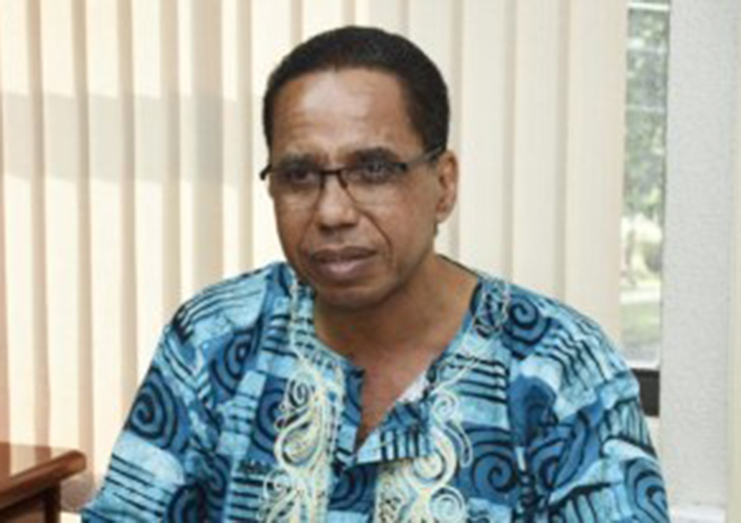
Social activist Mark Benschop has argued that the government’s decision to reconvene Parliament on June 5, 2026 is further evidence that the PPP administration responds only when confronted with sustained pressure.
Reacting to today’s announcement by Minister of Parliamentary Affairs and Governance Gail Teixeira that the National Assembly will meet for the first time since February 14, Benschop said the development vindicates a long-held observation by former President Desmond Hoyte.
“The late President Desmond Hoyte told the nation that the PPP only responds to pressure, and today’s announcement proves exactly that,” Benschop said.
While welcoming news that Parliament will finally reconvene after 111 days of inactivity, the activist urged opposition parties and civil society organisations not to ease their efforts.
“I welcome the announcement, but I also want to take this opportunity to advise the opposition and civil society to apply more pressure,” he said.
According to Benschop, it should not be overlooked that the government appears more responsive to international actors than to the concerns of Guyanese citizens whose taxes fund the state.
“It is not lost on me, and it should not be lost on society, that the PPP regime seems more responsive to the international community than to the Guyanese taxpayers who are paying the bills,” he stated.
Benschop cited what he described as two clear examples of that pattern: the convening of Parliament for the election of the Leader of the Opposition following intervention by representatives of the United States, United Kingdom, Canada, and the European Union (ABCEU countries), and now the scheduling of the next sitting of the National Assembly for June 5 after diplomats publicly highlighted the importance of Parliament meeting regularly.
While welcoming the intervention of foreign diplomats on the parliamentary issue, Benschop argued that international partners should also speak out on what he views as broader violations of citizens’ rights in Guyana.
Saying the government appears to pay particular attention to the views of the diplomatic community, Benschop called on the ABCEU countries to press for action on a number of outstanding national issues.
Among the issues he wants the diplomatic community to press for is the establishment of a Commission of Inquiry into alleged extrajudicial killings between 2002 and 2006. Benschop noted that the United Nations Human Rights Committee in 2024 urged Guyana, as a matter of priority, to address discrimination and establish an inquiry into those deaths after expressing concern that no substantive progress had been made despite previous commitments by successive governments. He said the families of the victims deserve answers and justice.
He also called for investigations into the 2006 murder of Agriculture Minister Satyadeow Sawh, along with members of his family and a security guard, as well as stronger protections for the rights of citizens, workers and trade unions.
Benschop further urged greater attention to the rising cost of living, arguing that many Guyanese are struggling despite the country’s oil wealth.
“It is a shame that in oil-rich Guyana people can only afford to buy three slices of bread or one tennis roll,” he said.
The social activist further called for an independent probe into explosive allegations of contract corruption detailed in a VICE News investigation involving Chinese businessman Su Zhirong, including allegations concerning the involvement, if any, of Vice President Bharrat Jagdeo, as claimed by Zhirong.
“The list is long, but we can start here for now,” Benschop said. “I hope the ABCEU countries are listening and will add their voices to these calls for justice, accountability and respect for democratic rights.“
He also challenged the parliamentary opposition to adopt a more proactive and assertive approach in holding the government accountable.
“They were elected to represent the people, and they must do so with vigour, courage and determination. The Guyanese people deserve an opposition that is prepared to fight relentlessly for their interests and defend the institutions of democracy,” Benschop said.
To Benschop, the June 5 sitting stands as further proof that persistent public advocacy and international scrutiny can compel action from the government. He said the lesson for opposition parties, trade unions and civil society is clear: pressure works, and there must now be greater pressure to address a wider range of national issues affecting Guyanese citizens.