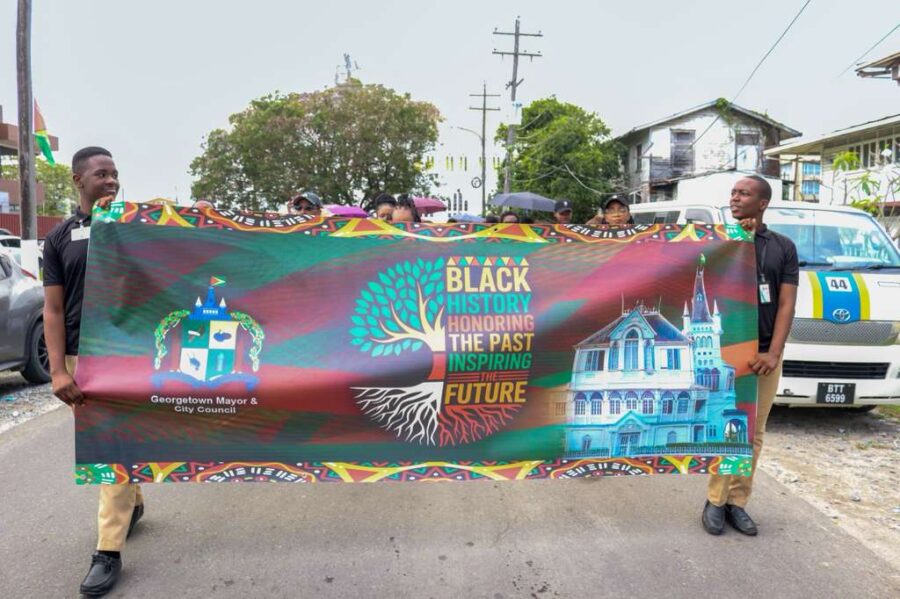
More than 300 citizens filled the streets of the capital on Friday as the Mayor and City Council of Georgetown hosted a Black History Month March under the theme “Claiming Our Legacy: From Apology to Reparative Justice.”
The march began at City Hall and proceeded to the historic Independence Park (Parade Ground), where participants paused in reflection before returning to City Hall for a formal programme of cultural performances and thought-provoking remarks.
Participants march through the streets of Georgetown during the Black History Month March on February 27, 2026, moving from City Hall to Independence Park (Parade Ground) in observance of the theme “Claiming Our Legacy: From Apology to Reparative Justice.”
Among those participating were His Worship Mayor Alfred Mentore and councillors of the Georgetown City Council, alongside government officials, students, civil society organisations, reparations advocates and members of the wider community.
Held in partnership with The Repair Campaign, the event marked the culmination of Black History Month 2026 observances in Georgetown. Organisers said the march signalled a unified commitment not only to remembering history, but to confronting its truths and advancing the national conversation on reparative justice.
His Worship the Mayor Alfred Mentore (right) and Councillor Kesha Sertima (left) share a light moment during the Black History Month March.
Reparative justice refers to efforts to address and remedy the enduring harms of slavery and colonialism through formal acknowledgement, apology, institutional reform, and development-focused compensation. Across the Caribbean, the movement has been spearheaded by the CARICOM Reparations Commission, which has advanced a Ten-Point Plan for Reparatory Justice calling on former colonial powers to engage in structured dialogue, issue formal apologies, and support programmes to address the socio-economic legacies of enslavement.
Members of the Haiti Support Group, students of St. Stanislaus College and The Hon. Dr. Dexter Todd, pose for a photo at City Hall following the Black History March.
Caribbean leaders have intensified international advocacy in recent years, pressing Britain and other European nations to accept responsibility for their historical role in the transatlantic slave trade. While the United Kingdom has acknowledged the brutality of slavery, it has consistently rejected calls for direct financial reparations, maintaining that monetary compensation is not under consideration.
Drummers perform along the march route during the Black History Month March on February 27, 2026, adding a rhythmic tribute as participants proceeded from City Hall to Independence Park (Parade Ground).
Friday’s strong turnout in Georgetown underscored growing public engagement around issues of historical accountability, legacy, and equity, as Guyana continues to reflect on its past while shaping conversations about justice and repair for future generations.
Guyana’s Constitution permits the death penalty following a lawful conviction, and the country’s criminal laws retain capital punishment for certain...
Opposition Leader Azruddin Mohamed has intensified his campaign against Senior Superintendent of Police Prem Narine, demanding the immediate release of...