To the esteemed diplomatic corps of the United States, the United Kingdom, Canada, and the European Union—the so-called “ABCE” nations who so fervently championed democratic principles during Guyana’s 2020 elections—I write this not as a plea, but as a warning.
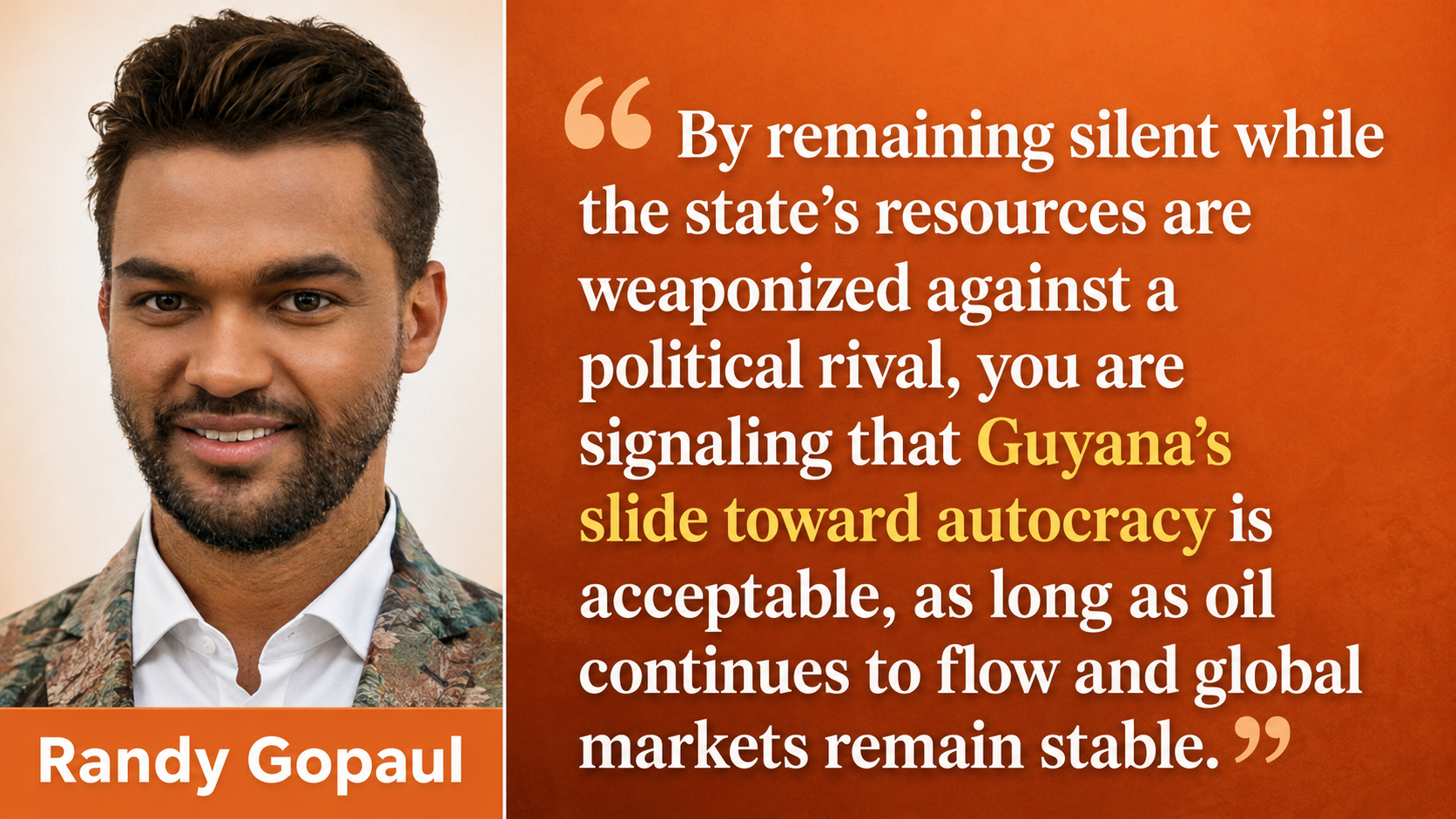
Your silence in the face of the People’s Progressive Party (PPP) government’s escalating authoritarian tactics against the Leader of the Opposition, Azruddin Mohamed, is not just deafening; it is complicit. By remaining silent while the state’s resources are weaponized against a political rival, you are signaling that Guyana’s slide toward autocracy is acceptable, as long as oil continues to flow and global markets remain stable.
On September 3, 2026, two members of the Leader of the Opposition’s staff—a cameraman and a driver—were detained and remain in police custody. They were arrested on suspicion of operating a drone near the President’s private home in Leonora. Opposiion Leader Mohamed himself, along with two Members of Parliament, was also held for questioning, only being released late that night. While the government, through the Guyana Civil Aviation Authority (GCAA), claims “unregistered drones” were found in a vehicle, Mr. Mohamed has vehemently denied this, stating the area is a restricted zone which makes drone operation “impossible.” He insists he and his team were simply observing sea defence works, which they suspect are plagued by “major corrupt activities.”
This is not about drones. This is a clear and deliberate attempt to intimidate, harass, and neutralize the most significant political threat to the PPP’s grip on power. The arrest of innocent staff members is a practice we typically associate with authoritarian regimes, not a burgeoning petro-state that claims to be a beacon of democracy.
The diplomats who were so vocal during the 2020 electoral crisis must recognize that the PPP is heading down a slippery slope. Their abuse of state machinery to target citizens and political opponents is not a minor infraction; it is a fundamental attack on the very fabric of democracy. As one analysis points out, if the tactic of using state resources to crush opposition is allowed to succeed, then the safety of all citizens is at risk.
The issue is deeper than the PPP’s actions. Many Guyanese are exhausted by politics-as-usual. However, what they may not realize is that Mr. Mohamed is wealthy, connected, and resourceful. The PPP’s strategy of trying to demonize and break him is a miscalculation of epic proportions. But more importantly, if the government can do this to a man of his means, what stops them from doing it to any citizen who dares to dissent?
This is where your diplomatic silence becomes a direct threat to your own national interests. You have invested heavily in Guyana’s stability. The country is the world’s fastest-growing economy, a geopolitical prize, and a crucial partner for energy security. However, you cannot have it both ways. You cannot tout democracy while enabling its dismantling.
The government’s actions are laying the groundwork for immense pushback from society. The people of Guyana have already been promised an “oil boom” that is failing to deliver on its equitable potential. If the political opposition is systematically silenced, public frustration will inevitably boil over. This will lead to civil unrest, which in turn will disrupt the flow of commerce and increase risks for investors.
One must ask: If the government can so brazenly flout the rule of law to jail the staff of the opposition leader, what is to stop them from unilaterally undermining US investors or changing the rules of the game? Such actions create a volatile political environment that is kryptonite to foreign investment. You cannot declare that Guyana is “open for business” while it is, in fact, closing down the mechanisms of a peaceful and democratic society.
Once again I appeal to the diplomats of the U.S., UK, Canada, and EU: You were present and vocal in 2020 when democracy was at stake. You must be present and vocal now. Your silence is a gift to the PPP’s authoritarian wing. It emboldens them to continue this path.
The Guyanese government must be warned to cease and desist from using state resources to target its citizens and political opponents. The PPP must be reminded that the “resource curse” often leads to a “democracy curse,” where wealth is concentrated among elites while the institutions of the state weaken.
The window to act is closing. Do not wait for the streets of Georgetown to erupt before you find your voice again. Do not wait for the next US investor to be the object of silent undermining before you remember your democratic principles. Either you speak out now against this creeping authoritarianism, or you risk the entire country—and your investments—burning in the fire of instability.