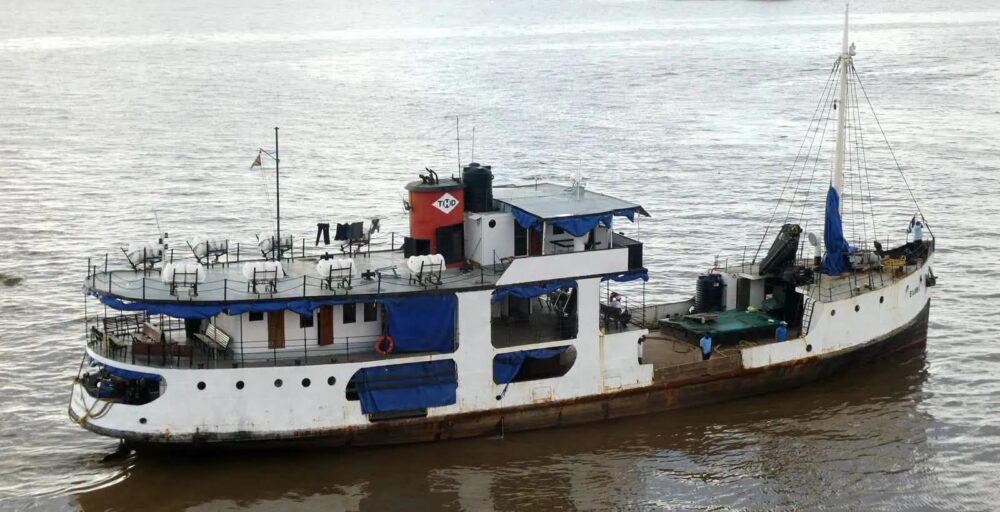
The Maritime Administration Department (MARAD) is facing escalating scrutiny after its latest statement on the MV Barima salvage operation directly contradicts evidence already in the public domain, raising serious questions about transparency, credibility, and whether the procurement process was compromised from the outset.
In a press statement dated August 7, 2026, MARAD categorically denied that any contractor had been identified.
“The Maritime Administration Department (MARAD) wishes to clarify that no individual, company, or entity has been selected to undertake the salvaging of the MV Barima,” the agency said.
It further claimed that the process only began days earlier: “Commencing August 2, 2026, MARAD has publicly advertised an Expression of Interest (EOI) inviting suitably qualified entities to submit proposals…”
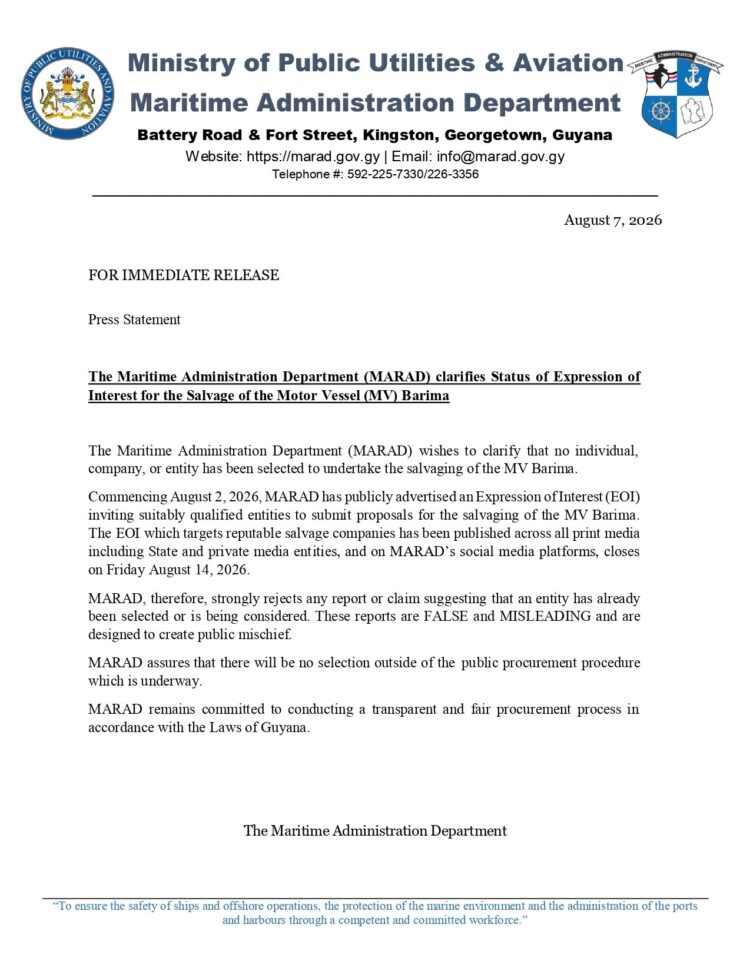
Dismissing contrary reports, MARAD asserted: “MARAD… strongly rejects any report or claim suggesting that an entity has already been selected or is being considered. These reports are FALSE and MISLEADING and are designed to create public mischief.”
However, the timeline—and the paper trail—tell a different story.
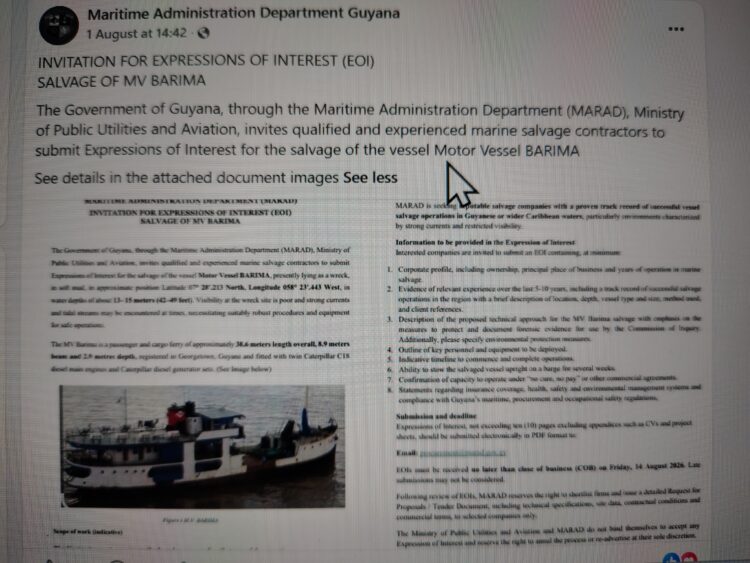
MARAD’s own Facebook page shows the Expression of Interest was issued on August 1, not August 2 as stated in the official release. While seemingly minor, the discrepancy adds to growing concerns about the accuracy of the agency’s account.
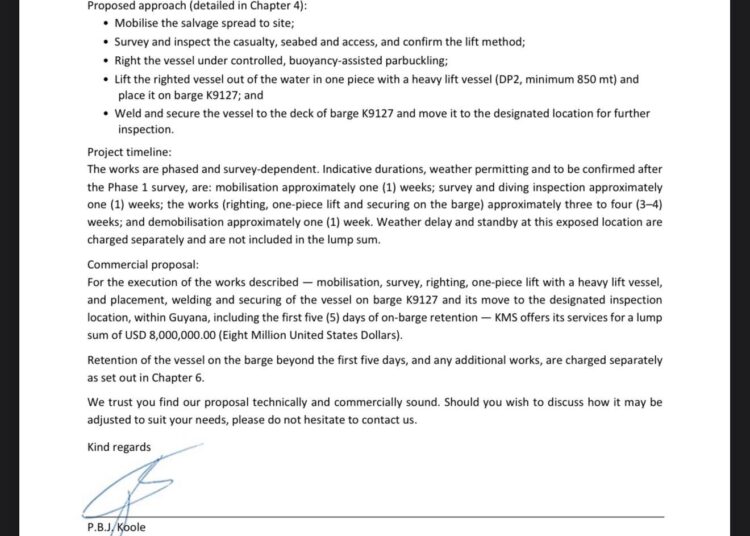
More significantly, reporting by Kaieteur News on August 5 revealed that the Government of Guyana had already engaged a Dutch firm, Koole Onshore and Koole Offshore (KMS), days before any public procurement process was announced. Documents in the newspaper’s possession are dated July 28, 2026—four days prior to the public Expression of Interest.
In that proposal, the company states plainly: “KMS has been invited by the Government of the Co-operative Republic of Guyana, through the Maritime Administration Department (“MARAD”), to submit a proposal for the righting and recovery of the passenger ferry MV BARIMA…”
The proposal outlines a US$8 million recovery plan and a six-to-seven-week timeline, including mobilisation, surveying, lifting, and demobilisation—suggesting a level of engagement that appears at odds with MARAD’s claim that no entity is being considered outside of a competitive process.
The contradiction comes amid shifting government positions on whether the vessel should even be recovered.
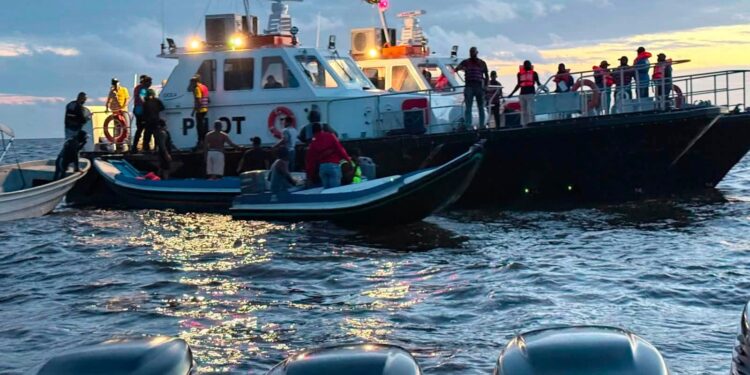
In the immediate aftermath of the July 18 disaster, which claimed 73 lives, the government had indicated that the MV Barima would remain on the seabed. That position drew sharp public backlash, particularly amid fears that bodies could still be trapped within the wreck.
As pressure mounted—including calls for accountability, closure for grieving families, and the preservation of evidence—Leader of the Opposition Azruddin Mohamed publicly proposed to self-finance the recovery effort.
It was only after this intensifying pressure that the government reversed course and moved to initiate a procurement process, issuing the Expression of Interest for salvage operations.
Against that sequence of events, MARAD’s insistence that no entity has been selected—or even considered—now raises a critical question: if the process was truly open and transparent, why was a specific firm invited to submit a proposal before the public tender was announced?
The MV Barima disaster has already exposed serious discrepancies, with authorities now estimating that as many as 179 people were on board—far exceeding the original manifest of 116 passengers and 17 crew. The tragedy has ignited national outrage and heightened scrutiny of maritime oversight, safety standards, and institutional accountability.
Three transport workers have been charged with murder over the loss of life, even before an inquiry or comprehensive investigation has been completed.
Now, the emerging inconsistencies surrounding the salvage process risk compounding that crisis of confidence.
At stake is not only the recovery of a sunken vessel, but the credibility of the institutions tasked with managing its aftermath. If the procurement process was influenced before it officially began, as the evidence suggests, then the issue is no longer administrative—it is one of public trust.
And in the shadow of a tragedy that claimed dozens of lives, that trust is already dangerously fragile.