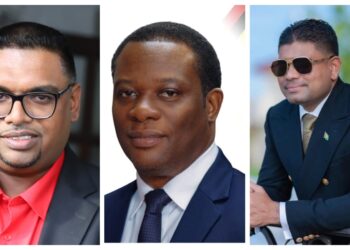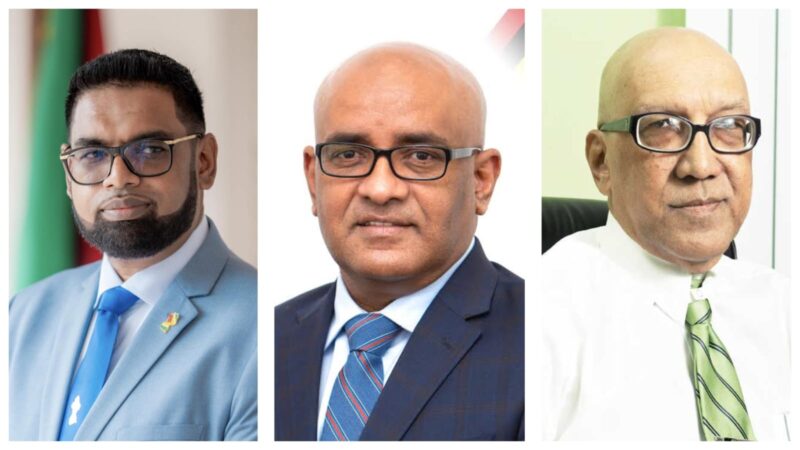
Political commentator GHK Lall has challenged Vice President Bharrat Jagdeo’s sudden appeal for cooperation between the People’s Progressive Party (PPP) and the People’s National Congress (PNC), questioning whether the call for national unity is also a calculated response to shifting political fortunes.
In two sharply worded opinion pieces, “Bharrat Jagdeo at Robert Corbin’s Gathering” and “Jagdeo’s Corbin Funeral Symphony – Pt II,” Lall dissected Jagdeo’s remarks at the October 14 evening of reflection for former PNC leader Robert Corbin, arguing that the vice-president’s warning about the possible extinction of both parties was far more politically significant than a routine tribute.
Jagdeo told the gathering at the Arthur Chung Conference Centre that the two historically dominant political forces would have to find a way to work together if Guyana were to overcome decades of division.
“We believe that the future of Guyana would involve at some level and some fashion, whatever that framework may be, these parties working together. They have to, of necessity,” Jagdeo said.
He also warned that both parties risked extinction unless they abandoned entrenched political thinking and adapted to changing expectations, particularly among younger voters.
For Lall, the remarks raised an obvious question: why is a political leader long associated with fierce partisan confrontation now making such an emphatic appeal for cooperation with his principal historical rival?
Lall acknowledged the importance of political inclusion and welcomed the prospect of a less hostile political culture. But he argued that Jagdeo’s timing, at a gathering honouring Corbin, gave the intervention additional significance.
“When Bharrat Jagdeo finally comes around to this what he called enlightened place, it was worth the wait,” Lall wrote.
He pointed to Jagdeo’s declaration that Guyana needed “a new form of enlightened thinking” and “a new approach to solving issues”, questioning why such thinking had not been more evident during years of political confrontation.
Lall also revisited Corbin’s attempts at constructive engagement with the PPP during Jagdeo’s presidency. Those efforts, he argued, demonstrated that cooperation between the two camps had been contemplated before, even as mistrust and accusations of political betrayal undermined the process.
Corbin, who died on October 4, led the PNC Reform from 2003 to 2012 and served as Leader of the Opposition. In his tribute, Jagdeo said Corbin had defended his party while recognising the need to build trust and work across political divisions.
Lall’s more pointed argument was that Jagdeo’s overture could have a strategic purpose beyond national reconciliation. He speculated that closer relations with the PNC might help the PPP counter the electoral challenge posed by We Invest in Nationhood (WIN), led by Azruddin Mohamed. He argued that the emergence of a strong alternative political force could compel the established parties to reassess their positions.
In his second article, Lall focused on Jagdeo’s warning that the PPP and PNC could face “extinction” if they failed to change. He questioned why the ruling PPP, after securing a parliamentary majority at the September 2025 general and regional elections, would publicly raise the prospect of its own political demise.
Jagdeo’s argument was that electoral dominance could not guarantee long-term survival if the parties remained trapped in outdated political divisions. He said younger voters were increasingly willing to support different parties on different issues.
Lall interpreted the warning as a sign that Jagdeo recognised the risks posed by a changing political landscape. He portrayed the vice-president’s call as an exercise in political calculation, with the future of the two established parties potentially depending on their willingness to adapt.
Whether Jagdeo’s appeal will lead to a formal framework for cooperation remains unclear. No partnership was announced in his remarks.
The central question raised by Lall’s commentary is whether the call for unity will translate into meaningful political change—or remain an appeal made at a moment of mourning, as the parties confront new electoral pressures and a changing electorate.