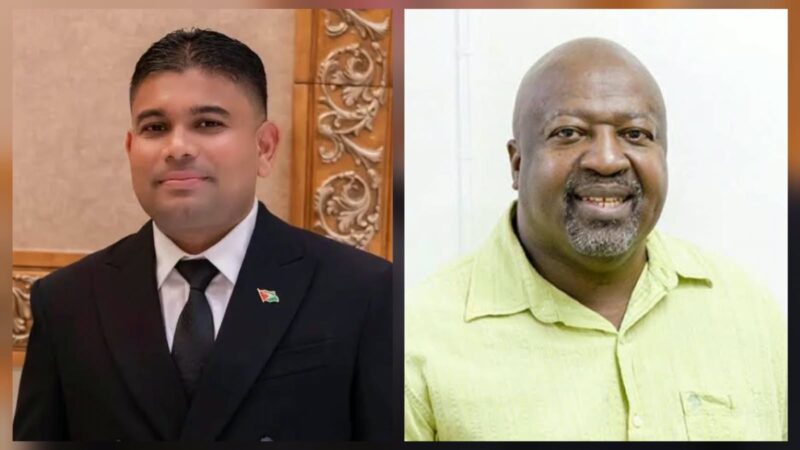
Speaking on Tuesday night’s edition of Politics 101, Hinds suggested that the People’s Progressive Party/Civic (PPP/C) government’s concerns about Mohamed may be linked to what the opposition leader knows about alleged wrongdoing involving individuals with whom he was previously associated.
“He’s not a political prisoner. He’s a victim of … operating in the government for fallout,” Hinds said.
He maintained that Mohamed does not represent a significant electoral threat to the governing party, arguing that the government’s apprehension about him is rooted in personal rather than political considerations.
“He’s in jail for his personal action. And the state, the government considers his personal action dangerous,” he said.
Hinds further suggested that Mohamed’s former association with persons in government and his alleged knowledge of their activities could explain the treatment he is receiving.
“The government fear of Muhammad is that Muhammad was hand in hand with them in the badness and that he knows the PPP badness and at some point, if he realises that there’s no turning back for him, he’s going to spill some terrible badness of the PPP.”
“The PPP’s fear of Muhammad is not political. It is personal,” he added.
Nevertheless, Hinds cautioned against portraying Mohamed as blameless simply because he has become a vocal critic of the government. He argued that the opposition leader must also account for allegations surrounding the accumulation of his wealth.
“When he stands up in front and says this is what corruption looks like, he should go in front of his own property and say this is what corruption looks like.”
Hinds argued that Mohamed should not be exempted from scrutiny over practices he now criticises, but stressed that questions surrounding his past conduct do not justify persecution or the denial of his fundamental rights.
“That doesn’t mean that they must take advantage. That doesn’t mean that I must prosecute him and persecute him. Because as an individual, he has individual rights.”
“Whether big millionaire or small millionaire, everybody has rights. Billionaires got rights too,” he said.
What constitutes a political prisoner?
The debate over whether Mohamed qualifies as a political prisoner raises questions about internationally recognised criteria for political detention.
The Parliamentary Assembly of the Council of Europe, in Resolution 1900 (2012), established criteria for determining when a person deprived of liberty may be considered a political prisoner. These include detention imposed for purely political reasons, violations of fundamental rights such as freedom of expression, disproportionate detention motivated by political considerations, discriminatory treatment, or proceedings that are clearly unfair and appear connected to the authorities’ political motives.
Amnesty International has also acknowledged that there is no universally agreed definition of a political prisoner in international human rights law. Its assessment considers whether political considerations significantly influence the reasons for a person’s detention.
Against this background, Hinds distinguished Mohamed’s circumstances from those of political activists who, he argued, are targeted specifically because of their opposition to the government.
“When they go after us, it’s because of political work. When they shackle us, it’s because of a political statement that we made that has political repercussions.”
“When they persecute and prosecute Mohamed, it’s not overtly political. It’s overtly personal,” he said.
Mohamed’s legal troubles
Mohamed’s latest incarceration followed his October 30 remand, alongside 20-year-old Police Constable Ryan Greene, on a charge under the Cybercrime Act relating to the alleged unauthorised disclosure of electronic data from the Guyana Police Force’s Safe City surveillance system.
The prosecution alleges that Greene obtained surveillance footage connected to the October 12 shooting outside the residence of Senior Superintendent Prem Narine, head of the Police Force’s Special Branch, and supplied it to Mohamed in exchange for $800,000. Mohamed subsequently released portions of the footage during a press conference.
Both men were denied bail and remanded until November 24. Mohamed’s lawyers have challenged the bail decision through a High Court application.
The proceedings are separate from extradition proceedings involving Mohamed and his father, businessman Nazar Mohamed. The United States is seeking their extradition to face an 11-count indictment involving allegations of gold smuggling, fraud and money laundering. Both men have denied the allegations.
Mohamed also faces separate criminal proceedings arising from the October 12 shooting incident. He and two others have pleaded not guilty to charges including unlawful possession of a firearm and ammunition and attempting to obstruct the course of justice.
Hinds’ position ultimately underscores a distinction between accountability for alleged criminal conduct and the protection of individual rights. He maintained that the existence of criminal allegations cannot justify excessive treatment or disregard for due process, regardless of an individual’s wealth or political standing.