The Government has expanded its unprecedented criminal prosecution arising from the MV Barima disaster, charging three more Transport and Harbours Department (THD) employees with murder even as fundamental questions remain unanswered about the condition of the state-owned vessel, the Government’s oversight of its ferry fleet and the decisions that allowed the aging ship to continue carrying passengers.
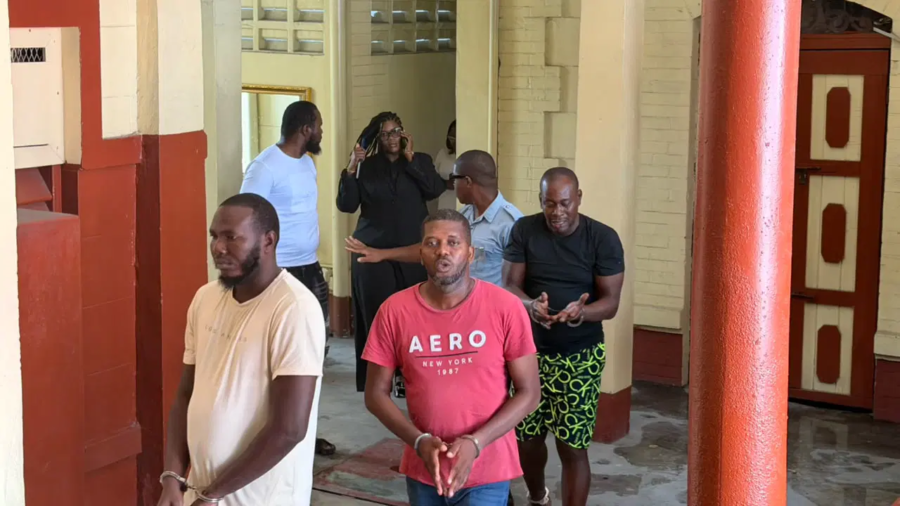
In a statement on Tuesday, the Guyana Police Force announced that, acting on legal advice from the Director of Public Prosecutions (DPP), it had charged Captain Kevin Price, 40, of Melanie Damishana, East Coast Demerara; Chief Mate Rondell Dwayne Roberts, 42, of Grove Public Road, East Bank Demerara; and Goods Superintendent Delon Granderson, 33, of Fellowship, West Coast Demerara, with the common law offence of murder.
The three men appeared before Chief Magistrate Judy Latchman at the Georgetown Magistrates’ Court, where the indictable charge was read to them. They were not required to plead and were remanded to prison. The matter has been transferred to the Charity Magistrate’s Court and adjourned until August 3.
The charges stem from the July 18 sinking of the MV Barima, a state-owned passenger and cargo ferry operated by the Transport and Harbours Department. The vessel capsized while sailing from Georgetown to Port Kaituma with 116 passengers and 17 crew members aboard.
Government verification has confirmed 76 survivors, while 53 bodies have been recovered, leaving several passengers still missing in what has become one of Guyana’s worst maritime disasters.
The latest prosecutions deepen a case that has already generated national debate, not only because murder charges have been brought against members of a vessel’s crew, but because the criminal proceedings are unfolding before the public has been given a full account of the Government’s own role in ensuring the ferry was safe to operate.
The MV Barima was owned, maintained and operated by the State through the Transport and Harbours Department. Responsibility for inspecting, maintaining and certifying the vessel ultimately rested within the Government’s maritime administration.
Since the tragedy, procurement records and other documents released publicly have raised serious questions about the ferry’s condition before it sailed. Opposition figures have asserted that the vessel required extensive repairs and should have been dry-docked rather than continuing in passenger service. Those disclosures have intensified demands for the release of maintenance records, inspection reports and seaworthiness certifications to establish whether the vessel met the standards required to carry passengers safely.
To date, the Government has not publicly released the full maintenance history, inspection findings or certification documents that would allow independent scrutiny of the vessel’s operational condition before its final voyage.
Those unresolved issues have led many to question why criminal liability is, at this stage, being focused on employees aboard the vessel while no public action has been announced against those responsible for vessel maintenance, regulatory inspections, operational approvals or management decisions within the Transport and Harbours Department.
The prosecutions also come as the Government has signaled that it has no current plans to raise the wreck from the seabed, despite appeals from relatives and experts who argue that salvaging the vessel is essential to recovering any remaining victims and preserving crucial evidence.
Prime Minister Brigadier (Ret’d) Mark Phillips recently stated that the Government has not contacted anyone to undertake a salvage operation and that the MV Barima is “likely to remain there as is” on the seabed.
That position has further intensified public concern that evidence capable of helping investigators reconstruct the final moments of the disaster could remain permanently beyond reach.
The decision to pursue murder charges while leaving unanswered broader questions about the Government’s management of its own vessel has also drawn condemnation from organised labour. The Guyana Trades Union Congress (GTUC) has argued that workplace accidents do not occur in isolation but are often the result of systemic failures, inadequate safety measures and decisions made well beyond the control of frontline workers. It has called for accountability to be apportioned wherever it belongs, including among those responsible for occupational safety and the operation of the ferry service.
As the three accused prepare to return to court on August 3, the proceedings are unfolding amid mounting calls for a comprehensive, independent commission of inquiry to examine every level of responsibility—from the maintenance and certification of the MV Barima to the decisions that kept the aging state-owned ferry in service.
For the families who lost loved ones and the nation still searching for answers, justice cannot rest solely with those who were aboard the vessel. It must also determine whether failures within the Government’s own systems, oversight and decision-making contributed to one of the deadliest maritime disasters in Guyana’s history.