


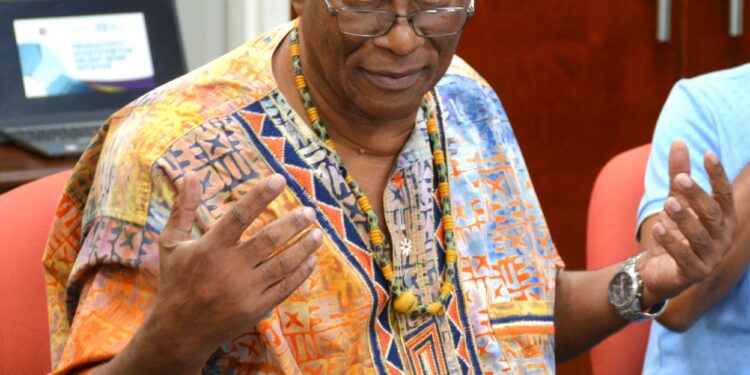
By Calvin G. Brown (WiredJA)- When one of the Caribbean’s most consequential statesmen rises to speak, the region should lean in and listen carefully. At the University of the West Indies, Mona Campus, on April 1, 2026, the Most Honourable P.J. Patterson — former Prime Minister of Jamaica, architect of Caribbean integration, and a legal mind of uncommon sharpness — delivered the Norman Manley Distinguished Lecture. What he said deserves not polite applause but urgent, honest reckoning.
Patterson invoked Manley’s own words — that the rule of law is part of “the air we breathe” in the Caribbean — not as comfort, but as a challenge. Because the air, he argued, is being corrupted. And some of the most corrosive pollutants are not external threats. They are structural. They are inherited. And we have been too polite, for too long, to name them plainly.
The Privy Council Absurdity
The most striking passage in Patterson’s address confronts a constitutional absurdity that sits at the very heart of Caribbean jurisprudence, largely unquestioned by the political classes who benefit from the status quo.
For the majority of CARICOM Member States, the final authority on Caribbean law — on the fundamental rights of Caribbean citizens, on the meaning of Caribbean constitutions — remains a committee of judges sitting in London. Not Caribbean judges.
Not jurists immersed in Caribbean social reality, history, or constitutional culture. London judges, tendering what is formally described not as binding judgments, but as advice — to the British Monarch.
Let that sink in. In territories that have shed the colonial relationship with the Crown, the highest court still functions as an advisory body to a foreign Head of State. The legal oxymoron is breathtaking. Independence declared, but legal sovereignty deferred. The flag changed; the final word did not.
“Independence can only be fully located within our sovereignty when our Constitution and Laws are interpreted according to our realities.”
— The Most Honourable P.J. Patterson
Patterson is precise and unsparing: “Independence can only be fully located within our sovereignty when our Constitution and Laws are interpreted according to our realities.” That is not a radical statement. It is a self-evident truth that the Caribbean has been reluctant to fully act upon.
The Historical Weight
Patterson does not permit the Privy Council’s admirers the luxury of selective history. Those same English courts that are venerated for their legal tradition had no difficulty, for centuries, declaring enslaved Africans to be property rather than persons — because the law, as written, said so.
The law was not neutral. It was an instrument of domination. And the “savings clauses” embedded in our Independence Constitutions — which preserved colonial-era legislation intact — cannot be allowed to serve as vehicles to perpetuate those malignant categories into the present.
This is a critical point. Legal formalism, stripped of moral accountability to human dignity, can coexist perfectly well with barbarism. It has before. The rule of law, Patterson insists, must mean something more substantive than procedural compliance with inherited structures.
The CCJ — And the Failure to Embrace It
The Caribbean Court of Justice exists. It is staffed by regional jurists of distinction. It is our court — independent, financially secure, grounded in Caribbean constitutional law and Caribbean lived experience.
And yet, the majority of CARICOM states have not made the transition to the CCJ as their final appellate court. Every year of delay, Patterson argues, is a year in which Caribbean legal sovereignty remains incomplete — a half-finished project of independence.
The Domestic and the Global
Patterson does not stop at the Privy Council. He indicts the failure of some governments to appoint senior judicial officers in a timely manner — whether by design or neglect, an assault on judicial independence. He names political attacks on integrity commissions and auditors-general for what they are: threats to the architecture of accountability.
And he casts a clear eye beyond our shores, where a superpower head of state has openly declared his intention to govern by personal morality alone, where ICC prosecutors face sanctions for doing their jobs, and where summary executions have taken place in Caribbean waters without any judicial process whatsoever.
Patterson’s message is clear, and it demands clarity in response: a rule of law that tolerates colonial anachronism at its apex, that bends to political interference domestically, and that falls silent in the face of international lawlessness, is not a rule of law at all. It is a performance — and the Caribbean deserves better than theatre.





![Amid mounting protests, the United States, which is Haiti's biggest donor, warned that the government should exercise restraint until the elections take place [File: Andres Martinez Casares/Reuters]](https://villagevoicenews.com/wp-content/uploads/2021/02/Amid-mounting.jpeg)

