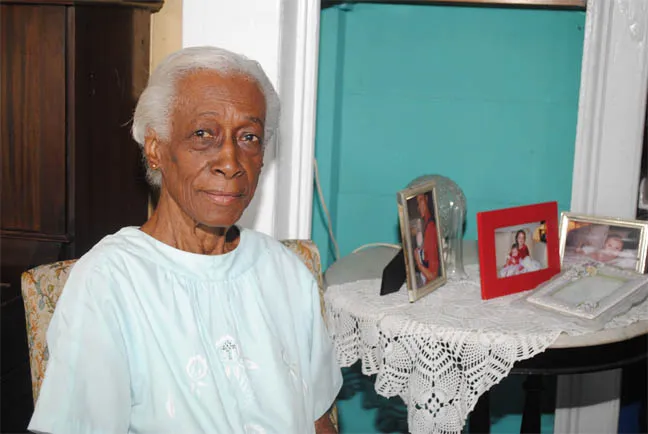
As Guyana marks Women’s History Month, the name Magda Lois Muriel Pollard stands not just as a symbol of achievement, but as a reminder of a time when women’s rights were neither institutionalised nor politically convenient—and had to be fought for, deliberately and persistently.
Pollard did not inherit influence. She built it.
Born in 1931 in Buxton to educator parents, she was raised in an environment where discipline and learning were non-negotiable. Her early years at Bishops’ High School revealed both intellect and leadership. By the time she graduated in 1950, she had risen to Head Girl and earned the school’s prestigious Fidele Collier Medal—an early signal of the authority she would later wield across the Caribbean.
But Pollard’s trajectory was not simply academic excellence—it was strategic preparation.
After beginning her career as a teacher, she pursued professional training at the Glasgow and West of Scotland College of Domestic Science, graduating with distinction. She later advanced her studies at Queen Elizabeth College, again earning high honours in home economics and community development.
At a time when “home economics” was often dismissed as domestic training, Pollard reframed it as economic power.
Rewriting the Value of Women’s Work
When Pollard returned to Guyana and joined the Carnegie School of Home Economics—eventually becoming its Principal—she began advancing a quiet but radical idea: that women’s unpaid labour was not invisible, but central to national development. It was a challenge to economic systems that excluded women’s contributions from measurable value.
Former colleagues recall that Pollard pushed students to see themselves not as homemakers alone, but as economic actors—capable of shaping households, markets, and policy. That philosophy would later underpin her regional work.
Inside the CARICOM Transformation
Pollard’s most consequential move came in 1980, when she was appointed the first Women’s Affairs Officer at the CARICOM Secretariat.
At the time, “women’s affairs” was often treated as a peripheral concern—symbolic rather than structural. Pollard changed that.
Internal accounts of her tenure point to a deliberate strategy: embed women’s issues into governance frameworks so they could not be ignored. She worked across Caribbean governments to establish Women’s Bureaus, influence legislation, and align regional policy with international conventions like CEDAW.
But her work was not without resistance.
Government systems accustomed to male-dominated decision-making did not easily absorb gender-focused reforms. Pollard, by all accounts, navigated these tensions with persistence rather than confrontation—building alliances, training senior women administrators, and forcing incremental but irreversible change.
Her programme, Management for Development: Effecting Change, became a pipeline for women entering leadership roles across the region—quietly reshaping the face of public administration.
From Advocacy to Law: Changing the Face of Parliament
Perhaps one of Pollard’s most enduring—and measurable—achievements was her role in pushing for women’s political inclusion to be embedded in law, not left to political goodwill.
Through sustained advocacy at both the national and civil society levels, including her leadership within Women Across Differences (WAD), Pollard helped lead the fight to ensure that women’s representation in the Parliament of Guyana was not optional.
That effort culminated during Guyana’s constitutional reform process, which introduced a mandate requiring that at least one-third of the List of Representatives submitted by political parties must be women.
The reform fundamentally altered the composition of political life in Guyana—transforming women’s participation from aspiration into obligation.
It was a structural intervention, and one that reflected Pollard’s broader philosophy: that equality must be designed into systems, not hoped for within them.
Beyond Policy: Networks of Influence
Pollard understood that policy alone was insufficient. She cultivated networks—and in doing so, built movements.
As co-founder and leader of Women Across Differences, she worked to bridge ethnic, political, and social divides among women in Guyana, advancing unity in a deeply polarised society.
She was also a founding member of the Caribbean Association of Home Economists and chaired Guyana’s National Commission on Women, while maintaining active engagement with United Nations and regional gender forums.
This dual approach—grassroots mobilisation and institutional reform—gave her influence a rare durability.
Recognition—and the Question of Legacy
Her work earned her some of the region’s highest honours, including the CARICOM Triennial Award for Women and Guyana’s Cacique Crown of Honour and Golden Arrow of Achievement.
Yet, decades after her landmark appointment at the CARICOM Secretariat, questions remain.
Have Caribbean states fully realised the frameworks she helped build? Are women’s contributions now adequately measured, or merely acknowledged in rhetoric?
Pollard’s own career suggests she would have demanded more than symbolic progress.
Conclusion
In honouring Magda Pollard during Women’s History Month, Guyana is not merely remembering a pioneering individual—it is recognising the foundation she laid for generations of women to lead, participate, and thrive.
Her life’s work stands as both a blueprint and a challenge: that the advancement of women must remain central to the region’s progress.
Magda Pollard’s legacy is not just preserved in awards or archives—it lives on in the laws, institutions, and movements she helped shape. The question now is whether the region will continue to build on that foundation, or allow it to stagnate.
——————–
Sources
– Prominent Women’s Rights Activist Magda Pollard Dies- Kaieteur News
– Magda Lois Pollard- CARICOM
– Women and Gender Equality Activist Magda Pollard Passes- Stabroek News
– Magda Pollard: A Trailblazer for Women’s Rights- News Room
– World Wide Web