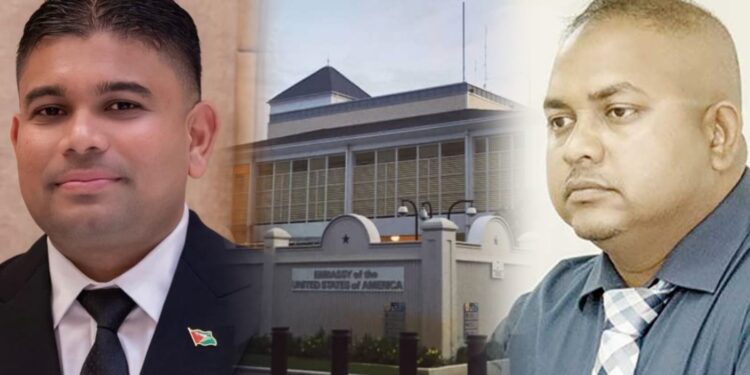
In a forceful and urgent statement that echoed the gravity of the moment, the Alliance For Change (AFC) sounded the alarm on what it calls a calculated assault on democracy, accusing the People’s Progressive Party/Civic (PPP/C) administration of weaponising the justice system to target critics and suppress political opponents. The party warned that Guyana is on a perilous path toward authoritarianism unless the nation changes course—and fast.
The party described what it sees as a pattern of politically motivated prosecutions, selective enforcement of laws, and legal overreach designed to intimidate, silence, or discredit individuals seen as dissenters or emerging political challengers.
“What we are witnessing is the quiet dismantling of the guardrails that protect Guyana’s democracy and constitutional freedoms,” the AFC stated.
Cases That Paint a Disturbing Picture
The AFC pointed to several recent legal actions as evidence of this alarming trend. Among them is the high-profile case of businessman Azruddin Mohamed, who now faces tax-related charges that had reportedly been resolved years ago. The party suggested the sudden revival of this case raises questions about motive, particularly as Mohamed’s political profile has grown. Mohamed is currently facing court proceedings over alleged tax evasion related to the importation of luxury vehicles five years ago. The case was initiated by the Guyana Revenue Authority.
Political activist Rickford Burke, who resides overseas, was charged under defamation laws already ruled unconstitutional. Even more troubling, according to the AFC, was the questionable attempt to serve Burke a summons outside of Guyana’s legal jurisdiction—an act the party labeled as legally groundless and politically motivated.
Then there is the case of social commentator Daniel Wharton, popularly known as “Baby Skello,” who was remanded on charges of blasphemous libel—a charge the AFC says is legally dubious. No evidence of flight risk or attempts to obstruct justice was presented, yet Wharton was denied his freedom.
“The public perception is clear: these actions serve a political script, not judicial prudence,” the party declared.
The Bigger Picture: A Calculated Erosion of Trust
The AFC also raised concerns about the re-opening of the Ricardo Fagundes murder investigation, commonly known as the “Paper Shorts” case. The party questioned whether the renewed focus is truly about justice or part of a broader effort to weaken Azruddin Mohamed’s political ascent.
“Whether true or not, the optics are deeply concerning. In a democracy, even the appearance of prosecutorial bias erodes trust,” the AFC warned.
Fagundes, a well-known associate of convicted drug trafficker Roger Khan, was gunned down in a hail of bullets outside the Palm Court nightclub in Georgetown on March 21, 2021. The brazen execution, carried out by heavily armed assailants who fled the scene with alarming ease, sparked public outrage and raised serious questions about the involvement of powerful figures and possible cover-ups.
Mohamed, who has launched a political party and is contesting the upcoming General and Regional Elections, has firmly denied any involvement in the crime and recently stated that he is fully prepared to cooperate with the authorities to clear his name.
However, the AFC said the pattern, of targeting dissent and political opponent points to a growing culture of fear and repression.
“These actions are not isolated; they are part of a broader erosion of institutional independence,” the statement continued. “When police and prosecutors are used as instruments of political retribution, every Guyanese—regardless of party affiliation—has reason to be concerned.”
In a society already grappling with widening inequality and economic hardship, the misuse of legal authority only adds to public frustration and disillusionment, the AFC noted.
Call to Action: A Crossroad for Governance
In a bold call for reform, the AFC urged the People’s Progressive Party Civic (PPP/C) administration to stop politicising the justice system. It also appealed to the Director of Public Prosecutions, the Commissioner of Police, and members of the judiciary to defend the independence of their offices.
“Our democracy demands nothing less,” the AFC stated.
The party pledged that under an AFC-led government headed by Nigel Hughes, it would:
- End the abuse of prosecutorial power.
- Strengthen the independence of the judiciary and law enforcement.
- Establish clear guidelines and oversight mechanisms to prevent political interference in legal matters.
- Create an Independent Justice Review Commission to monitor and audit politically sensitive prosecutions.
Justice Must Not Be a Weapon
The AFC’s statement struck a final, emphatic note:
“The erosion of legal norms threatens not just political opponents, but every citizen’s freedom. We must resist the normalization of fear and recommit to a Guyana where law is a shield for the people—not a sword for the powerful.”
With the 2025 elections approaching, the AFC is making clear that the fight for justice, transparency, and institutional integrity will be central to its campaign.
“Better Must Come. United Guyana, Fair and Free.”