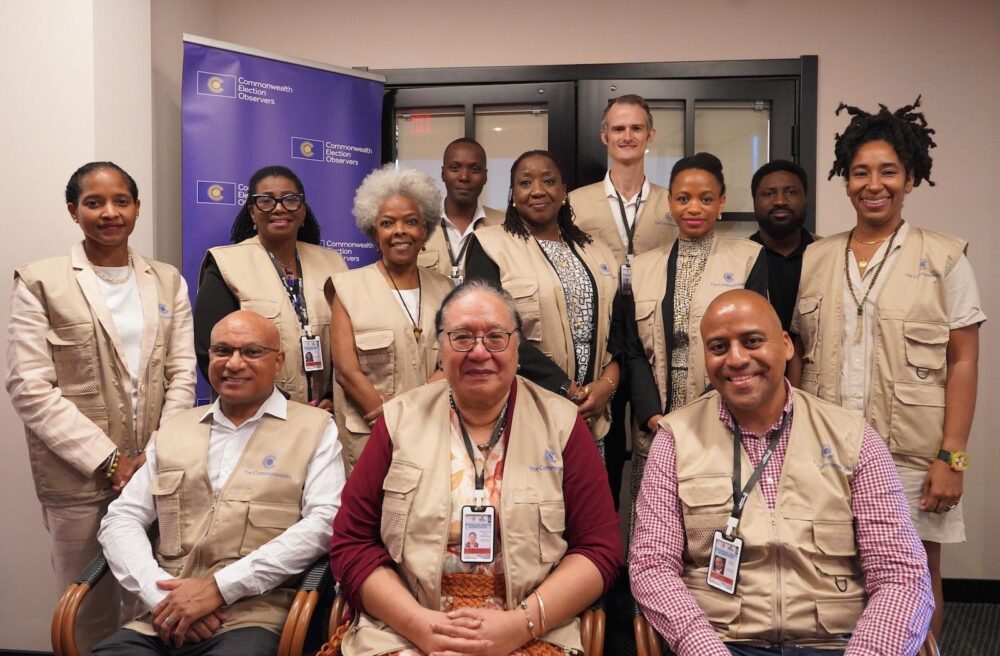
By Mark DaCosta- In an assessment of the recent Guyana’s General and Regional Elections, observers from the Commonwealth Observer Group have painted a picture of cautious optimism, highlighting a generally peaceful and orderly electoral process. Nevertheless, the report has also pointed out several significant challenges that threaten to undermine public confidence in the democratic fabric of our society
During their mission from August 23 to September 7, 2025, the observer group, led by the esteemed former Foreign Minister of Tonga, Mrs. Fekitamoeloa Katoa ‘Utoikamanu, reported a well-managed election with a commendable degree of professionalism in the operations of voting, counting, and tabulation. However, the diplomats did not shy away from addressing the underlying issues that have plagued our electoral process, particularly those that have enabled a political environment skewed in favour of the incumbent party, the People’s Progressive Party (PPP).
A pronounced concern raised by the observers was the uneven distribution of campaign resources among political entities, which ultimately tilted the scales in favour of the governing party. This begs the question: can genuine democracy exist when one party has disproportionate access to both financial and media resources? The Commonwealth report vividly underscores that “media bias that favoured the governing party” created an inequitable playing field. Such an imbalance raises alarms about the integrity of our democratic processes and highlights the urgent need for reform in campaign financing regulations.
The report also revealed serious gaps in inclusive participation. Notably, youth, persons with disabilities, and Indigenous communities remain vastly underrepresented in both the electoral process and GECOM’s operations. The lack of sex-disaggregated data for polling staff and candidates limited transparency and, ultimately, accountability in efforts to create a truly inclusive electoral environment. This is particularly troubling in a country that prides itself on diversity and inclusivity. The observers pointedly noted that “the Guyana Elections Commission (GECOM) lacked sex-disaggregated data,” highlighting a fundamental flaw in planning for equitable representation.
Against the backdrop of significant economic transformation driven by the newfound potential of offshore oil reserves, the stakes of this election were higher than ever. Despite the PPP’s attempts to orchestrate a narrative of positive change, many citizens perceive a reality that belies that narrative — one marked by political polarisation and diminishing public confidence in our leadership. Amid mounting concerns of misinformation and a lack of media independence, the observers’ call for “strengthened media independence, digital resilience against misinformation” clearly points to a pressing need for reform which, if neglected, could jeopardise the very democratic rights that every citizen should enjoy.
The recent elections were held amid heightened public concern over the management and distribution of the country’s newfound wealth, GECOM’s failure to implement biometric systems to mitigate electoral fraud, a bloated voters’ list, the agency’s non-adherence to its own work plan, and its failure to comply with Sections 96 and 99 of the Representation of the People Act during the tabulation of votes, among other anomalies.
While certain legislative updates, such as those to the Representation of the People (Amendment) Act 2022, have been acknowledged for their potential to enhance procedural accuracy, the effectiveness of such reforms is heavily contingent on their implementation and the accompanying political will — which many fear is lacking under the current regime.
In line with these observations, the European Union (EU) has echoed similar sentiments, noting a troubling alignment of power and resources that hinders genuine democratic engagement. Their critical analysis warns that without robust mechanisms to ensure equity and transparency, the government risks alienating the very electorate it claims to serve. Thus, further reforms are not merely suggestions; they are imperative to safeguard our democracy.
The Commonwealth Secretary-General, Shirley Botchwey, expressed a measured optimism in response to the observer group’s findings, stating, “I welcome the COG’s assessment that the elections… demonstrate encouraging improvements.” However, she also insisted that “more remains to be done to secure equity, full inclusivity, and public confidence.” This assertion resonates with many citizens who feel disillusioned by the political status quo and demand accountability from those in power.
View the Report here