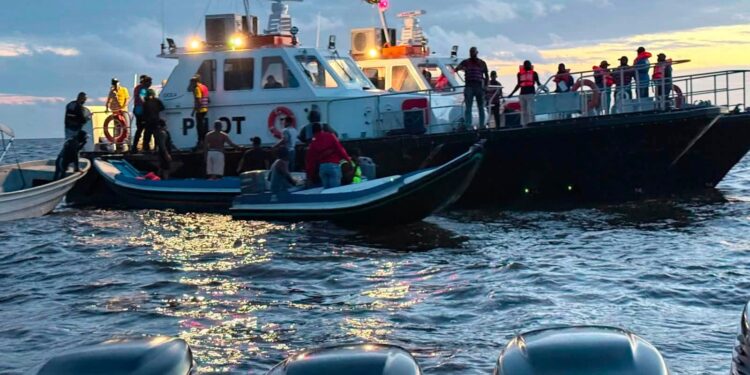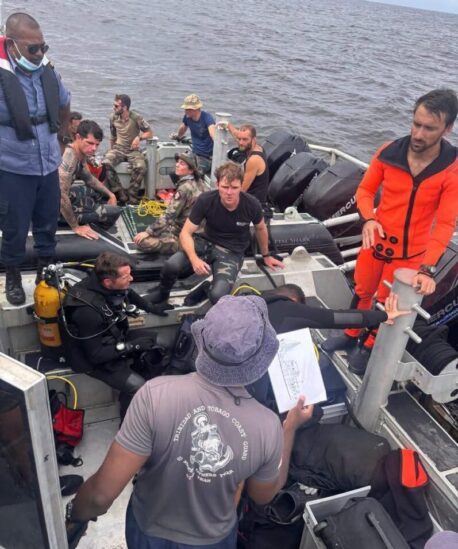
French military divers assisting in the recovery operation at the wreck of the MV Barima say extreme underwater conditions—including complete darkness, strong tidal currents and a tangled interior filled with ropes and hammocks—are making it exceptionally difficult to locate and recover those still missing from Guyana’s worst maritime disaster.
The grim assessment was shared with relatives during a briefing at the Charity Operations Centre on Sunday, where members of the French Armed Forces outlined the challenges they have encountered since joining the multinational recovery mission earlier this week.
“We arrived on Monday, and since Tuesday we have committed about 15 dives on the wreck,” one French military officer told family members.
According to the officer, every descent to the seabed presents significant risks, with divers operating in an environment where visibility is virtually nonexistent.
“It is totally dark there. There are very, very hard environmental conditions, especially because of the tide and the current on the wreck,” he said.
“So it is very difficult for us to navigate through the wreck. We have to feel the wreck, and it’s like we are blind.”
Unable to see their surroundings, the divers must rely entirely on touch to move around the vessel.
“We follow the rope, arrive on the wreck and try to navigate by searching the characteristics of the wreck,” the officer explained, noting that guide ropes are essential for reaching and exploring the submerged ferry.
He said conditions become even more dangerous inside the overturned vessel, where ropes, hammocks and other debris have created a maze that increases the risk of entanglement.
“It is too dangerous for us to enter into the wreck, and because of the many ropes and the hammocks, it’s very difficult to see where we are going,” he said.
The French officer emphasised that while every effort is being made to recover the remaining victims, the hostile underwater environment continues to dictate the pace of the operation.
“I would also like to thank the Guyana Defence Force for all their support, which has allowed us to conduct the dives, but the weather conditions and the environmental conditions of the sea are really, really hard,” he added.
Relatives also sought answers about whether the wreck could be raised to facilitate the recovery effort. Responding to the question, the officer cautioned that such an operation would be extremely difficult because of the vessel’s condition.
“I think it is very, very hard… the wreck is very strong, so it is difficult,” he said.
The briefing came as frustrated relatives, many of whom have repeatedly demanded answers from authorities, continued to press government officials for updates on the search and recovery operation.
The French Armed Forces joined the mission after Guyana sought international assistance in the wake of the July 18 tragedy. They are working alongside specialist divers from Trinidad and Tobago, the Guyana Defence Force, local divers and other agencies involved in one of the country’s largest recovery operations.
The MV Barima capsized shortly before midnight on July 18 while sailing from Georgetown to Port Kaituma with 116 passengers, 17 crew members and cargo on board. The sinking has claimed dozens of lives, plunged the nation into mourning and sparked widespread questions about the vessel’s seaworthiness, maintenance history and regulatory oversight. President Irfaan Ali has since announced a Commission of Inquiry into the disaster.
As of Sunday, officials reported that 73 bodies had been recovered, with 69 positively identified by their families. Recovery operations remain focused on locating those still missing while ensuring the safety of divers working under some of the most hazardous conditions encountered since the tragedy unfolded.