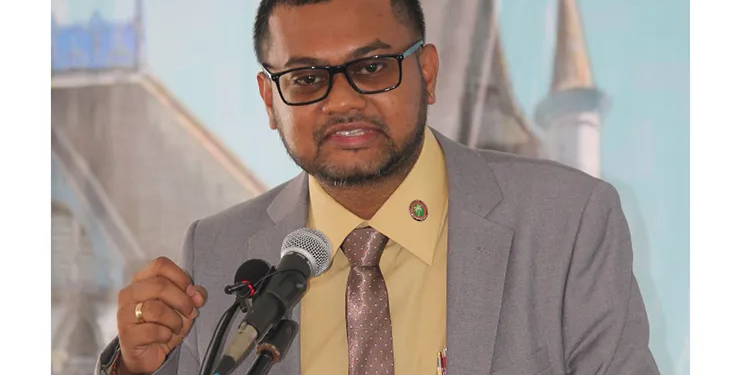
Political scientist and former People’s Progressive Party (PPP) minister Dr. Henry Jeffrey has warned that vote-buying, driven by poverty and weak accountability, continues to undermine democracy in Guyana and casts doubt on the credibility of recent elections.
In an opinion piece titled “Democracy, poverty and vote-buying,” Jeffrey described vote-buying as the offering of money or material benefits to voters in exchange for electoral support, noting that it can also take the form of abuse of state resources for political advantage. Citing the International Institute for Democracy and Electoral Assistance (International IDEA), he said the practice undermines electoral integrity and is illegal in more than 90 percent of countries.
Jeffrey pointed out that, just before the 2025 elections, the Guyana Elections Commission (GECOM) reminded stakeholders of their moral and legal obligation to ensure free and fair elections, amid concerns raised by the opposition about widespread vote-buying. Under the Representation of the People Act, he noted, it is an offence to offer money, gifts or loans to secure a voter’s support.
Despite these provisions, Jeffrey argued that vote-buying has persisted in Guyana since colonial times and has continued following the ‘return to democracy’ in 1992. He said the practice can be “positive,” encouraging voters to support a party, or “negative,” discouraging participation, and cited research indicating that during the 1997 elections agents campaigning for the ruling PPP bought voter identification cards from opposition supporters to prevent them from voting.
The former minister accused successive governments, and particularly the PPP during the last elections, of using public funds to influence voters. He referenced a report in the Kaieteur News that President Irfaan Ali had “hinted” that cash grants would be distributed to the population if his party won the elections, quoting the president as saying: “We will have a beautiful Christmas. Look at the smile on my face and know that you will have an enjoyable holiday!”
Jeffrey argued that voters’ willingness to accept inducements is largely a result of poverty and social exclusion. He reiterated his long-held view that decades of economic marginalisation, particularly of Guyanese of African descent, have contributed to this vulnerability. He also criticised the absence of up-to-date population census data and disaggregated ethnic statistics, despite calls from the United Nations International Decade for People of African Descent.
As a result, Jeffrey said, Guyana remains burdened by a growing poverty rate even as it is classified as one of the world’s fastest-growing economies. Elections conducted under such conditions, he argued, “cannot be free and fair much less democratic.”
He further questioned the government’s explanation for not delivering promised cash grants, stating that a lack of funds was unconvincing given the administration’s history of finding financing when it chooses. Jeffrey suggested instead that the government may have been advised that unilateral cash payouts to influence voters do not constitute democratic budgeting, contrasting Guyana’s approach with what he described as more predictable and sustainable cash grant systems in neighbouring Suriname.
Looking ahead, Jeffrey cautioned against reducing democracy to simple majority rule or material benefits, warning that such thinking enables authoritarian practices. He argued that liberal representative democracy is not only a mechanism for governance but an expression of human freedom, adding that vote-buying fosters unaccountable leadership and weakens citizens’ ability to shape equitable development.
“When one seeks to buy or sell votes,” Jeffrey wrote, “one not only encourages unaccountable/dictatorial governance … but severely diminishes one’s capacity to equitably contribute to the appropriate development and appreciation of the world in which one lives.”