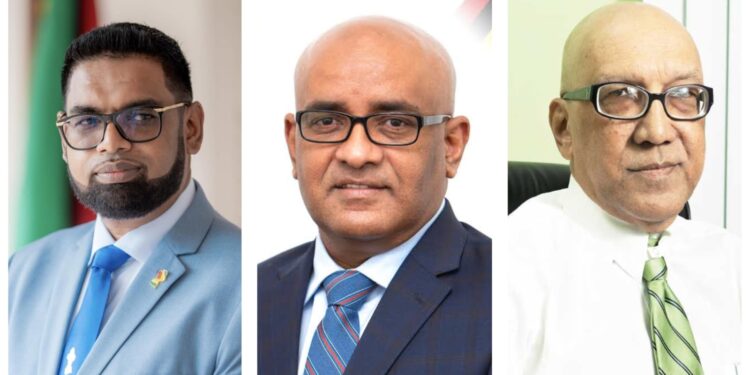
Former People’s Progressive Party (PPP) Cabinet minister and political scientist Dr. Henry Jeffrey has delivered one of his sharpest critiques yet of Guyana’s political system, arguing that the country’s governance model has become so unaccountable that piecemeal constitutional reform will no longer suffice.
Writing in his Future Notes column, The Future of Freedom, published in the Village Voice News on Sunday, July 19, Jeffrey contends that Guyana’s political crisis is not simply constitutional—it is rooted in a concentration of power that leaves governments with few meaningful checks while reducing democracy largely to periodic elections.
His intervention comes as calls intensify for constitutional reform following years of criticism over executive dominance, weak institutional oversight and increasing public demands for greater accountability.
Jeffrey begins by reflecting on recent comments by U.S. Secretary of State Marco Rubio, who condemned Cuba’s communist leadership for clinging to what he described as a failed Marxist ideology. While Jeffrey agrees that Soviet-style Marxism-Leninism inevitably produces authoritarian rule through its doctrine of democratic centralism, he argues that liberal democracies should not congratulate themselves too quickly.
In his assessment, both political models have failed humanity.
“Both liberal democracy and Marxist/Leninism are morally bankrupt,” Jeffrey argues, insisting that genuine freedom remains elusive under either system.
For Jeffrey, Guyana provides a compelling example of why constitutional reform cannot be confined to technical amendments.
“The pervasiveness of unaccountable governance in Guyana has led to multiple voices demanding fundamental constitutional reforms that must go well beyond those that took place at the turn of this century if they are to be useful,” he writes.
His criticism reaches beyond party politics to the structure of governance itself. Jeffrey argues that successive constitutional reforms have failed to address the deeper problem: the concentration of political power in the Executive and the absence of institutional safeguards capable of ensuring meaningful accountability.
Rather than focusing exclusively on elections, Jeffrey says reform must strengthen what he describes as the “soft power” of democracy—the rule of law, separation of powers, devolution of authority, federalism, independent institutions and multiparty governance.
Without those protections, he warns, governments become increasingly dependent on material development to maintain public support.
“In the near total absence of the kind of ‘soft power’… available to liberal democracies, most autocratic governments, such as in Guyana’s, have nothing but material outcomes with which to placate their populations.”
Jeffrey also launches a broader critique of global capitalism, arguing that extraordinary economic growth has failed to translate into genuine freedom for millions.
Citing international studies, he notes that while worker productivity has risen dramatically over the past half-century, wages have stagnated and wealth has become increasingly concentrated among a small economic elite. Freedom, he argues, cannot be measured solely by market opportunity when vast disparities in wealth determine who can truly exercise choice.
Looking to the future, Jeffrey sees artificial intelligence not as a threat but as an opportunity to redefine work and expand human freedom. Drawing on the writings of Karl Marx and recent initiatives by U.S. Senator Bernie Sanders advocating a 32-hour workweek, he argues that technological progress should allow societies to reduce working hours while improving quality of life.