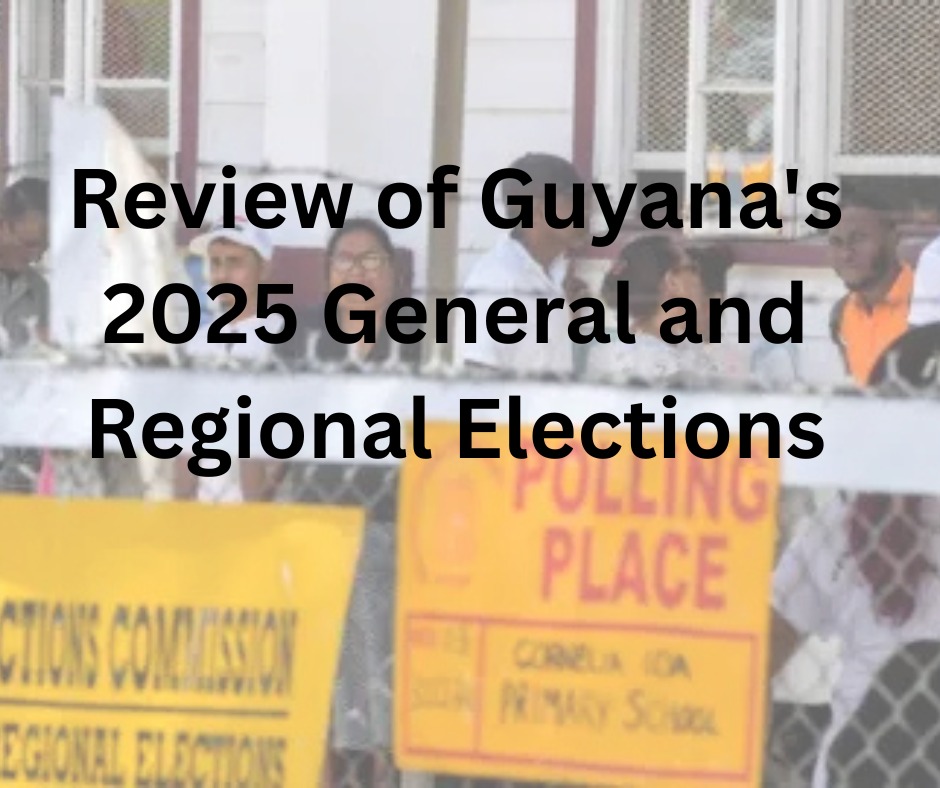
As Guyana emerges from its September 1, 2025 General and Regional Elections, many citizens are asking a painful question: Why did the governing People’s Progressive Party/Civic (PPP/C) and the Guyana Elections Commission (GECOM) allow the polls to proceed without biometric voter verification, despite a near-decade of warnings and broad support for reform?
Analysts argue that this omission was not a logistical failure but a deliberate choice—one that safeguards multiple voting, anonymity, and a bloated voter roll easier to manipulate.
Voter List Implosion: More Voters Than Makes Sense
One of the most troubling indicators is the size of the voter list itself. In the 2020 elections, the Official List of Electors (OLE) numbered 660,998 names. By 2025, that list had swollen to 757,066, a jump of nearly 96,068—an increase of about 14.5%. The refusal of the Government to release 2022 National Census data adds to the uncertainty surrounding the Voters List and the overall transparency of the electoral process.
Lincoln Lewis, General Secretary of the Guyana Trades Union Congress (GTUC), pointed out the stark improbability:
“Guyana’s voter list almost mirrors the population — this defies logic, and no serious democracy should accept that.”
“The PPP wants to avoid biometrics because it will block their ability to rig the vote.”
That list size, he and others contend, opens the system to multiple registrations, impersonation, and padding with ineligible names.
GECOM’s 2024 Feasibility Study: Benefits Acknowledged, but Action Deferred
GECOM’s own Chief Elections Officer, Vishnu Persaud, delivered a feasibility study in November 2024 that estimated US$20.7 million would be needed for biometric fingerprint registration and voting infrastructure.
Persaud extolled the benefits:
“While biometric technology offers the promise of increased data security and efficiency in the electoral process, issues such as privacy concerns, technical limitations, logistics, potential exclusion, maintenance, training and cost implications must not be overlooked.”
But the report also warned: the Constitution contains no explicit authority for biometrics at the polling place, and implementing such a system would require legislative reform.
Despite this roadmap, GECOM did not act, citing time constraints and legal barriers.
In January 2025, GECOM Chairperson Ret’d Justice Claudette Singh declared that mandatory biometric identification would be “unconstitutional” unless the law was amended—effectively blocking the rollout.
The Commission also declared that biometric voter verification was “not possible in the short term.”
“If GECOM were to implement biometrics as a supplementary tool … it will still require legislation since such a system would impose an additional requirement on voters and would therefore be unconstitutional.”
They cited the need for stakeholder consultations, procurement, training, public education, and hardware deployment as insurmountable given the election timeline.
Opposition, Civil Society, and the Debate Over “Feasibility”
However, That argument was sharply rejected by opposition parties and legal observers, who said Singh’s refusal to even pursue reform revealed a deeper agenda.
Just because GECOM declared impossibility doesn’t mean others agreed. In January 2025, Lincoln Lewis strongly rebuked the Commission’s stance:
“For GECOM to admit use of biometrics could enhance voter integrity yet find reasons to say it may not be possible before the next elections is an insult to the people of Guyana.”
Lewis also pressed that the “legal obstacle” argument is a smokescreen:
“There is no legal barrier to revisiting the National Assembly to pass the necessary laws,” he wrote, accusing GECOM Chair Ret’d Justice Claudette Singh and senior counsel Ralph Ramkarran of “hiding behind legal technicalities.”
GTUC reinforced that the technology was feasible and that the window was not lost:
“Biometric technology is not complex … The system already exists. What is needed now is for GECOM to move the process forward.”
The opposition parties had signaled support for reform. In public forums and statements leading into 2025, A Partnership for National Unity (APNU) and Alliance for Change (AFC), along with civil society, made clear they would support amendments necessary for biometric implementation.
PPP/C Leadership: Denial, Delay, and Distraction
PPP leaders have consistently dismissed allegations of electoral manipulation. Vice President Bharrat Jagdeo, once an ardent critic of a bloated voter list and advocate for biometrics, has since responded to concerns about biometrics by suggesting they could “disenfranchise voters” or “cause confusion” if deployed hastily.
Jagdeo described opposition fixation on biometric systems as a political ploy:
“This ‘non-issue’ is being weaponised by APNU and AFC to undermine confidence in the electoral process.”
Attorney General Anil Nandlall has echoed that biometric systems required legislative groundwork and risked delaying the 2025 elections.
Critics say that despite knowing about the need for reform, the PPP/C did not prioritise electoral modernisation—and that may have been intentional.
Comparative Failures: The Region Did It, Why Not Guyana?
Across the Caribbean and Commonwealth, biometric voting systems are not sci-fi—they’re reality.
-
Jamaica has deployed fingerprint-based verification and uses an Automated Biometric Identification System (ABIS) at polling stations.
-
Ghana, with a far larger electorate and more challenging terrain, introduced biometric registration and verification systems within a compressed timeframe.
-
The Bahamas and Dominican Republic issue biometric voter cards combining fingerprint or facial recognition data to reduce duplication and fraud.
These success stories show that cost and logistics, though real, are surmountable with political will and planning.
Conclusion: A Choice Made, Not a Barrier Met
No publicly documented proof has surfaced of vote-level tampering or direct falsification by the PPP/C or GECOM. Yet the decision not to pursue biometric reform, despite ample time, public demand, and technical feasibility, leaves an electoral system vulnerable to suspicion, and in many eyes, manipulation.
In a country where nearly 100,000 new names appeared on the voter roll in five years—with no census data to justify it—maintaining opacity over voter verification was not a neutral choice. It was a decision aligned with those who benefit from uncertainty.
Guyana voters may now ask not just whether their ballots were counted, but whether the system was ever designed to count them fairly.
To be continued….







![The two-dose Oxford-AstraZeneca vaccine has been hailed as a 'vaccine for the world' because it is cheaper and easier to distribute than some rivals [File: Jason Cairnduff/Reuters]](https://villagevoicenews.com/wp-content/uploads/2021/02/Oxford-AstraZeneca-vaccine.jpg)