With Guyana’s General and Regional Elections set for September 1, veteran trade unionist Lincoln Lewis has issued a grave warning about the integrity of Guyana’s electoral process. In a recent commentary, Lewis raised serious allegations regarding the impartiality and operational readiness of the Guyana Elections Commission (GECOM), pointing to what he described as troubling interference by the People’s Progressive Party/Civic (PPP/C) government.
He contended that GECOM’s failure to address long-standing deficiencies, coupled with political influence at the highest levels, constitutes a direct threat to the credibility of the elections and could ultimately call into question the legitimacy of the results. Warning about the state of Guyana’s democracy, Lewis describes as a continuation of troubling patterns of electoral misconduct. He pointed to longstanding issues that have plagued the electoral process, including the bloated voters list, allegations of multiple voting, fraudulent ballots cast in the names of deceased or missing persons, and ballot box stuffing.
Bloated Voters List and Electoral Malpractices
Guyana’s current voter list raises serious concerns about its accuracy in reflecting the true voting population. While the national population is estimated to be between 750,000 and 780,000, the Preliminary List of Electors as of June 2025 contains 757,066 names—nearly equal to the entire population, including minors. This marks a sharp increase from the 660,998 names that appeared on the Official List of Electors during the 2020 General and Regional Elections, highlighting the urgent need for a thorough review and cleansing of the voter roll
The Recount conducted after the 2020 Elections serves as a compelling example of the challenges facing the electoral system. Based on the findings outlined below, more than 90,000 voters were affected—raising serious concerns that the outcome of the last election may not have accurately reflected the will of the people.
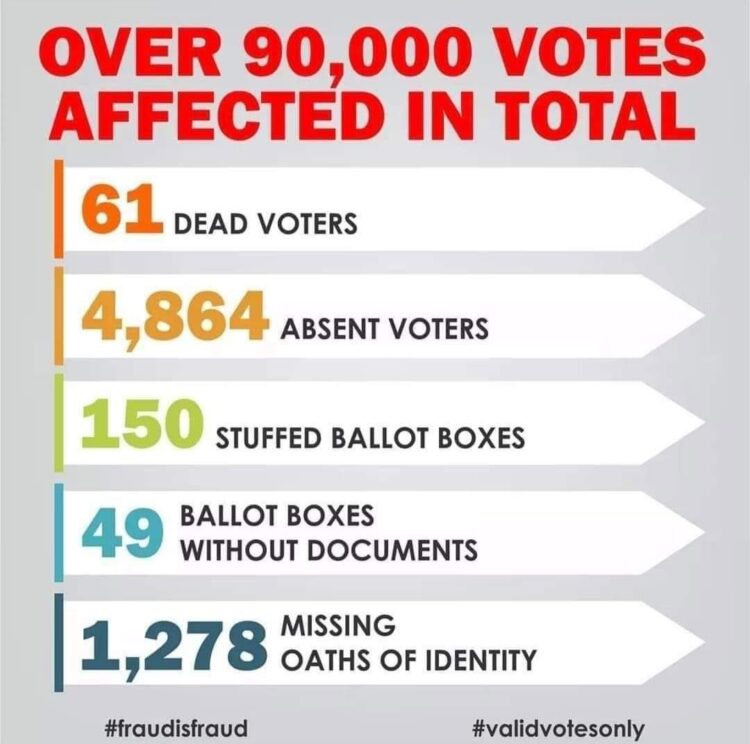
Despite these recurring concerns, he notes, no meaningful reforms have been implemented to safeguard democracy.
At the core of Lewis’s argument is the abandonment of biometric voter identification, a reform he describes as essential to ensuring free, fair, and credible elections. He criticised the government’s promotion of a new national identification (ID) system, which it says is aimed at differentiating citizens from residents and facilitating business and travel. Lewis views this initiative as a deliberate attempt to avoid meaningful electoral reform.
“The PPP wants to avoid biometrics because it will block their ability to rig the vote,” Lewis states firmly.
He characterises this approach as not only “dangerous” but “wicked,” warning that it risks undermining Guyana’s democratic foundations before a single ballot is cast.
GECOM and Gov’t Failures
Lewis, General Secretary of the Guyana Trades Union Congress (GTUC), also expressed concern over the independence of GECOM, accusing the commission of relying on legal advice from the government’s Attorney General, Anil Nandlall, who is himself a PPP/C candidate, and failing to hold accountable officials with a history of electoral misconduct. He warned that such actions point to a “co-opted” electoral body that appears to favour the incumbent party.
At the heart of Lewis’ concerns is the impact on ordinary Guyanese—the workers, farmers, teachers, and small business owners—who, he says, are the ones most affected by a compromised system.
Notably, Bharrat Jagdeo, now Vice President, had previously called for a clean voters’ list and the implementation of biometric verification when serving as Leader of the Opposition. At the time, Jagdeo emphasised the importance of such reforms to ensure electoral transparency.
However, since assuming office, the PPP/C administration has failed to take concrete steps to engage GECOM, the Opposition, or civil society stakeholders in implementing those very reforms, raising serious questions about the government’s commitment to genuine electoral reform and transparency.
“When the electoral system is rigged, it is your rights, your voice, and your future that is stolen,” Lewis warned
The veteran trade unionist accuses the PPP/C of double standards—calling for transparency when in opposition, but suppressing dissent when in power. He also cautions against a growing trend where laws are used to intimidate and imprison political opponents.
Concluding with a passionate appeal, Lewis urges citizens to unite in defense of their democratic rights:
“This country does not belong to the PPP, or any party. It belongs to the people, all the people. And the people must reclaim it, with vigilance, with unity and with righteous defiance.”