The European Union Election Observation Mission (EU EOM) on Monday submitted its Final Report on Guyana’s 2025 General and Regional Elections to the Guyana Elections Commission (GECOM). While the EU report outlines recommendations to strengthen transparency, voter education, administrative capacity, and the legal framework, widespread concern has emerged that GECOM itself failed to uphold the integrity of the process.
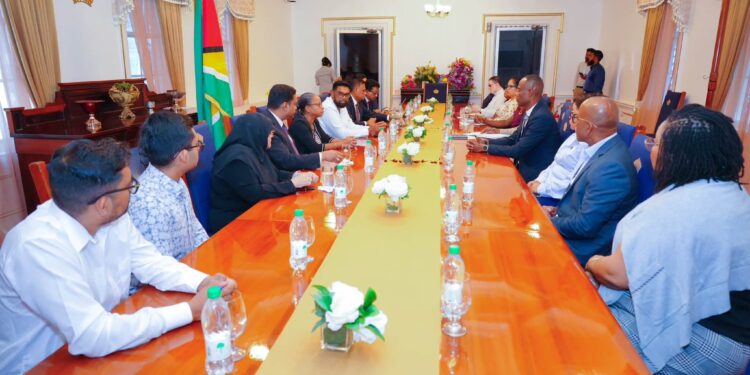
Upon arriving in Georgetown, EU Chief Observer Robert Biedroń presented the report to senior GECOM officials, highlighting key findings and proposed improvements for future elections. While the EU EOM’s analysis provides an external assessment, questions are mounting about whether domestic institutions have met the legal and procedural standards required to safeguard electoral credibility.
Sections 96 and 99 of the Representation of the People Act (ROPA) set out the steps GECOM is legally obliged to follow:
- Section 96: “The Chief Election Officer shall, after calculating the total number of valid votes of electors which have been cast for each list of candidates, on the basis of the votes counted and the information furnished by returning officers, ascertain the result of the election.”
The section further requires that the CEO prepare a report, in both manual and electronic form, which then serves as “the basis for the Commission to declare and publish the election results under section 99.”
- Section 99: “As soon as practicable, but not later than fifteen days after election day, the Commission shall publicly declare the results of the election and cause to be published in the Gazette a notification thereof, specifying the number of votes cast for each list of candidates, the number of rejected ballot papers, the number of seats allocated to each list of candidates, and the names of the persons who have become members of the National Assembly.””
There is widespread concern that GECOM bypassed these two critical stages of verifying and validating the credibility of results and moved directly to gazette them on September 16. Even the gazetted results contained glaring errors, including identical vote totals for the People’s Progressive Party/Civic (PPP/C) in Regions 9 and 10. The official declaration showed the PPP/C receiving the exact same number of votes—9,938—in both regions. The gazetted information, dated September 16, 2025, was signed by GECOM Chief Election Officer Vishnu Persaud. Society and public scrutiny that highlighted the glaring error in the Gazette, forcing the CEO to make an amendment to the published results.
Opposition-nominated Commissioners have repeatedly warned that by failing to follow Sections 96 and 99, GECOM compromised both the verification process and the credibility of the declared results. Commissioner Vincent Alexander, the most senior member of the Commission, said, “What GECOM did is bypass the two critical stages in verifying and validating the credibility of results and move directly to gazette them on September 16.”
Historical lapses exacerbate public concern. In 2006, former GECOM CEO Gocool Boodhoo altered seat allocations, awarding the PPP a seat that rightfully belonged to the Alliance for Change (AFC). In the current cycle, similar errors were detected, with opposition interventions preventing further misallocation that could have shifted the balance of the National Assembly.
Analysts and civil society groups warn that bypassing the legally mandated stages of result verification and gazetting undermines the credibility of the elections and erodes public trust in democratic institutions. The contrast between international recommendations in the EU EOM report and domestic procedural failures highlights a growing debate over whether key electoral bodies in Guyana are equipped—or willing—to uphold the standards necessary for a transparent and credible process.