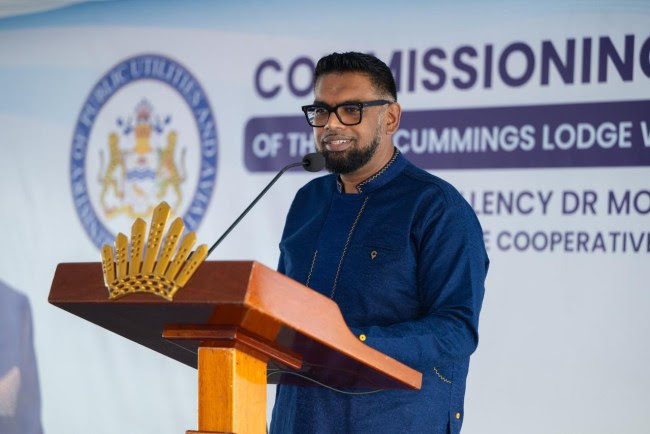
President Irfaan Ali recently called on Guyana’s religious and social institutions to partner with the government in building a stronger moral and civic foundation for the nation’s citizens. Speaking at the commissioning of the Cummings Lodge Water Treatment Plant, last Saturday, he announced plans to work with churches, mosques, temples, and other faith groups to tackle social challenges and promote responsible citizenship.
However, analysts argue that for the Ali administration to truly establish a moral government, reforms must begin at the highest levels of leadership. A moral government, defined by philosophers like John Rawls as one grounded in justice, fairness, and the protection of human dignity, prioritises the well-being of its citizens, upholds the rule of law, and ensures accountability among its leaders (Rawls, A Theory of Justice, 1971). Theologian Charles G. Finney similarly emphasised that God’s rule is moral and that both individuals and governments are accountable to a higher moral law (Finney, Lectures on Systematic Theology, 1846).
Analysts stress that the government must implement systems that hold every public official accountable, including convening Parliament to strengthen oversight and transparency. They insist on a full investigation into allegations involving Vice President Bharrat Jagdeo and Chinese businessman Su Zhirong, as well as the extrajudicial killings of hundreds of Guyanese during Jagdeo’s presidency—issues highlighted by the United Nations Human Rights Committee (UNHRC) last year, which the Ali government has yet to address.
Guyana’s reputation as the most corrupt English-speaking country in the Caribbean is a notoriety that began under the People’s Progressive Party (PPP)-led Jagdeo administration, worsened during the PPP-led Donald Ramotar government, saw some relief under the David Granger/Moses Nagamootoo A Partnership for National Unity and Alliance for Change (APNU+AFC) government (2015–2020), and has since deepened under Irfaan Ali’s leadership.
Analysts also emphasise that government officials must lead by example in public engagement. They cite Vice President Jagdeo’s weekly press conferences, which have devolved into hostile exchanges, including derogatory remarks calling Guyanese “stupid,” undermining the goal of moral revival. Moral leadership, they argue, is not solely the responsibility of churches but must be embraced by government through respecting citizens’ rights, including political and social freedoms, protection from discrimination, and equitable sharing of national resources.
The call for moral and spiritual revival is not new. Former Mayor Hamilton Green is credited with championing this cause since the 1990s, as Guyana grappled with rising corruption, discrimination, and social decay in the early days of the PPP administration.
One analyst critiqued the PPP’s record as devoid of original ideas, noting that the party frequently adopts external blueprints-without attributing credit- and struggles with effective implementation. The expansion of Guyana’s road infrastructure, acknowledged as a major achievement, is largely building on the 1970s Forbes Burnham Infrastructure Development Plan.
President Ali’s initiative to engage faith-based organisations highlights an important dimension of nation-building, that is, physical infrastructure alone is insufficient. True transformation requires nurturing citizens grounded in strong moral and civic values. Yet, analysts warn that without systemic accountability beginning at the top—particularly addressing corruption and past abuses—the vision of a moral government and moral society will remain out of reach.