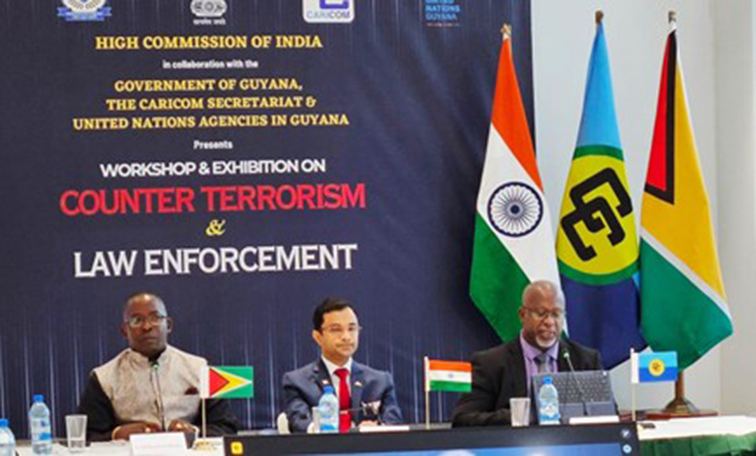
Guyana, in partnership with India, the Caribbean Community (Caricom), and the United Nations offices in the country, recently hosted a workshop and exhibition aimed at strengthening regional efforts in counterterrorism and law enforcement. The event stemmed from discussions at the Second India-Caricom Summit and Prime Minister Narendra Modi’s landmark visit to Guyana in November 2024.
Held at the Pegasus Hotel in Kingston, Georgetown, the workshop served as a forum for sharing policy insights, showcasing technological advancements, and discussing best practices for tackling modern security threats.
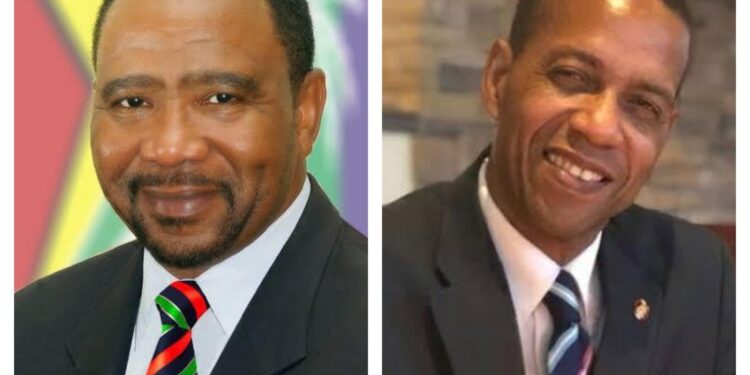
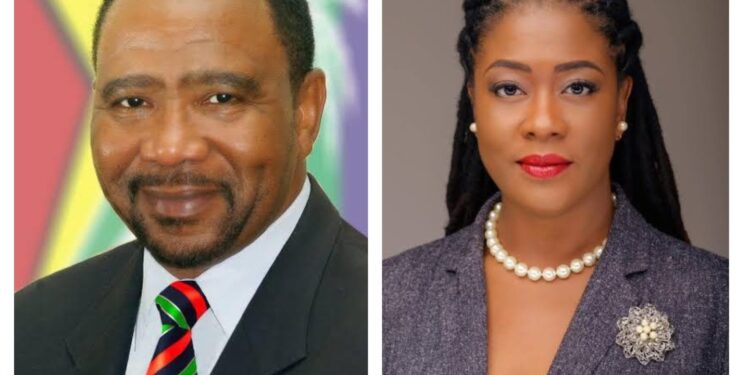
Indian High Commissioner to Guyana, Dr. Amit Telang, was joined by Brigadier (Ret’d) Godfrey Bess, Ambassador and Director of Defence Policy at Guyana’s Ministry of Foreign Affairs, and Sherwin Toyne-Stephenson, Programme Manager for Crime and Security at the Caricom Secretariat.
Also taking part were representatives from India’s premier security institutions — the National Forensic Sciences University and Rashtriya Raksha University — whose Vice Chancellors, Professors J.M. Vyas and Bimal Patel, respectively, presented their expertise in forensic science and security policy.
Dr. Telang highlighted India’s commitment to supporting Caricom’s Maritime Security Strategy, which targets major regional concerns including drug and human trafficking, piracy, illegal fishing, and terrorism. Drawing on India’s own experience, Telang emphasized the importance of collaborative capacity-building efforts.
“In particular, … anti-narcotics, human trafficking, piracy and illegal fishing are areas in which India can provide more structured capacity-building initiatives based on specific requirements projected by our partners,” he noted. He also stressed the urgency of addressing threats such as radicalisation, state-sponsored terrorism, cybercrime, and the proliferation of illegal weapons.
“Terrorism today is far more complex than it was decades ago,” Telang cautioned. He went on to explain that the involvement of both state and non-state actors, along with their connections across regions, has made countering these threats increasingly complex. He added that rising extremism and radicalism now pose a significant threat to national sovereignty and democratic institutions.
He added that cyber threats and the financial networks supporting terrorism — including money laundering — require global, well-coordinated responses. “These are no longer confined by borders. Global cooperation and innovative strategies are essential,” Telang said.
Brigadier Bess echoed these concerns, warning that while the Caribbean has long been viewed as a peaceful region, it now faces serious cross-border threats — from cyber-attacks and organised crime to human trafficking and extremist ideologies.
“No country, no matter how peaceful its traditions, is immune to such evolving threats,” Bess said. “If left unaddressed, these forces can erode public safety and compromise national sovereignty.”
He outlined five key objectives of the workshop:
- Enhancing regional awareness and cooperation on transnational security threats.
- Demonstrating advanced technology and training capabilities, especially in forensic science and cyber policing.
- Encouraging dialogue on legal and operational frameworks, including the classification of criminal networks as terrorist entities.
- Strengthening intelligence-sharing and joint training among Caricom nations.
- Recognising the link between economic pressures and security vulnerabilities, particularly in the context of sanctions and trade barriers.
Bess stressed that the event was not a theoretical discussion but a practical, action-oriented gathering. It included live demonstrations of forensic and cybersecurity tools and scenario-based exercises to address maritime threats, crisis response, and cyber risks.
“Organised networks continue to traffic drugs, weapons, and people with increasing sophistication,” he warned. He also warned that cyber-attacks have the potential to cripple national infrastructure within minutes, while extremist propaganda spreads rapidly through online platforms. Given these threats, he emphasised that the Caribbean must take proactive measures now, rather than wait to react later.
Sherwin Toyne-Stephenson provided historical context, noting that Caricom has not been untouched by terrorism. He referenced the 1976 bombing of a Cubana Airlines flight over the Caribbean Sea — an unresolved act of terrorism — as well as attempted coups in the region, including one in 1990 that involved violent tactics and significant national security implications.
He also emphasized the importance of targeting terrorist financing, citing UN Security Council Resolution 2482, which links transnational crime with terrorism. “Caricom supports the implementation of strong legislation to prevent impunity and ensure accountability,” Toyne-Stephenson said. He praised regional bodies like CDEMA, IMPACS, RSS, and the Caribbean Financial Action Task Force for their ongoing work.
The event concluded with a unified call for deeper collaboration, more robust legal mechanisms, and technological advancements to bolster regional and international security efforts.