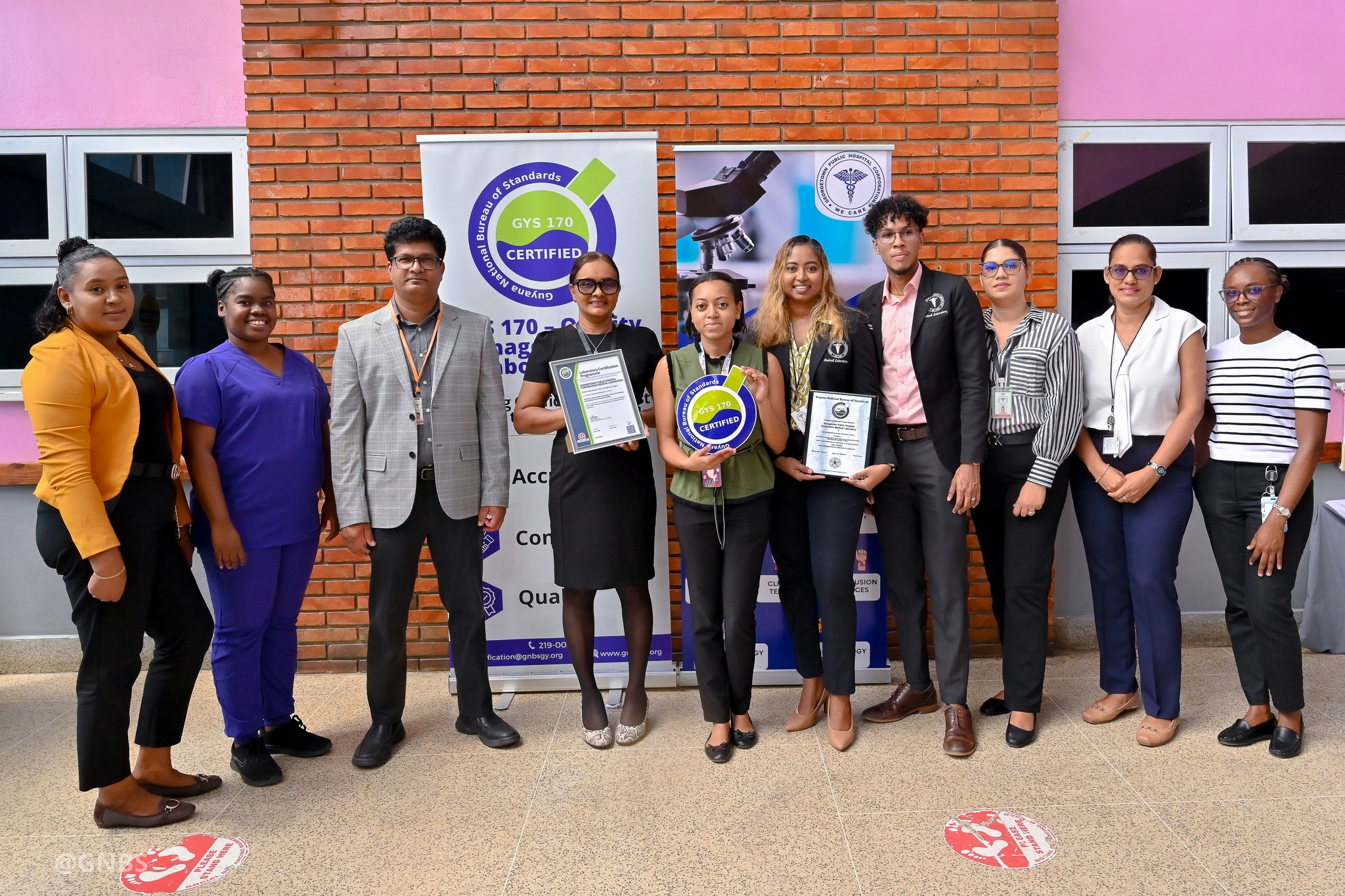
As Guyana continues to strengthen its healthcare system, accurate measurements remain essential for reliable laboratory results. The Guyana National Bureau of Standards (GNBS) provides calibration services to laboratories, ensuring that their instruments are accurate.
The Georgetown Public Hospital Corporation (GPHC) Medical Laboratory is one of several laboratories in Guyana certified to the National Standard, GYS 170:2021 – General Requirements for the Operation of a Laboratory, which requires the calibration of their measuring instruments.
The GPHC Medical Laboratory offers several specialised services, including andrology, biochemistry, immunology, immunohaematology, haematology, microbiology and urology, all of which require strict quality controls and precise measurements to ensure accurate and reliable results for patients and healthcare providers.
Quality Manager of GPHC Medical Laboratory, Adeila Melville, stated that continued certification by GNBS reflects the laboratory’s unwavering commitment to delivering reliable and traceable results.
“Maintaining our certification to the GYS 170:2021 standard is an exceptional achievement which shows our laboratory’s commitment to quality results and improved healthcare to the people of Guyana,” Melville shared.
She disclosed that for more than 18 years, the GPHC Medical Laboratory has relied on GNBS calibration services to ensure its equipment performs accurately and consistently. Among the equipment regularly calibrated by the GNBS are automated micropipettes, electronic balances and digital thermometres, which are calibrated every 6 months, annually and every two years.
In 2025 alone, the laboratory calibrated 34 automated pipettes, 12 digital thermometres, two electronic balances and one mechanical scale at the GNBS.

Melville explained that calibration plays a fundamental role in maintaining confidence in laboratory results, adding, “Regular calibration not only confirms the usability of a measuring device, but it also helps to determine whether that device is drifting out of tolerance, or requires adjustment. Overall, it ensures that all your measurements are accurate and reliable.”
She further emphasised that calibration ensures that the readings of equipment in use are comparable to recognised standards, ensuring that results remain traceable to international measurements and consistent over time, regardless of the user operating the equipment.
Melville noted that the impact of calibrated equipment extends directly to patient care, explaining that the calibrated balances are used to weigh blood products before transfusions are administered. This process is especially critical for neonates, who require blood products in precise proportions based on body mass.
“Inaccurate results can cause harm, especially to neonates who require proportional amounts of blood products to body mass,” Melville explained.
Calibrated balances are also essential for oral glucose tolerance tests used in diagnosing and managing diabetes, as well as for preparing microbiological culture media used to identify infections and determine appropriate antimicrobial therapy.
Micropipettes are used to measure blood samples and prepare quality control materials that verify analytical instruments are functioning correctly. Meanwhile, calibrated thermometers help ensure that laboratory reagents are stored at appropriate temperatures to prevent deterioration and inaccurate test results.
Melville highlighted that GNBS calibration services are not only important for daily laboratory operations but are also mandatory for maintaining certification under the GYS 170 Standard and for international accreditation under the International Organisation for Standardisation (ISO) 15189 Standard for medical laboratories.
Like calibration, the verification of measuring instruments by the GNBS extends beyond measuring equipment used in the GPHC laboratory. Melville underscored the significance of verifying scales used to weigh patients in the healthcare facility.
“This verification process is very important to ensure that medication given to patients is accurate, since the weight of a patient is used to calculate dosage,” she said. “For neonates and paediatric patients, a verified scale means accurate measurement; an unverified scale can (adversely) impact the life of the patient.”
The GPHC Quality Manager also praised the GNBS for its support through training programmes, consultation and certification services over the years.
“The support received from the GNBS has propelled the laboratory to the forefront of public hospitals in Guyana,” she stated.
Melville said that GNBS can look to exploit additional opportunities to provide other calibration services within the health sector, particularly for humidity readers used in laboratories.
“I have been awaiting the calibration services of the humidity readers for a long time now, and I would be happy to see this service being offered by the GNBS,” she highlighted.
Melville encouraged laboratories and organisations to prioritise calibration, verification and conformance to standards. She advised that laboratories should not hesitate to contact the GNBS.
“Ensure that your devices are calibrated and verified. Contact the GNBS Legal and Industrial Metrology Departments and speak with a staff member; they are eager to help support your journey,” she advised.
With more medical and testing laboratories across Guyana continuing to implement national and international standards, the GNBS anticipates the increased demand for its metrology services. In response, the Bureau will continue to deliver these services to ensure patients and healthcare providers benefit from reliable and quality diagnostic services across the health sector.