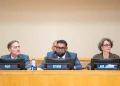
More than a year after the United Nations Human Rights Committee (UNHRC) called on the Government of Guyana to investigate serious allegations of corruption and extrajudicial killings, no substantive action has been taken, raising concerns about democratic backsliding and governance failures in the oil rich South American nation.
During a 2024 review, UNHRC officials questioned Minister of Governance Gail Teixeira about the government’s failure to initiate an independent probe into allegations against former President Bharrat Jagdeo. Her response was widely criticized by civil society groups as evasive and indicative of a broader reluctance to pursue accountability at the highest levels of government.
The UN’s concerns were echoed by international observers and watchdog organisations, including Transparency International, whose most recent rankings placed Guyana as the most corrupt English speaking country in the Caribbean. The damning designation comes amid growing fears about the management of oil revenues, delays in parliamentary oversight, and allegations of misuse of state resources during recent elections.
A 2023 investigative report by VICE News revealed alleged financial misconduct linked to Jagdeo, currently serving as Vice President under President Irfaan Ali. The exposé detailed questionable transactions through intermediaries and captured Jagdeo in compromising discussions related to potential corrupt deals. Despite widespread coverage and calls for inquiry, the ruling People’s Progressive Party (PPP) has dismissed the allegations and publicly defended its senior official.
At the same time, critics say governance standards continue to deteriorate. The delayed opening of Parliament has effectively stalled the work of the Public Accounts Committee, one of the primary bodies tasked with scrutinizing government spending. Civil society groups argue this has undermined transparency and accountability at a time when public trust is already fragile.
“The Parliament’s delay is not just a procedural matter. It is an obstruction of democratic oversight,” said one civil society advocate who asked not to be named due to fears of political retaliation.
Concerns have also been raised over the distribution of government cash grants, with little public disclosure about the selection process or financial tracking. Opposition figures have accused the administration of using these grants as political tools in the lead up to the September 1 General and Regional elections, which were also marred by allegations of state resources being deployed to benefit the ruling party.
These allegations were further validated by The Carter Center, which observed the 2025 elections and flagged significant concerns about campaign financing and the abuse of state resources. In its pre election statement, the Center noted that Guyana’s campaign finance system “continues to lack transparency,” with no meaningful regulation of donations or spending and no mechanisms to ensure public accountability before election day. It also highlighted the absence of enforcement around financial disclosures, despite existing requirements under the Representation of the People Act.
The Carter Center further warned that the “use of public resources including state media, vehicles, and temporary public workers gave the ruling party a clear and unfair advantage,” describing these practices as inconsistent with Guyana’s international obligations on campaign finance standards.
“The use of public funds and assets in a partisan campaign effort erodes public trust and violates the principle of fair competition in elections,” said an election observer based in Georgetown.
The government has denied all accusations of wrongdoing, maintaining that its actions are consistent with the law and intended to support citizens and development. However, public sector agitation, particularly among teachers and public servants demanding higher wages, has intensified scrutiny over how national resources are being managed.
Meanwhile, concerns continue to grow around the country’s rapidly expanding oil and gas sector. Since first oil in late 2019, Guyana has earned approximately US$7.5 billion in oil revenues from sales and royalties as of September 2025. In 2024 alone, the country generated around US$2.5 billion, reflecting the growing scale of production. These figures are expected to increase significantly in the coming years as output continues to expand.
With billions of dollars in projected earnings, transparency advocates say the lack of independent audits and full disclosure of production sharing agreements pose long term risks to both the economy and public interest.
The lack of action in the face of serious allegations, combined with weakened oversight and growing concerns over state resource misuse, signals a deepening threat to Guyana’s democratic institutions. In an environment where checks and balances are sidelined, the rule of law becomes increasingly fragile, and the fundamental rights of citizens to fair governance, transparency, and justice risk being systematically eroded. Analysts warn that without credible, independent intervention, the country may face a steady decline into authoritarian practices under the guise of democratic rule.