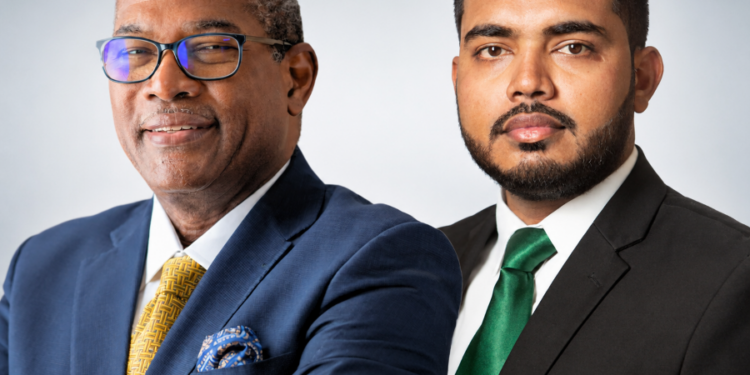
Guyana is changing at a speed its institutions may not be equipped to fully understand, as oil-driven economic growth reshapes communities, the labour market, infrastructure and emerging industries. Against that backdrop, educator and STEMGuyana Executive Director Dr. Karen Abrams is urging greater research into how the transformation is affecting the lives of Guyanese.
Writing in the Kaieteur News on September 13, under the headline “Who Is Studying Guyana?”, Abrams argued that economic growth figures alone cannot provide government with the information needed to plan effectively for the country’s future.
“In a country changing this quickly, governing by instinct is no longer good enough.”
Guyana closely tracks GDP, oil production, inflation and trade. Abrams questions whether comparable attention is being paid to the country’s social conditions—population growth, education, health, migration, poverty, skills and access to economic opportunities.
The issue is becoming more pressing as Guyana undergoes a dramatic demographic and economic transformation. The 2022 Census recorded a population of 878,674, while subsequent estimates indicate continued growth amid increased migration and expanding economic activity.
Abrams argues that better social data are also necessary to determine whether the benefits of development are being broadly shared in Guyana’s ethnically diverse society.
Among the questions she raises are whether government-supported business loans, scholarships, state land, contracts, homeownership and business ownership are reaching different sections of the population equitably. She acknowledges that ethnicity may not always be recorded and that privacy must be protected, but questions how inclusion can be objectively assessed without measuring outcomes.
“How does a multi-ethnic society objectively determine whether development is inclusive if it does not measure outcomes?”
Education, she argues, presents another major gap.
Abrams questions how many Grade Two children are meeting expected standards in reading and mathematics, how many catch up by Grade Four, whether differences among regions and schools are narrowing, and whether assessment findings are being used to shape policy.
She also calls for clearer measurement of publicly funded programmes, including the Guyana Digital School and the Board of Industrial Training. Among the questions are how many people participate and complete the programmes, gain certification and subsequently secure employment.
Health data, she suggests, demonstrate even more clearly why such research matters.
Abrams cites a 2026 study by Diana Elizabeth Khan and Paul Abiodun Olaiya, based on 8,822 Guyana National Cancer Registry records covering 2015 to 2024. Registered cancer cases increased from 525 in 2015 to 1,635 in 2024.
The researchers caution that the increase does not necessarily mean cancer incidence tripled, as improved identification and registration could account for part of the rise.
The study nevertheless found an overall case-fatality rate of 53.8 per cent. Prostate cancer was the leading cancer among men, while breast cancer was the leading cancer among women, followed by cervical cancer.
The study also identified significant data gaps. Cancer stage was unknown in 73.6 per cent of the records, while 19 per cent had missing or unusable regional information.
For Abrams, such limitations make it more difficult to determine where health problems are concentrated, whether early detection is improving and whether interventions are producing results.
She argues that Guyana already generates large amounts of information through schools, hospitals, businesses, taxation, migration, births and deaths. With appropriate privacy safeguards, she says, aggregated and anonymised administrative records could become an important national research resource.
The broader issue, Abrams maintains, is not simply the collection of more data but the country’s ability to convert information into knowledge that improves policy, planning and public accountability.
“We should be measuring Guyana while Guyana is changing.”
She is calling on government agencies, universities, independent researchers and the private sector to study the country’s transformation while it is taking place, rather than leaving future researchers to reconstruct this period from newspaper reports, political speeches and personal memories.
Guyana already knows how much oil it is producing and how rapidly its economy is expanding. Abrams is urging the country to apply the same level of attention to what that transformation is doing to education, health, poverty, migration, wages, housing, entrepreneurship and social mobility.