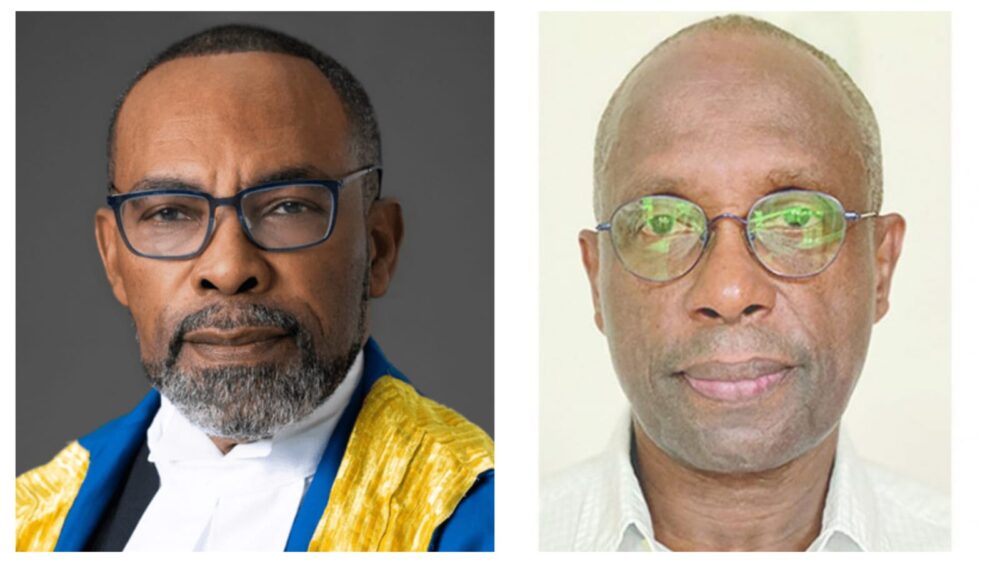
Former People’s Progressive Party (PPP) government minister and political scientist Dr. Henry Jeffrey is accusing Caribbean Court of Justice (CCJ) President Justice Winston Anderson of intervening in Guyana’s judicial affairs in a manner that, rather than strengthening judicial independence, has “enhanced the power of the ruling autocracy” over the justice system.
In his August 16, 2026 “Future Note” column in Village Voice News, Jeffrey argues that Anderson’s intervention in the prolonged dispute surrounding Guyana’s judicial leadership went too far and may have deepened an existing constitutional weakness.
At the centre of the problem is Guyana’s failure over many years to secure substantive appointments to the positions of Chancellor of the Judiciary and Chief Justice. Under the Constitution, the President and Leader of the Opposition must agree on the appointments, a requirement that has contributed to prolonged deadlock.
Jeffrey argues that a mechanism intended to encourage political consensus has instead left critical judicial offices operating in acting capacities and weakened the separation of powers.
He places the dispute within Guyana’s broader history of political and ethnic conflict, arguing that constitutional reforms adopted after the political upheavals of the 1990s failed to address the country’s fundamental winner-takes-all political structure.
Jeffrey recalls that the PPP, in a 2003 policy document, described the post-reform Constitution as among the most inclusive in the Caribbean and the world. He now argues that such claims overlooked whether the constitutional framework was actually capable of delivering stable and independent governance.
“It should not take much intelligence to recognise that constitutions are not good in themselves: they are expected to bring peace, good governance and development and thus must be properly aligned with their context.”
Jeffrey points to the prolonged judicial appointment deadlock as evidence of that failure.
“For 17 years of its 21 years of existence clauses in this ‘most advanced’ constitution have prevented Guyana from having a confirmed Chancellor and Chief Justice thus undermining the separation of powers and facilitating the delivery of tainted justice to the Guyanese people.”
Anderson intervention under scrutiny
Jeffrey’s sharpest criticism is directed at Justice Anderson, whom he says intervened in Guyana’s judicial leadership dispute at precisely the point when the Government was increasingly comfortable exercising political power.
Jeffrey also references reports of serious internal disagreements at the CCJ involving Anderson and five of his six fellow judges. He argues that the highly public nature of the dispute raises questions about whether adequate institutional mechanisms exist to resolve disagreements within the region’s highest court.
“Firstly, the chaotic public way this quarrel has developed questions the appropriateness of the institutional arrangements that are in place to amicably put such matters to rest.”
At the same time, Jeffrey cautions against treating dissent among judges as inherently damaging.
“Secondly, among other things, the very existence of dissenting legal opinions can on occasion be useful brakes upon majority excesses and should not be discouraged.”
He says he is also awaiting the outcome of an investigation into the circumstances surrounding the timing and presentation of the CCJ’s final decision in the Azruddin Mohamed extradition case, asking what precisely was considered improper about the process.
Executive power versus judicial independence
Jeffrey frames the dispute as part of a much larger constitutional problem: whether Guyana’s institutions genuinely restrain executive authority.
He invokes the work of Montesquieu, whose doctrine of separation of powers sought to prevent excessive concentration of authority by dividing governmental power among separate branches.
Jeffrey argues that, in Guyana, that safeguard is largely theoretical.
“But constitutionally, the separation of powers in Guyana is a mere theoretical contraption: it does not in fact exist as the constitutional/legal arrangements allow the leader of the ruling party near absolute control over the three arms of government.”
He argues that the prolonged failure to confirm substantive judicial leaders has gone beyond a political inconvenience, creating greater room for executive influence over the judiciary.
Jeffrey accepts that presidents of the CCJ have a legitimate interest in urging Guyana’s political leaders to resolve the appointment impasse. He argues, however, that Anderson crossed the line between encouraging a constitutional resolution and intervening in a way that altered the balance of power.
According to Jeffrey, Anderson’s intervention helped persuade the previous Chancellor to relinquish the position, paving the way for the Government to make acting appointments rather than resolving the underlying constitutional disagreement.
Jeffrey argues that the consequence was precisely the opposite of what an institution committed to judicial independence should seek.
“Indeed, it was a step too far. For, if anything, Justice Anderson’s intervention has enhanced the power of the ruling autocracy over the justice system and resultantly over the entire society!”
Jeffrey’s warning extends beyond Anderson personally. His central concern is whether constitutional mechanisms designed to prevent executive overreach can, through deadlock, acting appointments and institutional intervention, end up producing the very concentration of power they were intended to prevent.
Jeffrey’s argument goes beyond the dispute over judicial appointments: it is a test of whether Guyana’s judiciary can remain an effective check on executive power in an increasingly dominant political system.