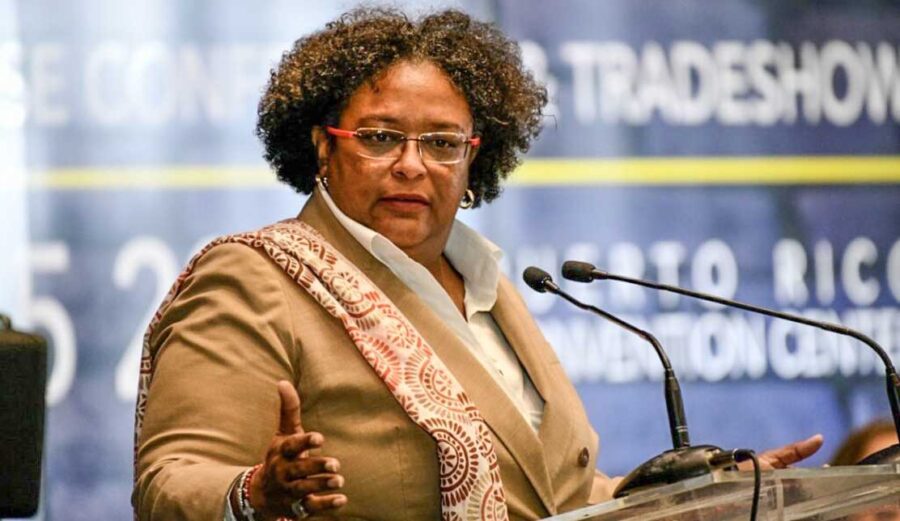
Barbados Prime Minister Mia Mottley has urged Caribbean businesses to accept lower profit margins on essential goods as part of a regional agreement designed to protect households struggling with the rising cost of living.
Addressing a high-level private sector session with key CARICOM stakeholders on Monday, Mottley proposed a formal compact between governments, businesses and labour that would keep the prices of basic food items, sanitary products and household essentials within the reach of ordinary families.
She argued that while businesses have a legitimate right to earn profits, they also have a social responsibility to ensure that necessities do not become unaffordable for the region’s most vulnerable citizens.
“Food, sanitary items and basic household goods cannot keep moving beyond the reach of ordinary families while others take every dollar they can get. There is room for profit, but there must also be room for conscience,” Mottley said.
The Barbadian leader called on the Caribbean to demonstrate that governments, employers and workers can unite during difficult economic periods to safeguard citizens from worsening financial pressures.
“The Caribbean must lead from the front on this. Keep faith with the people who built these societies. Prove that in difficult times, we still know how to stand together,” she told the gathering.
Mottley said Barbados has already implemented similar arrangements aimed at limiting price increases on essential products, noting that the approach has largely succeeded in shielding consumers from steep increases.
She stressed that the proposed regional compact would be limited to everyday necessities rather than luxury or premium products.
“There is no basis, and forgive me, but Massy cannot make BDS$49 million in profit in Barbados, and middle-class people can’t afford to buy food,” Mottley said.
“They could have made BDS$20 million in profit in these circumstances, and they would have been just as good, just as happy, and BDS$29 million would have been left in the pockets of the people who have to decide whether to eat today or not to eat.”
She clarified that businesses would not be expected to reduce margins on high-end goods.
“We’re not asking you to do it on cheeses and nuts and all these fancy things… We need to be able to make sure that we leave here with a common approach,” she said.
Mottley argued that adopting a uniform regional strategy would prevent companies from taking advantage of market conditions while contributing to greater social and economic stability.
“If there is a common approach, then invariably it becomes difficult for others to exploit the fact that you are prepared to offer on the table something back in order to ensure that we can sustain the journey, rather than you making extraordinary profits, but living in a society that you can’t protect yourself because your profits are going into security and other considerations,” she said.
As part of the initiative, Mottley proposed that governments, labour representatives and the private sector agree on a list of between 30 and 40 essential food, sanitary and cleaning products that would be covered under the regional compact.
“I hope that at the high level, we can agree on 30 or 40 items in terms of food, in terms of sanitary and cleaning items, that are essential for every family to be able to live in the Caribbean,” she said.
The proposal comes as Caribbean governments continue grappling with persistent inflation and the high cost of imported goods, which have placed increasing pressure on household budgets across the region. Mottley’s appeal seeks to balance commercial interests with the need to ensure that essential products remain affordable for Caribbean families.