Thursday, July 30, 2026
Village Voice News
ADVERTISEMENT
  • Home
  • News
  • Sports
  • Editorial
  • Letters
  • Global
  • Columns
    • Eye On Guyana
    • Hindsight
    • Lincoln Lewis Speaks
    • Future Notes
    • Blackout
    • From The Desk of Roysdale Forde SC
    • Diplomatic Speak
    • Mark’s Take
    • In the village
    • Mind Your Business
    • Bad & Bold
    • The Voice of Labour
    • The Herbal Section
    • Politics 101 with Dr. David Hinds
    • Talking Dollars & Making Sense
    • Book Review 
  • Education & Technology
  • E-Paper
  • Contact Us
No Result
View All Result
  • Home
  • News
  • Sports
  • Editorial
  • Letters
  • Global
  • Columns
    • Eye On Guyana
    • Hindsight
    • Lincoln Lewis Speaks
    • Future Notes
    • Blackout
    • From The Desk of Roysdale Forde SC
    • Diplomatic Speak
    • Mark’s Take
    • In the village
    • Mind Your Business
    • Bad & Bold
    • The Voice of Labour
    • The Herbal Section
    • Politics 101 with Dr. David Hinds
    • Talking Dollars & Making Sense
    • Book Review 
  • Education & Technology
  • E-Paper
  • Contact Us
No Result
View All Result
Village Voice News
No Result
View All Result
Home News

French Guiana becomes CARICOM’s eighth associate member

Admin by Admin
July 8, 2026
in News, Regional
0
SHARES
0
VIEWS
Share on FacebookShare on Twitter

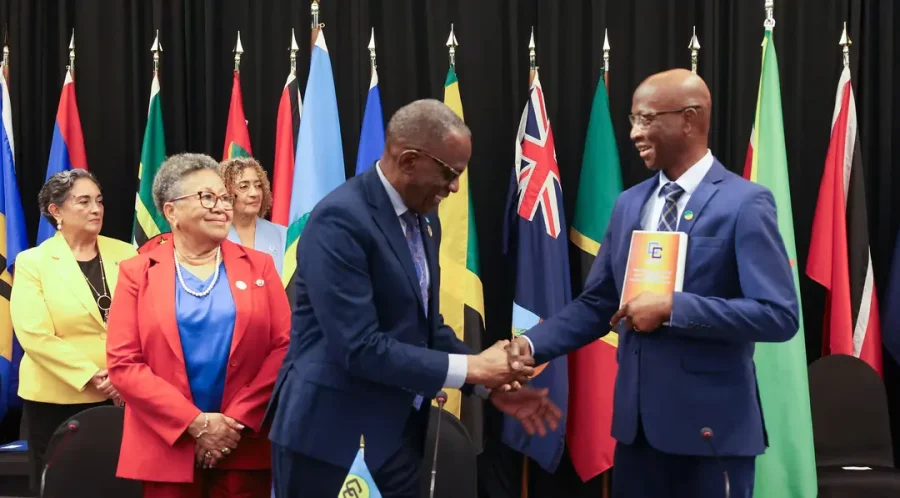
French Guiana has officially become the eighth associate member of the Caribbean Community (CARICOM), marking a significant expansion of the regional bloc as leaders gather in St. Lucia for the 51st Regular Meeting of the Conference of Heads of Government.

The agreement granting French Guiana associate membership was signed Tuesday by CARICOM Chairman and St. Lucian Prime Minister Philip J. Pierre and Gabriel Serville, president of the Territorial Collectivity of French Guiana.

READ ALSO

CCJ Rebukes Senior Government Officials Over Statements in Mohamed Extradition Case

BREAKING: No Working Life Rafts, No Distress Signals, No GPS – MV Barima Was a Doomed Voyage, Says TH&D Source

French Guiana has already begun participating in the regional summit, which is currently underway in St. Lucia.

Speaking at the signing ceremony, Pierre described the move as an important milestone in the continued evolution of CARICOM and the strengthening of ties across the wider Caribbean.

“The Caribbean has always been more than a grouping of islands and mainland territories,” Pierre said. “It is a community shaped by geography, history, culture, shared vulnerabilities and common aspirations.”

He said the agreement represents more than a legal or institutional step, calling it “a meaningful act of regional inclusion” that reflects CARICOM’s commitment to expanding cooperation throughout the region.

Pierre noted that French Guiana’s associate membership will create new opportunities for collaboration in several key areas, including regional development, trade and economic cooperation, climate resilience, border security, education, health, environmental protection, culture and people-to-people exchanges.

“As we prepare for the 51st Regular Meeting of the Conference of Heads of Government of CARICOM, this signing carries special significance,” Pierre said. “It signals our continued commitment to broadening engagement, strengthening relationships and ensuring that the Caribbean Community continues to adapt to the changing circumstances of our region.”

He also described regional integration as “a living process” that grows through expanded cooperation and stronger partnerships across the Caribbean.

Pierre thanked the CARICOM Secretariat, led by Secretary-General Dr. Carla Barnett, for advancing the membership process and also acknowledged the Government of France and representatives of French Guiana for their cooperation.

“Let this ceremony serve as a reminder that CARICOM continues to move forward,” he said. “We are not only preserving the achievements of regional integration; we are building upon them.”

Associate membership allows non-independent Caribbean territories to participate in CARICOM’s work and collaborate on matters of mutual interest, although they do not enjoy the full rights and obligations of the organisation’s 15 full member states.

With the addition of French Guiana, CARICOM now has eight associate members, further broadening the organisation’s engagement across the wider Caribbean.

caribbeannationalweekly.com
ShareTweetSendShareSend

Related Posts

News

CCJ Rebukes Senior Government Officials Over Statements in Mohamed Extradition Case

by Staff Writer
July 29, 2026

The Caribbean Court of Justice has sharply criticised statements made by senior Guyana Government officials during the extradition proceedings involving...

Read moreDetails
News

BREAKING: No Working Life Rafts, No Distress Signals, No GPS – MV Barima Was a Doomed Voyage, Says TH&D Source

by Staff Writer
July 29, 2026

A bombshell source from Guyana's Transport and Harbours Department (TH&D) has revealed that the ill-fated MV Barima was operating without...

Read moreDetails
Former Trinidad and Tobago prime minister Dr. Keith Rowley calls Prime Minister Kamla Persad-Bissessar "unpatriotic and recklessly incompetent".
Regional

Rowley calls for end to Trinidad and Tobago state of emergency, accuses government of abuse

by Admin
July 29, 2026

Former Prime Minister Dr. Keith Rowley on Tuesday called on the government to immediately end the country’s state of emergency...

Read moreDetails
Next Post
Barbados Prime Minister Mia Mottley

Mottley Calls on Caribbean Businesses to Cut Profits on Essentials to Ease Cost of Living


EDITOR'S PICK

Hope, Powell stay with defending champs as Rutherford joins Knight Riders for ILT20 2025

July 8, 2025
His Excellency President Dr Irfaan Ali described the St George’s School of Sciences as a pioneering step in reshaping Guyana’s educational landscape and as a “new model of education” tailored for the modern era.  The school, officially commissioned today in Georgetown, stands as the country’s first secondary institution solely dedicated to scientific education—an initiative, the President said, that promises to profoundly impact the academic and professional futures of Guyana’s youth.  “This is no ordinary school. It is a school of excellence, created for those with the hunger to learn and the commitment to achieve. Admission to this institution is not automatic—it is earned. Students must demonstrate strong competence in English, mathematics, and science, with marks that reflect discipline and potential.”  The school is equipped with smart classrooms featuring interactive boards, multimedia technology, and digital tools; state-of-the-art laboratories for science and information technology; and device-based learning whereby students will each receive a laptop, among other world-class facilities.  A new model of education  President Ali underscored that the school’s holistic curriculum marks a deliberate departure from the “narrow confines of rote learning”. Extended learning opportunities will be offered through tutorials, while students will also be required to participate in music, sport, foreign languages, technical and vocational education and training (TVET), and community service.  “We want to produce scientists with soul, technicians with talent, and leaders with compassion,” he stated.  “And let me emphasise—standards will be enforced. Students will be monitored for punctuality, attendance, and completion of assignments. Parents will be promptly notified of infractions. This school is not just about nurturing intelligence—it is about cultivating responsibility.”  The President highlighted the growing importance of STEM (Science, Technology, Engineering, and Mathematics) education in today’s rapidly evolving and technology-driven global economy.  “From climate change to artificial intelligence, from health to renewable energy, the challenges and opportunities of the 21st century demand problem-solvers who can think critically, analyse data, and innovate with purpose. In developing countries like Guyana, it is especially important, as it empowers young people to participate meaningfully in national development, close the digital divide, and compete on the global stage.”  He also emphasised that Guyana’s national transformation will require a new generation of scientific minds across sectors such as oil and gas, climate resilience, biotechnology, artificial intelligence, and healthcare.  “We need local talent to fill those roles. We need to train our children not just to get jobs—but to lead industries.”  President Ali further noted that his Government is currently building a national digital ecosystem that will connect classrooms, hospitals, government services, agriculture, commerce, and industry through the power of information and communication technology (ICT).  “As we roll out this system, we need to prepare our citizens for a digital future. We cannot do so unless science and technology assume greater importance within our education system. We need students to be equipped with the analytical skills, technical competencies, and creative mindset to thrive in a digitally connected and data-driven world. Without a strong grounding in science, we risk becoming consumers rather than creators in the digital age.”  He added that science education is a gateway to equality, teaching critical thinking, logic, and evidence-based decision-making.  “It empowers young people, especially those from marginalised communities, to challenge assumptions, solve real-world problems, and create innovative solutions.”  The Head of State added that while specialised learning is an idea long overdue in Guyana and represents a bold shift in the country’s academic approach, traditional schools, with their rigour and cultural legacy, will continue to serve as the bedrock of the nation’s education system.  He said that these traditional institutions must be complemented with specialised schools that focus on the arts and creative industries; agricultural science; engineering and robotics, and maritime studies and aviation technologies, among other areas.  “To all of Guyana, I wish to say that what was once a school reduced to ashes is now a symbol of resilience and reinvention.  Let the St George’s School of Sciences stand tall and vindicate the confidence which we have placed in its role as a torchbearer of the type of education system we are rolling out across Guyana.”  The school is equipped with 10 classrooms, five laboratories (three for science, one for IT and one for home economics), and other state-of-the-art amenities. It also has the capacity to house about 250 students.  Minister of Education, the Honourable Priya Manickchand, and other Government officials were also at the event.

St George’s School of Sciences represents new model of education—President Ali

July 2, 2025

Residents experiencing inconvenience due to halted road construction in BV/Triumph

August 30, 2023
L-R  are CCJ Registrar Gabrielle Figaro-Jones, President Justice Winston Anderson, and Administrative Officer Marlon Prince (APNU Facebook photo)

Judicial Reform in Focus as CCJ President Engages Guyanese Opposition

October 17, 2025

© 2024 Village Voice

No Result
View All Result
  • Home
  • News
  • Sports
  • Editorial
  • Letters
  • Global
  • Columns
    • Eye On Guyana
    • Hindsight
    • Lincoln Lewis Speaks
    • Future Notes
    • Blackout
    • From The Desk of Roysdale Forde SC
    • Diplomatic Speak
    • Mark’s Take
    • In the village
    • Mind Your Business
    • Bad & Bold
    • The Voice of Labour
    • The Herbal Section
    • Politics 101 with Dr. David Hinds
    • Talking Dollars & Making Sense
    • Book Review 
  • Education & Technology
  • E-Paper
  • Contact Us

© 2024 Village Voice