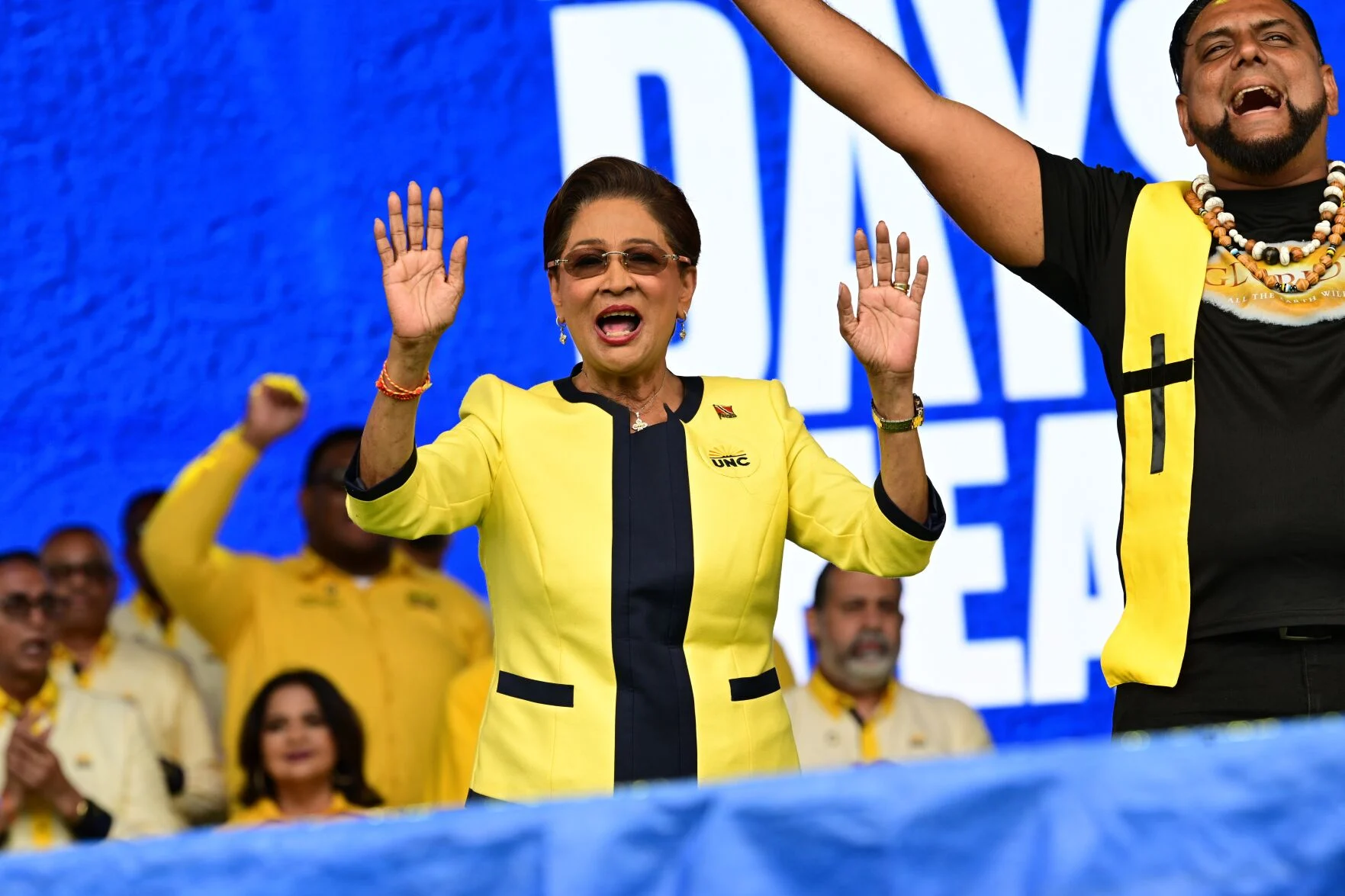
THE state of emergency (SoE) will be extended by another three months if this is recommended by the National Security Council, says Prime Minister Kamla Persad-Bissessar.
‘If advised by the Government’s National Security Council to extend the SoE, I will have no problem to do so,’ said Persad-Bissessar in response to questions from the Express yesterday.
The SoE took effect on March 3, 2026, and Parliament approved a three-month extension on March 13, 2026. It is expected to end in June 2026 unless the Government moves to extend it again before then.
Persad-Bissessar said there has been a decline in serious crime in 2025, and Trinidad and Tobago is on course for a reduced murder rate this year.
Asked how she would respond to critics who argue that the decrease in crime is a result of the SoE, Persad-Bissessar said: ‘Well, if they are saying that the decrease in crime is because of the SoE, that would mean the SoE is working. Therefore, logically, they shouldn’t be against it. Law-abiding citizens have no problem with the SoE, it’s just the political and race grifters, along with the criminals and their supporters, who are against it.’
The Prime Minister noted that in 2024, under the People’s National Movement (PNM), the country recorded its highest-ever murder toll-626.
She said 2025 has seen a major decline under the United National Congress (UNC), with 367 murders recorded, 259 fewer than in 2024.
It was the lowest annual figure since 2011, a span of 15 years, she noted.
‘This year, we are working hard to have less murders than 2025 and are on track to do so. There has also been a decrease in serious crimes this year compared to last year. I expect more success as we are adopting new technologies and are being assisted by the US to improve our anti-crime capabilities,’ she said.
Questioned about funding to strengthen the national security apparatus, Persad-Bissessar said after reviewing the existing system, it became clear that the country was not getting value for money.
She said the Government had also found that it was overpaying in many instances when equal or better options were available at lower cost. Further, she said the Government was ‘paying for outdated or unnecessary services and equipment’ and was ‘bounded to a small mafia of suppliers’.
She said that was why her administration sought assistance from the United States and would be receiving funding. ‘The costs would not be exorbitant,’ she assured. The Prime Minister reiterated that the crime problem cannot be fixed overnight but said gains are already being made in dismantling gangs and cutting off funding streams.
‘The end of the CEPEP and URP programmes helped cut funding of gangs, along with the American military presence in the region. The blowing up of drug boats coming to Trinidad from South America severely impacted gangs and drug trafficking business fronts here,’ she said.
Persad-Bissessar said the country’s economy is heavily influenced by illegal drug and illegal gambling money that is laundered through local businesses.
She said: ‘That’s why you suddenly saw some businesses struggling, closing or posting decreased revenue after the American military started taking out the drug supply into Trinidad.’
The National Security Council in Trinidad and Tobago is typically chaired by the Prime Minister and comprises key ministers and senior national security officials responsible for the country’s security and defence policy.
While the exact composition can vary depending on the administration and matters under discussion, the council generally includes: the Prime Minister, Attorney General, Minister of Homeland Security, Minister of Defence, Minister of Foreign and Caricom Affairs, Commissioner of Police, Chief of Defence Staff, director of the Strategic Services Agency (SSA), and other senior security and intelligence officials as required.
Trinidad Express