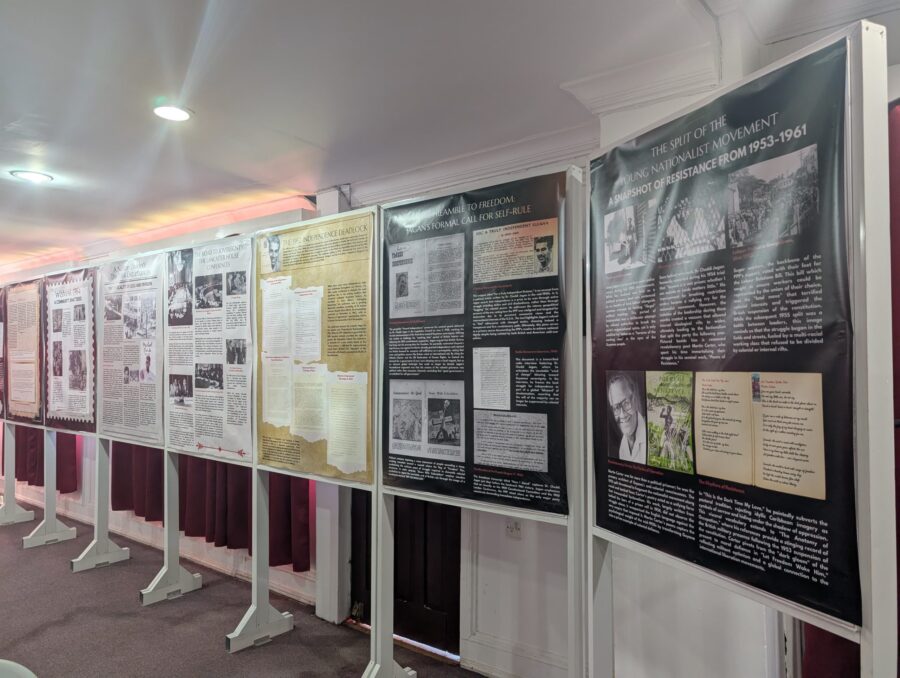
The Cheddi Jagan Research Centre (CJRC) on Monday launched a new exhibition marking Guyana’s 60th anniversary of Independence, offering visitors a glimpse into the political struggles, social movements and historic events that shaped the country’s journey from colonial rule to nationhood.
The exhibition, titled “Guyana at 60: Independence Exhibition,” opened at Red House in Kingston, Georgetown, as part of activities commemorating Guyana’s Diamond Jubilee celebrations.
The exhibition is free to the public and runs until May 29 at Red House, the headquarters of the Cheddi Jagan Research Centre. It is open Monday to Friday from 9:30 a.m. to 3:00 p.m.
A central feature of the exhibition is its exploration of the “Long Road to Independence,” tracing Guyana’s political evolution through the 1940s, 1950s and 1960s.
Through archival documents, photographs, films and historical records, visitors can examine key milestones, including the formation of the Political Affairs Committee (PAC), the emergence of the People’s Progressive Party (PPP), the suspension of the Constitution in 1953 and the turbulent events that preceded independence in 1966.
The exhibition also highlights the role of the late Dr. Cheddi Jagan, one of Guyana’s most influential political figures and a leading advocate for self-government. Jagan co-founded the PPP in 1950 and became the country’s first Chief Minister after the party’s historic victory in the 1953 elections. His administration was removed after just 133 days when the British colonial government suspended the Constitution amid Cold War concerns. Jagan later returned to office as President in 1992, serving until his death in 1997.
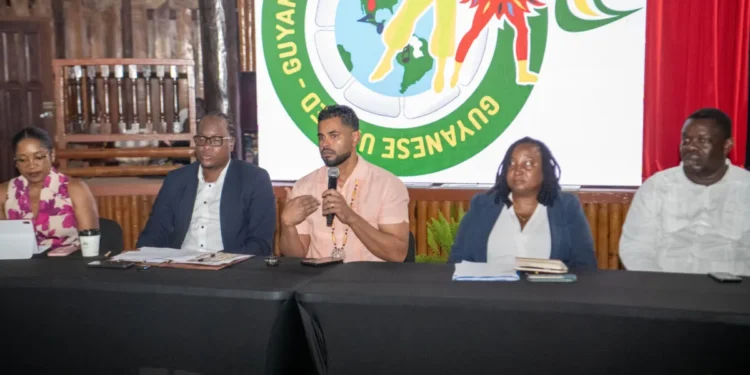
Speaking at the opening ceremony, Women’s Progressive Organisation Administrator Indranie Chandarpal said the exhibition offers an opportunity for Guyanese to reflect on the sacrifices that led to independence and the importance of national unity.
Drawing parallels between Guyana’s national motto, “One People, One Nation, One Destiny,” and the government’s current “One Guyana” initiative, Chandarpal said the country must continue striving for unity while remembering the hardships endured in the struggle for self-determination.
“There comes a time when people understand that we have to keep fighting for what we believe in. We have to heal and work together as one,” Chandarpal said.
Former President Donald Ramotar, who delivered the feature address, described Guyana’s independence as the culmination of centuries of resistance against oppression.
“The winning of Independence in 1966 was the continuation of a long struggle in our country,” Ramotar said.
He traced the roots of that struggle to the 1763 Berbice Slave Rebellion led by national hero Cuffy, noting that the quest for freedom and self-determination spanned generations before culminating in independence.
Ramotar also reflected on attempts throughout Guyana’s history to divide the independence movement along racial lines, arguing that national unity remains essential to fulfilling the aspirations of those who fought for self-government.
The exhibition was curated by Amrita Naraine, founder of Artellica AI and a specialist in data science and artificial intelligence for creative industries.
CJRC Chairman Hydar Ally encouraged members of the public to visit, noting that the collection of archival films, rare photographs and academic research on display provides valuable insight into Guyana’s post-war political and social development and the struggles that ultimately led to independence.