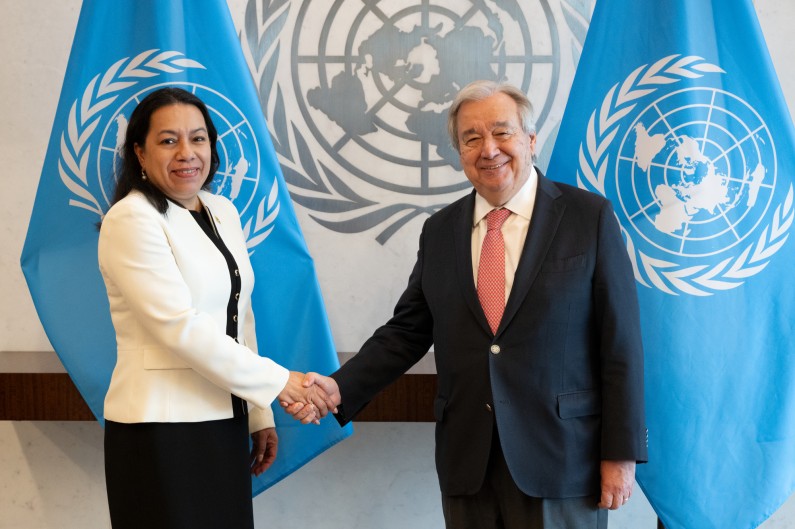
Guyana has taken over the Presidency of the United Nations Security Council for the month of June. Ambassador Carolyn Rodrigues-Birkett, Guyana’s Permanent Representative to the United Nations, will lead the Council’s activities throughout the month, with a strong emphasis on global security matters.
According to a release issued yesterday by the Ministry of Foreign Affairs and International Cooperation, the Council’s June agenda includes a series of mandated meetings on ongoing conflicts in Syria, the Democratic Republic of Congo, Iraq, Afghanistan, Sudan, Libya, and Yemen. A mandated session on Resolution 2334, which addresses Israeli settlements in Palestinian territories, is also scheduled.
President Irfaan Ali is expected to chair a High-Level Open Debate on Poverty, Underdevelopment and Conflict, which will feature briefings from representatives of the United Nations System and the African Union.
The Ministry noted that the debate aims to expand on earlier discussions within the Council regarding the link between sustainable development and international peace and security. The session comes at a time of increasing armed conflicts and a lag in progress toward achieving the Sustainable Development Goals (SDGs) by 2030.
Guyana will also host the annual Open Debate on Children and Armed Conflict later this month, with expected briefings from Special Representatives of the UN Secretary-General focused on this issue.
Additionally, the Ministry stated that Guyana intends to steer the Council’s focus toward several of its priority areas, including conflict prevention, the link between security and development, the effects of climate change on peace and security, the protection of children in armed conflict, and the Women, Peace and Security agenda.
Guyana is currently serving a two-year term on the Security Council as a non-permanent member from January 2024 to December 2026. This marks the country’s third time serving on the Council, with previous terms in 1975–1976 and 1982–1983.
The UN Security Council comprises 15 members, including five permanent members—China, France, Russia, the United Kingdom, and the United States—each of whom holds veto power over Council decisions.