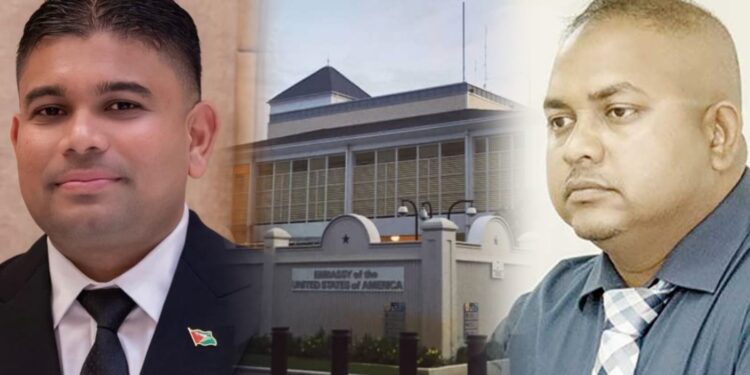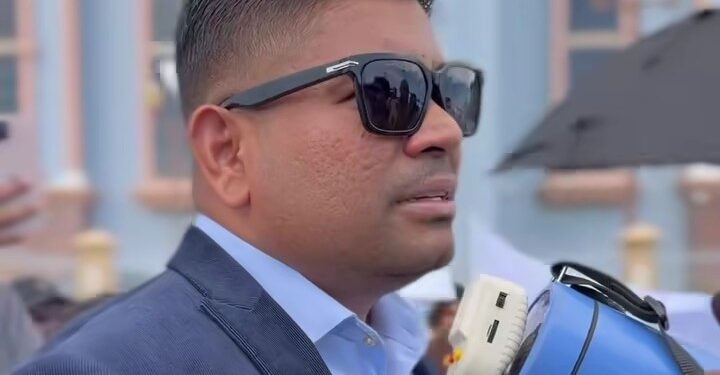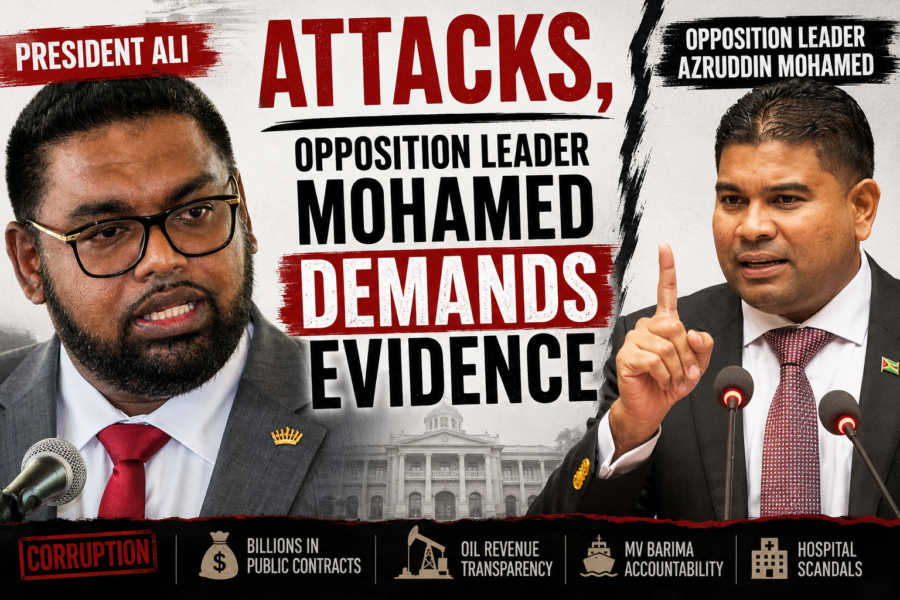
President Irfaan Ali and Opposition Leader Azruddin Mohamed have become locked in a fierce public confrontation over corruption, credibility and the use of public office, with Mohamed challenging the President to produce evidence against him rather than attack his credibility.
The exchange began at Ali’s press conference on Tuesday, where the President responded to corruption allegations levelled against his administration by questioning the standing of the person making them.
“When you speak about corruption, you’re talking about someone with allegations, who are making these allegations, the person who is making the allegation has himself indictment by the U.S. I don’t see this being highlighted. He himself having allegations of murder. He himself having allegations of robbing the country and its taxpayers hundreds of billions of dollars. So, in any fair system, credibility is important. How credible is the person that is making the allegation? How credible are the allegations when you speak about corruption?”
Mohamed, the Leader of the Opposition and head of the We Invest In Nationhood (WIN) party, responded the following morning, turning Ali’s credibility argument back on the President.
“When did you know I was a criminal? Was it when you were collecting my money? Was it when you rolled around in my bulletproof vehicles? When you sprawled off, enjoying life in my armoured vehicle, because you were scared?”
He continued:
“Did I become a criminal only when I became your political opponent? And if you have evidence that I’m a criminal, why are you withholding it from the state? You too should be charged in that case. Take it to the police, go to court.”
Mohamed challenges President
The confrontation comes as Mohamed continues to make allegations concerning Government contracts, the oil sector, public hospitals and the President’s reported farm.
Mohamed said Ali was avoiding the substance of those allegations by focusing on his legal troubles.
“Address the message, not the messenger. If what I said about your farm is false, prove it. If what I said about your government is false, prove it. If what I said about the contracts, the hospitals, the oil and gas sector, and the treatment of the Guyanese people is false, prove it. Do not attack me and ignore the matter at hand.”
The exchange is particularly charged because Mohamed himself faces serious allegations in the United States. A US federal indictment alleges that he and his father, Nazar Mohamed, participated in schemes involving gold exports, tax evasion, wire fraud and money laundering. US prosecutors allege that more than 10,000 kilograms of gold were involved and that the alleged scheme caused approximately US$50 million in losses to the Guyanese Government. These are allegations and have not been adjudicated at trial.
The United States Treasury had previously sanctioned the Mohameds in 2024, alleging corruption linked to gold exports and the under-declaration of more than 10,000 kilograms of gold.
Mohamed, however, challenged the Government’s repeated reference to G$191 billion, saying the figure should not be presented as though it were the amount in the US indictment.
“The president and his minions keep throwing around the figure of 191 billion in alleged tax evasion. Where did that figure come from? Where? The reported U.S. alleged indictment figure is 50 million, which is Guyana dollars 10 billion. So where did this 191 billion come from? Do not manufacture figures and use the office of the president to repeat them as political ammunition.”
Contracts, MV Barima and Accountability
Mohamed also broadened his attack to Government’s handling of major public contracts and the MV Barima disaster.
He renewed calls for the removal of Public Works Minister Juan Edghill and Minister of Public Utilities and Aviation Deodat Indar while the circumstances surrounding the July 18 sinking are investigated.
Opposition parties have previously made the same demand, with protests in Parliament and outside the National Assembly calling for the ministers to resign.
“If the investigation is supposed to be impartial, then those who may be implicated in the circumstances being investigated should not remain in positions where they can influence the process. That is basic common sense.”
The Barima disaster claimed at least 73 confirmed lives, while authorities reported 76 survivors and 30 people still missing as of July 27.
Mohamed also questioned the Government’s handling of major hospital projects involving VAMED Engineering, pointing to the company’s disputes with the Government over hospital construction and financing.
“Where was the due diligence? Where were the background checks?”
The Government has maintained that the Barima inquiry will establish the facts and that it intends to pursue a full investigation.
A broader fight over public accountability
At the heart of the escalating exchange is a fundamental question: when allegations of corruption are made, should the response be to challenge the accuser’s credibility—or to produce evidence addressing the allegations themselves?
Mohamed ended his response with a direct challenge:
“The president can call me whatever he wants. He can call me a criminal. He could question my credibility. He can send his trolls after me. He can use the machinery of the PPP to attack me. But none of that answers the questions.”
“Where is the evidence? What is the size of the farm? When will Edghill and Indar be fired? When can we expect the hospitals to be fully operational? Where is the urgency for the families of the Barima victims? Where is the preparedness for oil and gas? Where are the answers on these multibillion-dollar contracts? This is what the Guyanese people want to know.”