The Government’s National Consultation on Social Media and its Consequential Effects on Children begins from a proposition few would dispute: children should be protected from harm. But beneath the consultation lies a more fundamental question that has received far less attention. Is Guyana confronting the same social media reality as wealthy developed nations, or is it importing concerns, assumptions and policy prescriptions from societies that bear little resemblance to its own? The question deserves examination, particularly as the consultation process moves forward.
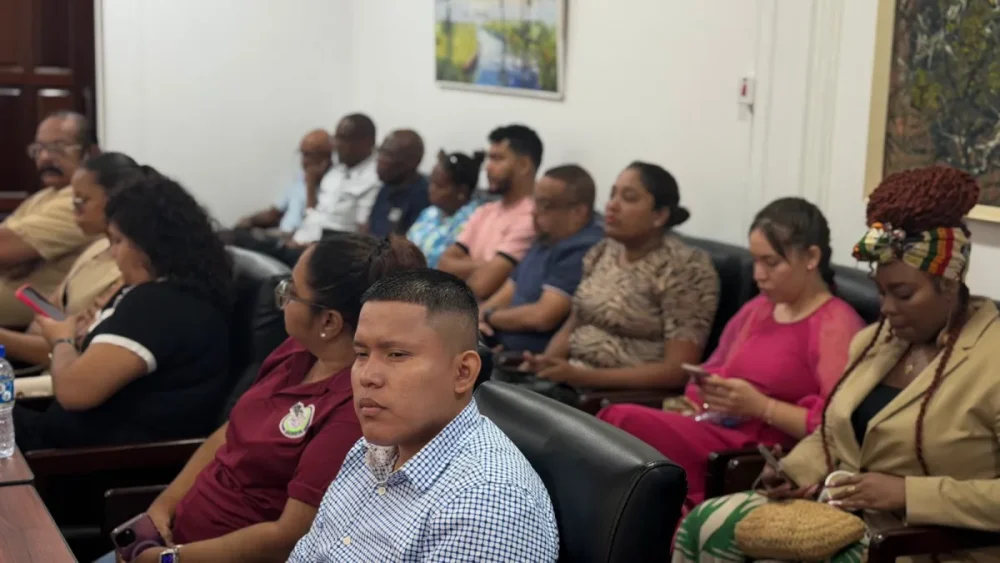
On Saturday, the Department of Public Information hosted a stakeholder engagement with media practitioners at the Office of the Prime Minister. The exercise, led by Minister within the Office of the Prime Minister with responsibility for Public Affairs, Kwame McCoy, formed part of the Government’s ongoing National Consultation on Social Media and its Consequential Effects on Children.
This publication– Village Voice News– was not invited to participate. That omission raises its own questions. A meaningful national consultation should seek out diverse viewpoints, particularly those willing to challenge prevailing assumptions and test the evidence underlying policy proposals. Complex issues require rigorous scrutiny, not merely consensus-building among like-minded participants.
At the heart of the consultation appears to be a concern that children are spending too much time online and are being exposed to harmful content through social media platforms.
In the United States, Canada, Britain and other developed nations, such concerns are understandable. Most children in those societies have personal smartphones. Many possess tablets, laptops, gaming consoles and uninterrupted broadband internet. They spend hours navigating YouTube, TikTok, Instagram, Snapchat, Netflix and Disney+. They play sophisticated online games such as Fortnite, Roblox, Minecraft, Call of Duty and EA Sports FC. Their challenge is often one of digital abundance.
Guyana’s reality is fundamentally different. Despite being classified as a high-income country due to its oil revenues, large sections of the population continue to experience conditions more commonly associated with developing societies.
According to a 2025 report by the Inter-American Development Bank (IDB), approximately 58 percent of Guyanese live in poverty and 32 percent live in extreme poverty. Local economists and social commentators have argued that the real figures may be even higher, pointing to escalating food prices, housing costs and the widening gap between official economic statistics and everyday living conditions.
The disparity cannot be ignored.
Whereas Guyana is simultaneously one of the world’s fastest-growing economies it is country where many families still struggle to afford basic necessities. Frequent power outages remain a recurring reality. Many households cannot afford multiple digital devices. Internet subscriptions and mobile data plans represent significant expenses. Children often rely on a parent’s phone to complete school assignments, access educational resources or communicate with teachers.
In numerous households there is one device serving an entire family. That reality alone raises questions about the premise underlying concerns over excessive digital access. How does a child become addicted to a smartphone they do not own? How does a family limit screen time when access is already limited by affordability, availability and infrastructure? These questions are rarely addressed in public discussions.
The comparison with developed countries becomes even more revealing when examining the broader social environment.
A child in Toronto, London or New York often lives in a society equipped with libraries, community centres, after-school programmes, sports facilities, mental health services and well-funded schools. Digital literacy programmes are integrated into education systems. Parents frequently have access to monitoring tools and support services.
Many Guyanese children face a different set of challenges altogether: overcrowded classrooms, transportation difficulties, household economic insecurity, limited recreational opportunities and uneven access to technology.
The issue, therefore, may not be excessive access but unequal access. This distinction matters because different problems require different solutions.
If the concern is genuinely about protecting children, then the discussion should extend beyond restrictions and examine digital literacy, parental education, cyber safety training and access to age-appropriate content. Questions should also be asked about whether resources would be better spent ensuring that every child has access to a device for educational purposes, affordable internet connectivity, reliable electricity, community learning centres and stronger parental support systems.
Yet another dimension of the discussion remains largely absent from the national conversation: the influence of adult behaviour itself.
If society is concerned about the harmful effects of media on children, then the discussion cannot be confined to social media alone. It must also include mainstream media and the conduct routinely displayed by political leaders, public officials and other authority figures.
Children do not learn exclusively from TikTok, Facebook, Instagram or YouTube. They also learn by observing adults.
They watch political leaders on television. They listen to speeches. They observe how public officials treat those with whom they disagree. They hear the language used in political campaigns and public debates.
When children witness political leaders insulting opponents, ridiculing critics, encouraging supporters to ostracise or chase political rivals from communities, or engaging in conduct that promotes division and hostility, they are observing behaviours that closely resemble many of the forms of bullying society claims to be combating online.
What lesson is being taught when adults condemn cyberbullying while simultaneously engaging in public humiliation, verbal attacks and exclusionary conduct?
What message is sent when children are told to respect diversity and tolerance while they watch political figures treat dissent as something to be punished rather than respected?
Research in child development has long established that children model behaviours displayed by authority figures. If Guyana is serious about addressing harmful influences on young people, then scrutiny must extend beyond social media algorithms and encompass the broader culture being modelled by adults.
Otherwise, society risks regulating the behaviour of children while ignoring the examples being set by those in positions of power.
The consultation also raises broader concerns about communication and information.
Historically, governments around the world have often justified restrictions on communications technologies in the name of public welfare, morality or public safety. Sometimes those interventions were necessary. In other cases, they evolved into mechanisms that restricted access to information and narrowed public discourse.
In Guyana’s deeply polarised political environment, such concerns cannot simply be dismissed.
Social media has become one of the few spaces where ordinary citizens can challenge official narratives, access alternative viewpoints and participate in national conversations without relying on traditional gatekeepers. Consequently, proposals affecting digital communications inevitably invite scrutiny.
Many Guyanese will want assurances that initiatives framed as child-protection measures will not eventually evolve into mechanisms that affect broader communication, access to information or freedom of expression. They will also want evidence that the policies being contemplated are grounded in Guyana’s realities rather than borrowed from societies facing very different challenges.
Those concerns do not negate the need to protect children. They simply demand transparency, evidence and public accountability.
The danger lies in treating Guyana as though it faces the same digital realities as wealthy Western societies. The child endlessly scrolling through multiple devices in a suburban North American household presents one challenge. The child waiting for a parent to return home with the family’s only smartphone presents another. One problem emerges from abundance. The other emerges from scarcity.
As the consultation continues, policymakers would do well to determine which problem Guyana is actually trying to solve. Otherwise, there is a risk that a country still grappling with widespread poverty, limited digital access and uneven infrastructure may adopt solutions designed for circumstances that do not exist here. And in doing so, it may end up solving the wrong problem entirely.