

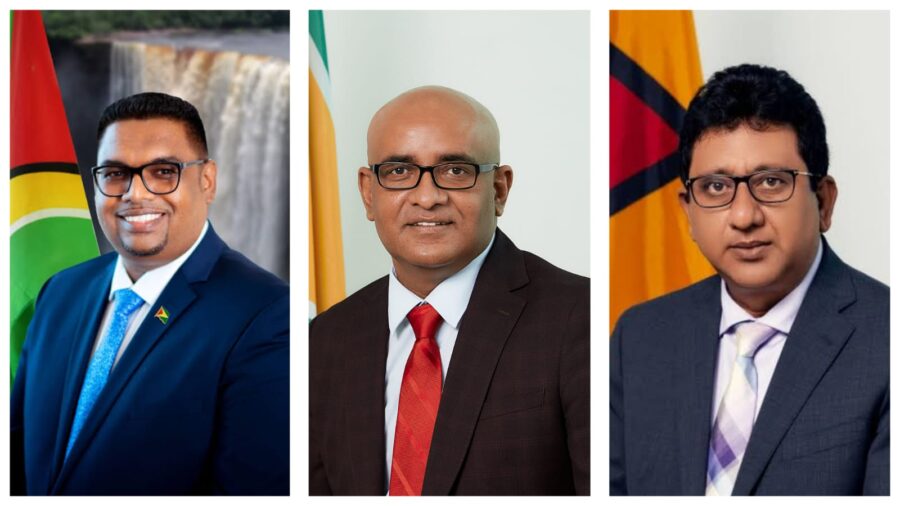
Guyana’s continued slide on the global press freedom index has drawn sharp criticism of the country’s political leadership, with social commentator GHK Lall warning that actions by President Irfaan Ali, Vice President Bharrat Jagdeo and Attorney General Anil Nandlall are constricting the space for free expression.
Writing in Village Voice News, Lall declared that press freedom in Guyana has been “hijacked,” linking the country’s deteriorating standing directly to political conduct and state practices.
“Press freedom in Guyana is once again in the headlines, the consciousness of Guyanese. It’s time to raise the cudgels several decibels,” he wrote.
The latest Reporters Without Borders (RSF) World Press Freedom Index shows Guyana slipping in global rankings, with concerns over media independence, political pressure, and the use of state resources to influence coverage—issues Lall argues are no longer isolated.
He pointed to President Ali’s insistence on “constructive criticism” as an early signal of narrowing tolerance for dissent.
“During his first turn at the wheel, it was Pres Ali who immersed himself in political sanctimonies, while railing against criticism,” Lall wrote, asking: “By what divine right of presidents did Excellency Ali seize for himself the moral authority to impinge on what acceptable criticism is…?”
Lall also highlighted the use of state advertising, suggesting it has been leveraged to sideline critical voices. Referring to the experience of the Stabroek News, he wrote: “Then came the kiss of death, a Jagdeo special… not chopping off of ads, but eliminating, through clever non-dispersal of tens of millions in ad payments.”
Such practices, long flagged by media advocates, raise concerns about indirect financial pressure on independent outlets. Lall further suggested that individuals who speak out have been singled out, contributing to a climate where criticism carries consequences.
Turning to the legal framework, he questioned the basis for what he described as government overreach, referencing Attorney General Nandlall.
“I am still trying to figure out the legal equation, the constitutional formula… that Minister of Law, Order, and PPP Justice, Mr. Anil Nandlall, employs as the basis for this overreach,” he wrote.
While the government has consistently maintained that it respects press freedom, Lall argued that its actions contradict those claims.
“Notwithstanding the foregoing, the Ali-Jagdeo-Nandlall government insists that it cherishes press freedom,” he wrote, adding that “press freedoms… are matters of principle; neither leadership luxuries nor benevolence.”
The issue arises at a time when Guyana is experiencing rapid economic growth and heightened scrutiny over governance and accountability. Analysts have noted that a strong, independent media sector is essential in such a context to ensure transparency and public trust.
Lall warned that restricting dissent carries inherent risks, stating that “those who labored to narrow the boundaries of argument and dissent have invariably self-destructed.”
With Guyana’s global press freedom ranking continuing to decline, the concerns raised have intensified calls for safeguards to protect independent journalism and uphold constitutional freedoms, placing the state of free expression firmly at the centre of the national conversation.



![European Commission President Ursula von der Leyen wears a mask after giving a statement on the outcome of the Brexit negotiations, in Brussels, Belgium [Francisco Seco/Pool via Reuters]](https://villagevoicenews.com/wp-content/uploads/2020/12/uk-eu-1.jpg)
