

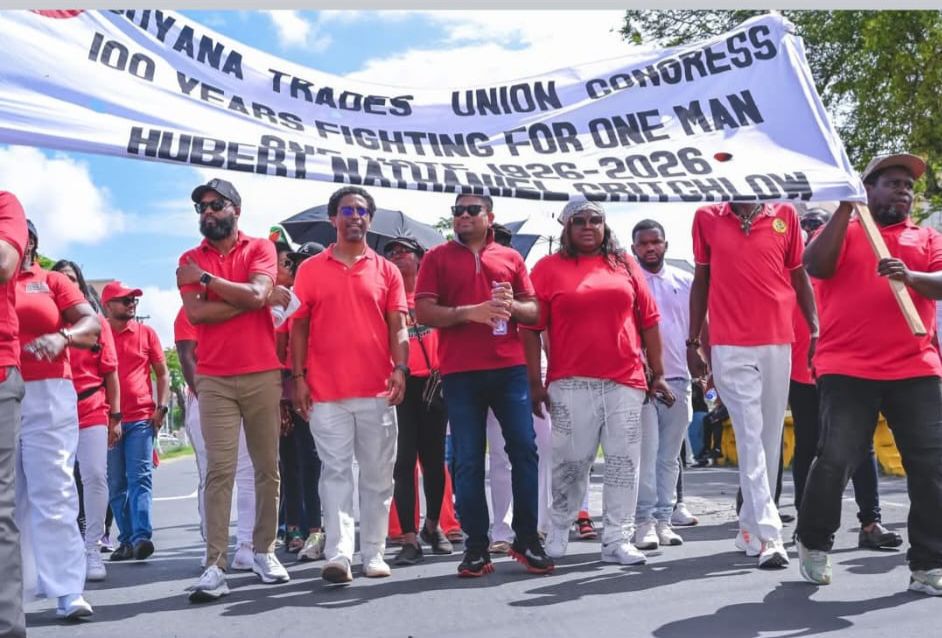
In an extraordinary and largely unexpected show of political proximity and civility, several of Guyana’s opposition political leaders and parliamentarians marched side by side with the Guyana Trades Union Congress (GTUC) on Friday in observance of Labour Day, signaling what many viewed as a rare moment of unity in the country’s fractured post-election political landscape.
The May Day march and rally, held under the theme “100 Years Fighting for One Man, One Vote (1926–2026) – Hubert Nathaniel Critchlow & Workers,” brought together parties and personalities who contested the contentious September 2025 General and Regional Elections, many of whom have since operated in visibly separate political spaces.
Leading the opposition contingent was Azruddin Mohamed, head of the We Invest in Nationhood (WIN) and Leader of the Opposition, accompanied by WIN General Secretary and parliamentarian Odessa Primus and other members of the party’s parliamentary team.
Also participating were Simona Broomes, leader of the Assembly for Liberty and Prosperity and former minister, Dorwain Bess of the Forward Guyana Movement (FGM), and Dr. Terrence Campbell, lead parliamentarian for A Partnership for National Unity (APNU), along with several other APNU legislators.
Noticeably absent from the march were FGM’s lone parliamentarian Amanza Walton-Desir and members of the Alliance For Change (AFC) leadership. Walton-Desir, however, later appeared at social events hosted by the Guyana Teachers’ Union and the Postal and Telecommunications Workers’ Union.
The governing People’s Progressive Party (PPP), meanwhile, marked Labour Day through its traditional alignment with the politically aligned Federation of Independent Trade Unions of Guyana (FITUG), maintaining the long-standing political divide between the country’s two major labour platforms.
The public show of opposition solidarity at the GTUC event did not go unnoticed.
For many observers, it represented more than symbolic politics. It was seen as a reminder of labour’s historic role as the original mass movement in Guyana—one that predates political parties and laid the groundwork for democratic representation.
This year’s observance carries added significance as Guyana marks 60 years of political Independence while the GTUC commemorates 100 years since workers advanced the struggle for universal adult suffrage—one man, one vote—and internal self-government.
GTUC has consistently argued that the labour movement’s fight for workers’ rights directly enabled the democratic system Guyanese participate in today, making Labour Day not merely a workers’ observance, but a national historical milestone.
Against that backdrop, the presence of opposition leaders at the GTUC event carried powerful political undertones.
At the rally, chaired by GTUC President Norris Witter, political leaders were invited to address workers and bring greetings.
Without exception, speakers sharply criticised the government over what they described as poor working conditions, the mistreatment of the working class, and the failure to ensure that economic growth translates into better wages, improved labour conditions, and greater social protections.
Guyana’s economy continues to expand rapidly, driven largely by oil production, but labour leaders and opposition figures have repeatedly argued that many workers remain burdened by low wages, rising living costs, and unequal access to economic opportunity.
The gathering also reignited public calls for greater opposition collaboration.
Many in attendance and others reacting publicly urged opposition parties to set aside individual political ambitions and work together in the national interest—both to strengthen parliamentary oversight and to hold the government accountable.
The message from the streets was unmistakable: workers remain the foundation of political representation, and those elected by their votes must remember they are representatives of the people—not masters of the people.
That sentiment, deeply rooted in the labour movement’s history, remains as relevant today as it was a century ago.





![Wallace said the UK had limited scope to act independently of its largest ally, the US [File: Toby Melville/Reuters]](https://villagevoicenews.com/wp-content/uploads/2020/11/uk.jpg)



