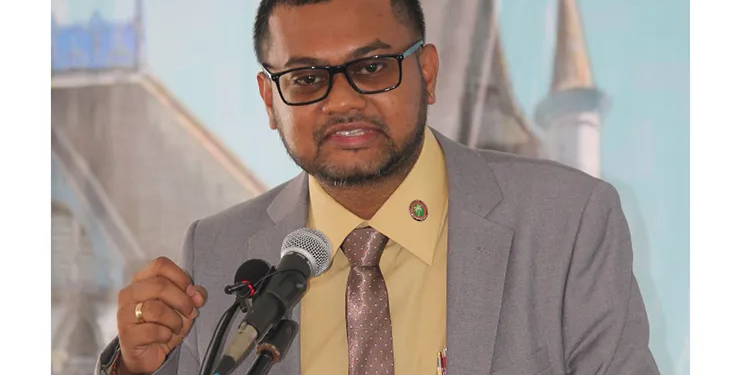
General Secretary of the Guyana Trades Union Congress (GTUC), Lincoln Lewis, delivered a sweeping and hard-hitting May Day feature address, declaring that the labour movement—not political parties—laid the foundation for Guyana’s democracy, independence and constitutional rights, while warning that today’s workers are still being denied their fair share of the country’s growing wealth.
Addressing workers under the theme, “100 Years Fighting for One Man, One Vote (1926–2026) – Hubert Nathaniel Critchlow & The Workers,” Lewis framed the observance as both a historical reckoning and a call to action.
“Brothers and sisters, comrades in struggle, workers of Guyana— Today we assemble under a theme rooted in struggle, sacrifice, and the unfinished work of justice,” Lewis declared.
He said the centenary marks the struggle led by Critchlow and organised labour for universal adult suffrage and self-government, describing it as a defining chapter in Guyana’s political evolution.
Lewis argued that the country’s political history has too often diminished labour’s foundational role, insisting that Guyana’s development did not begin with Independence or political parties.
“And let us understand something clearly: Guyana’s political development did not begin in 1966. It did not begin with political parties. It began with labour.”
In one of the strongest historical interventions of the address, Lewis drew a sharp line between labour’s origins and the rise of political leadership.
“Before there was Cheddi Jagan, there was Critchlow. Before there was Forbes Burnham, there was Hubert Nathaniel Critchlow. Before there was political organisation, there was labour organisation.”
He pointed to Critchlow’s establishment of the British Guiana Labour Union in 1919—now the Guyana Labour Union—as the country’s first organised mass movement, predating party politics and shaping the industrial and political landscape that followed.
Lewis also reminded listeners that labour’s influence extended into the formation of the People’s Progressive Party itself, noting that Critchlow was part of its founding, while Burnham gave the party its name and Eusi Kwayana wrote its battle song.
“These are historical facts. And facts matter,” Lewis said.
But the GTUC General Secretary moved quickly from history to the present, arguing that while Guyana is experiencing unprecedented economic growth, workers are seeing little of its benefits.
“We are told Guyana is the fastest-growing economy in the world. We are told wealth is flowing from oil, gas, gold, forestry and other minerals. But economic growth must mean more than statistics. Growth must improve lives.”
Lewis said too many workers remain burdened by low wages and a high cost of living, describing the current economic model as “growth without justice” and “prosperity without inclusion.”
“What we are witnessing is uneven development,” he said.
He warned that Guyana’s oil and gas wealth must not become another chapter of exploitation where foreign interests and local elites prosper while workers are left behind.
“Our foreparents did not resist colonial exploitation so that wealth could once again be concentrated in the hands of a few. They fought for shared prosperity.”
Lewis reiterated labour’s demand for equitable distribution of national resources, saying oil wealth must translate into higher wages, stronger public services, housing and opportunity for ordinary citizens.
Turning to governance, Lewis accused the political class of practising exclusion and ignoring constitutional obligations for inclusionary democracy.
He called on both the government and opposition to bring labour, civil society and other stakeholders into meaningful national dialogue.
“Bring stakeholders to the table. Bring the trade union movement to the table. Bring the opposition to the table. Bring civil society to the table. Bring the people to the table.”
“Governance without consultation weakens democracy. And governance without inclusion violates the spirit of the Guyana Constitution,” he added.
Lewis also issued a sharp warning against divisive politics, saying the country’s political leadership must abandon practices that deepen social and economic divisions.
“Stop the divisive politics. Stop the exclusion. Stop the hostility. Stop the economic attack on sections of this society.”
Addressing President Irfaan Ali’s Labour Day breakfast invitation, Lewis said the GTUC welcomed the outreach but maintained that Labour Day itself is reserved for worker mobilisation and reflection.
He said the labour movement remains willing to engage, but only on issues that directly affect workers, including collective bargaining, wages, and respect for trade unions such as the Guyana Public Service Union (GPSU), the Guyana Bauxite and General Workers Union (GB&GWU) and the Guyana Teachers’ Union (GTU).
“Workers do not live on promises. They live on wages, rights, protections, and respect,” Lewis said.
In a direct appeal to younger Guyanese, Lewis urged them to take up the mantle of struggle, warning that democracy and freedom require constant vigilance.
“Know your history. Know your rights. Know your Constitution. Demand accountability. Defend democracy.”
Lewis also conceded that labour had not taught its history loudly enough, but said the movement is recommitting itself to educating, organising and mobilising workers.
He ended with a warning and a pledge: labour will endure because its survival is tied to the survival of the people.
“To destroy labour is to destroy the social foundation of this society,” Lewis said.
And with that, he closed with a familiar rallying cry: “Protect it. Defend it. Honour it. Stay woke. Solidarity forever. Long live the Labour Movement. Long live the workers of Guyana.”