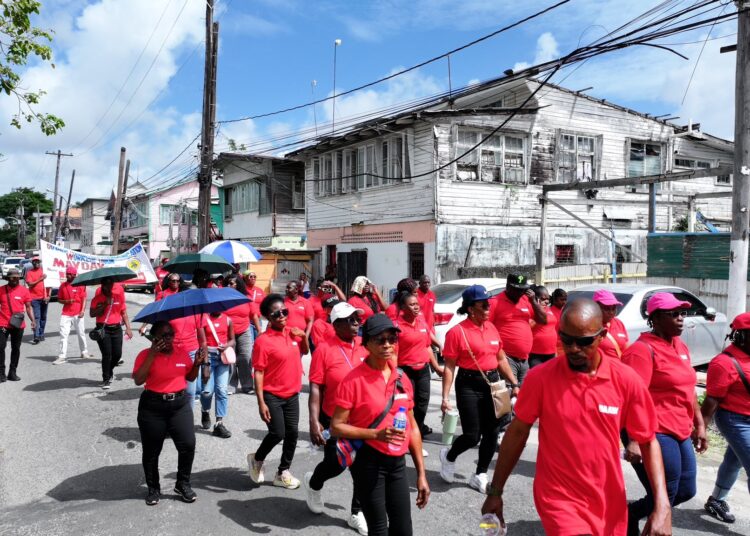
Thousands of workers took to the streets of Georgetown on Friday as Guyana Trades Union Congress (GTUC) and the Federation of Independent Trade Unions of Guyana (FITUG) marked International Labour Day with marches and rallies that blended celebration, protest and renewed calls for justice for the working class.
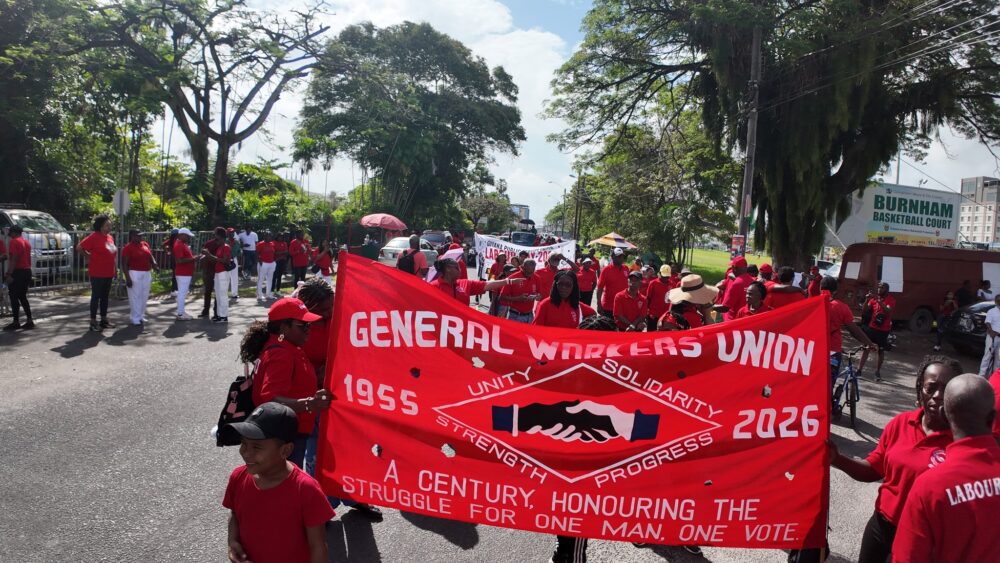
This year’s May Day observance carried heightened historical significance, with the GTUC marching under the theme “100 Years Fighting for One Man, One Vote (1926–2026) – Hubert Nathaniel Critchlow & Workers,” honouring the centenary of the labour movement’s push for universal adult suffrage and democratic participation.
Workers from across sectors—including public service, education, transport and clerical services—filled the capital in separate but parallel observances, highlighting both the enduring strength and the visible fragmentation of Guyana’s labour movement. While FITUG’s parade moved through central Georgetown to the National Park, the GTUC’s march began at Burnham Ground and ended at the Guyana Local Government Officers’ Union on Woolford Avenue, where union leaders delivered blistering critiques of economic inequality and political exclusion.
At the GTUC rally, General Secretary Lincoln Lewis used the platform to remind workers that labour—not political parties—laid the foundation for Guyana’s democracy, self-government and constitutional rights.
Lewis argued that while Guyana is now celebrated as one of the world’s fastest-growing economies, too many workers remain trapped by stagnant wages, rising prices and shrinking purchasing power.
He warned that the country’s oil-driven prosperity risks becoming another chapter where wealth bypasses the ordinary citizen.
The union leader’s remarks struck at what has become the defining contradiction of modern Guyana: unprecedented economic expansion alongside persistent worker hardship.
At the same rally, Coretta McDonald, President of the Guyana Teachers’ Union, echoed those concerns, saying many workers continue to live “pay cheque to pay cheque” despite the country’s booming revenues and expanding resource wealth.
She called for wages to better reflect the cost of living and for workers to receive a more equitable share of national development.
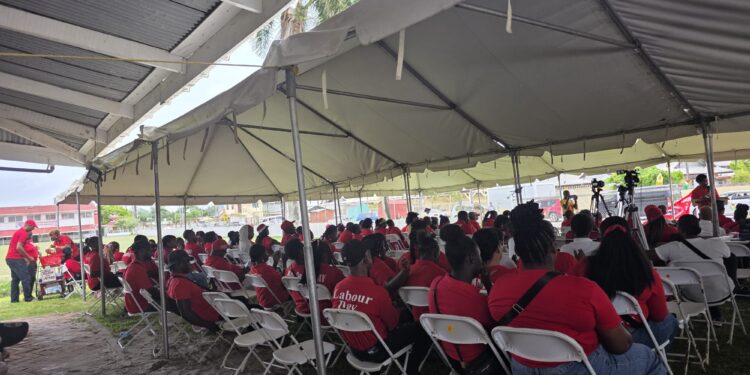
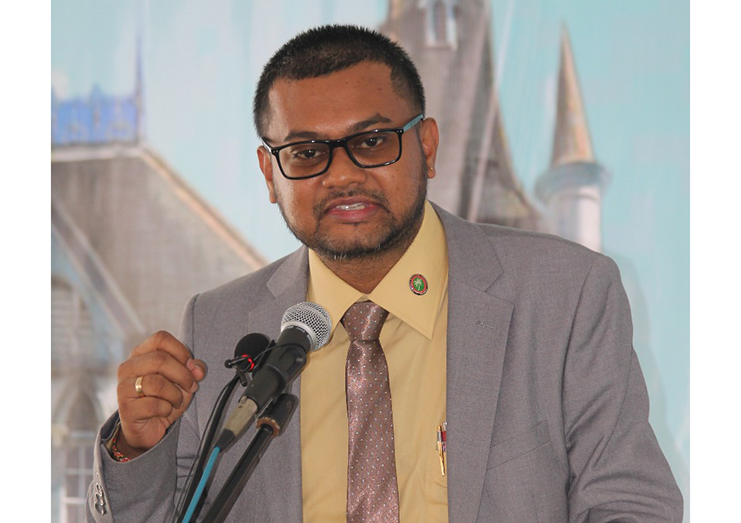
Meanwhile, at FITUG’s National Park rally, President Carvil Duncan focused on the need for investment in education and workforce training, arguing that strengthening workers’ skills remains critical to improving living standards and economic participation. FITUG General Secretary Dawchan Nagasar described workers as the backbone of society and called for continued solidarity across the labour movement.
But beyond the speeches, this year’s May Day also exposed tensions within the labour movement and its relationship with the state.
President Irfaan Ali hosted a Labour Day breakfast at State House, a move welcomed by some but criticised by others as poorly timed against the backdrop of workers’ marches and rallies.
The GTUC acknowledged the invitation but made clear that Labour Day itself belongs to workers in the streets—not at brunch tables.
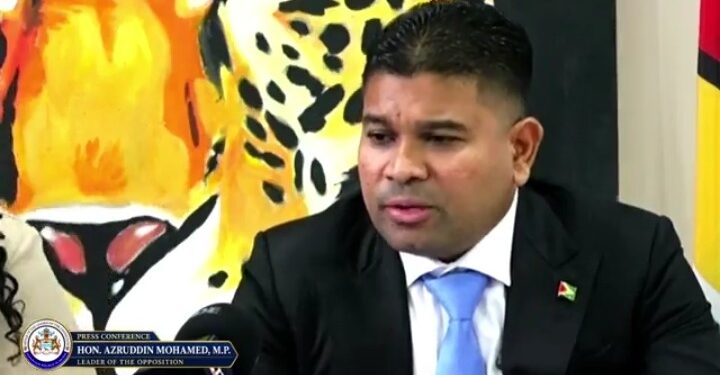
Political opposition figures also joined sections of the GTUC rally, using the occasion to criticise the government over wages, cost-of-living pressures and industrial relations, further underscoring the increasingly political undertones of the annual observance.
Yet despite the division of marches and competing narratives, the core message from May Day 2026 was unmistakable: Guyana’s workers are demanding more.
More inclusion.
More respect.
More wages.
And more of the wealth they believe they helped to build.
As Guyana approaches its 60th Independence anniversary and continues to reap billions from oil and natural resources, the labour movement is making it clear that economic growth alone is not enough.
For many workers on the road Friday, the fight remains what it has always been—fairness, dignity and a just share of the nation’s prosperity.