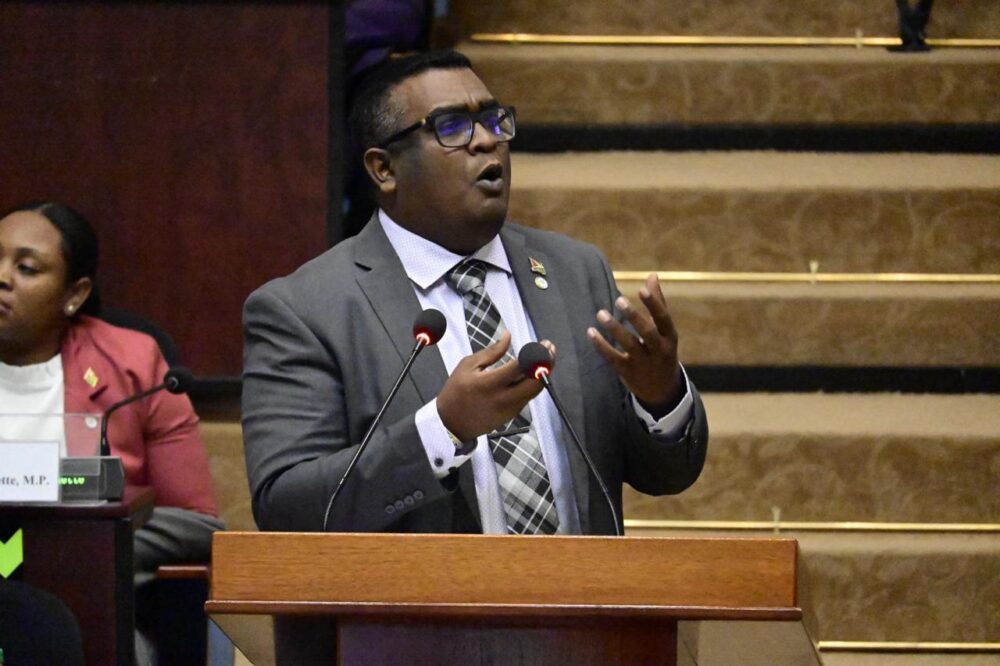
A Partnership for National Unity (APNU) Member of Parliament Ganesh Mahipaul on Wednesday said the Government’s $1.558 trillion 2026 Budget fails to live up to its theme of “Putting People First,” arguing that the plan prioritises the wealthy and politically connected while offering little relief to ordinary Guyanese.
Speaking on day three of the budget debates, Mahipaul said that while the budget is the largest in the nation’s history, its size does not guarantee impact. “Size alone does not make a budget significant or people centered. What matters is how that money touches and improves the lives of those who wake up every morning to go to work and are forced to struggle to survive,” he told the National Assembly.
He said the budget is heavily weighted toward infrastructure and mega capital projects that mainly benefit large contractors, developers and well-established businesses, while neglecting public servants, pensioners and vulnerable citizens. “This budget is so imbalanced that it will make the rich richer and the poor poorer,” Mahipaul said, adding that it strengthens those who already have while offering “little or no relief” to those in need.
Mahipaul criticised the increase in Old Age Pension, saying it leaves senior citizens attempting to survive on about $1,500 per day. “A senior citizen cannot live with dignity on G$46,000 per month in today’s Guyana,” he said, describing the increase as “arithmetic divorced from reality.” He also dismissed the $20,000 annual transportation allowance for pensioners as “tokenism, not dignity.”
Public Assistance, now set at $25,000 per month, was also condemned as inadequate. Mahipaul said the amount—less than $900 per day—is insufficient for food, rent, transport, utilities and healthcare. “A budget that puts people first would have aimed to reduce poverty, not administratively manage it,” he said, calling for a forensic audit of the programme and clearer eligibility criteria. He also urged the government to provide water and electricity subsidies to households on Public Assistance and families with children with special needs.
Mahipaul said the increase in the income tax threshold to $140,000 does not amount to meaningful relief, noting that VAT remains unchanged and rising prices erode marginal gains. “In relation to the cost of living, it is not real relief,” he said, adding that in an oil-rich economy experiencing rapid growth, the budget does not meaningfully redistribute wealth. “Those who benefit most from growth contribute the least proportionally. That is not balanced. That is preservation of privilege.”
Turning to the Ministry of Local Government and Regional Development, Mahipaul raised concerns about accountability, noting that the ministry was allocated $41.8 billion in 2025, including $38.7 billion for capital expenditure. He said $2.7 billion was reportedly fully spent on markets, green spaces and drainage works, yet little evidence of the projects exists on the ground.
“Where is the work?” Mahipaul asked, citing allocations including $200 million for Stabroek Market, $260 million for Phase One of the Bourda Green, and millions more for Albouystown, East Ruimveldt and other markets. “There is no evidence of any,” he said, calling for a forensic audit and warning that if funds were spent without physical results, it amounts to “Public Theft.”
He also questioned hundreds of millions reportedly spent on other markets, including Anna Regina, Port Kaituma, Rose Hall, Bath and Lethem, challenging citizens to verify whether the projects reflect the sums allocated. “The books tell one story, but the reality tells another,” he said.
Mahipaul highlighted that several ministry targets were not met despite full expenditure. Staff training and project completion fell short across multiple programmes. “Not one of the targets was met, yet all of the money was spent,” he said.
On solid waste management, Mahipaul said $11.6 billion was spent in 2025 while conditions at the Haag Bosch landfill remain unchanged, and with only $5.9 billion budgeted for 2026, the problem will persist.
In closing, Mahipaul cited selective law enforcement as another sign of inequity. He described cases where market vendors, small contractors and minibus operators faced penalties, while politically connected businesses operate without consequence. “This government has mastered the art of being strong against the weak and weak against the strong,” he said.
He said a truly people-first budget would reduce inequality, strengthen purchasing power and apply the law equally. “If the government truly wants to put people first, it must act to uplift ordinary Guyanese, not just enrich a privileged few,” Mahipaul said, concluding that Budget 2026 fails on all three counts.