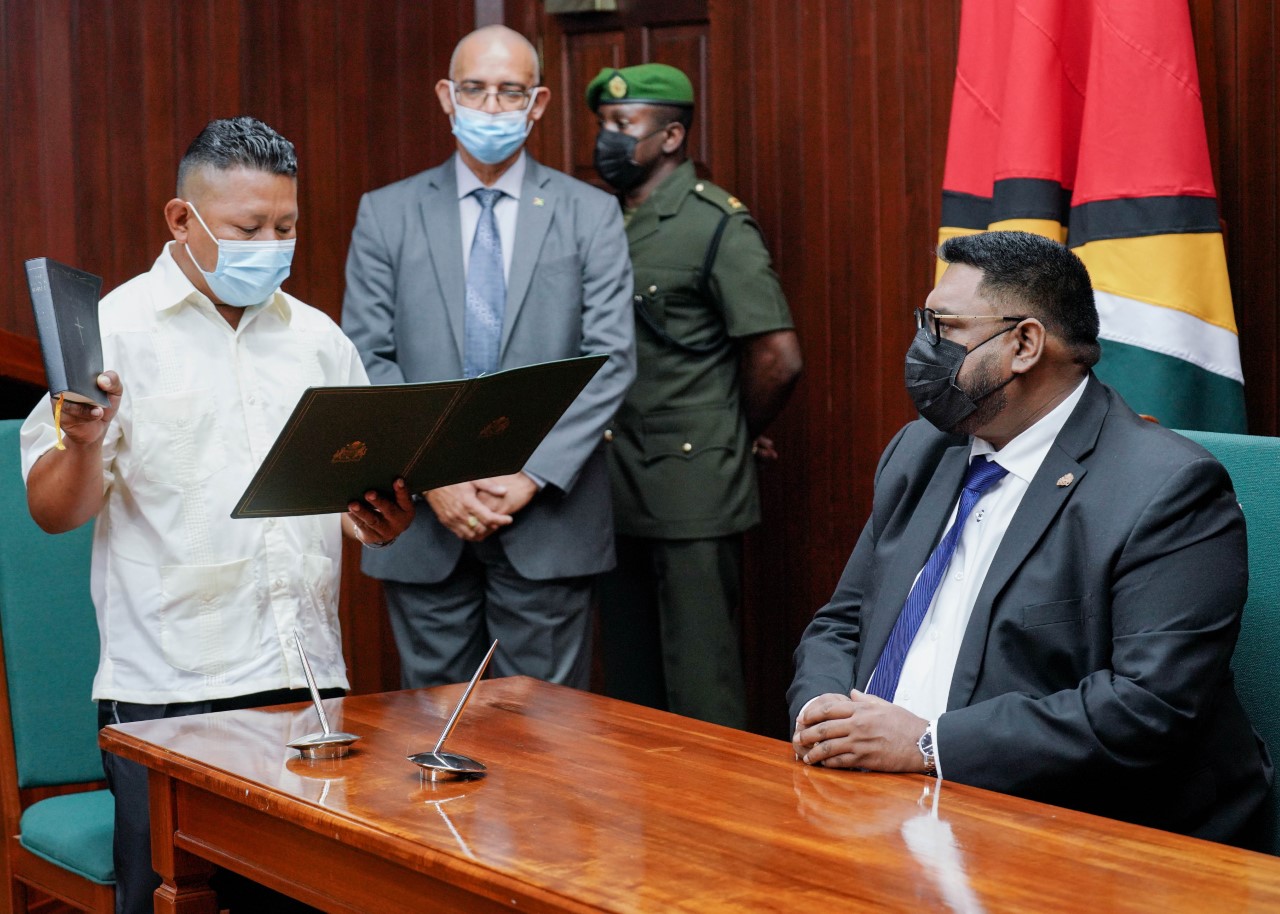
In 2020, Attorney General Anil and Minister of Legal Affairs, Nandlall S.C, acknowledged a serious gap in Guyana’s legal framework: the absence of specific laws to criminalise Ponzi schemes and investment fraud. He pledged swift action.
“We have to look back at our laws, tighten them and make Ponzi scheme and devices of this type criminal offences and to have very strong penalties attached to them when they are committed,” he said in a Department of Public Information (DPI) interview, warning that the issue “must change quickly.”
That warning came as the State was already confronting what it knew to be a major financial threat. In an August 2020 release, the Ministry of Legal Affairs disclosed:
“The Government of Guyana has received dozens of complaints from members of the public, in relation to the operations of a financial outfit, located on the East Coast of Demerara.”
The statement went further, revealing that the Guyana Securities Council (GSC) had formally alerted President Irfaan Ali, Vice President Bharrat Jagdeo, and the Commissioner of Police about the scheme. It described the entity—Accelerated Capital Firm Inc. (ACFI)—as “a ‘Pyramid or a Ponzi Scheme’ that has received hundreds of millions of dollars from thousands of Guyanese.”
The government’s response at the time suggested urgency and coordination:
“Today, Government assembled a high-level team headed by the Attorney General and Minister of Legal Affairs, the Commissioner of Police, the Governor of the Central Bank, the Head of the Financial Intelligence Unit and Head of the Guyana Securities Council to immediately… investigate the operations of ACFI, with a view, inter alia, of reimbursing monies to the persons who ‘invested’ in the scheme.”
Six years later, however, the central legislative gap identified during that crisis remains unresolved.
Despite early recognition at the highest levels of government—and the mobilisation of a multi-agency response—there is no clear evidence that Guyana has enacted comprehensive laws specifically criminalising Ponzi schemes or modern investment fraud. Authorities continue to rely on general fraud provisions, the very limitation Nandlall highlighted in 2020.
That continuity underscores a deeper failure. The State not only identified the threat but publicly documented its scale—“hundreds of millions of dollars” and “thousands of Guyanese” affected—yet did not follow through with structural legal reform to prevent recurrence.
The consequences are now more severe. Guyana is no longer a small, slow-growing economy; it is one of the world’s fastest-growing, fueled by oil revenues and expanding financial activity. That transformation increases both opportunity and exposure. Without modern legal safeguards, the country risks becoming fertile ground for increasingly sophisticated financial scams.
The implications are both economic and political. Financial fraud undermines investor confidence, distorts legitimate markets, and erodes trust in institutions. For a country positioning itself as an emerging investment destination, regulatory weakness is not a peripheral issue—it is a direct threat to credibility.
Politically, the gap between promise and action is equally significant. In 2020, the government acknowledged the problem, mobilised state institutions, and signaled urgency. In 2026, the absence of reform raises questions about follow-through, prioritisation, and accountability.
The human cost remains unresolved. Thousands affected by schemes like ACFI continue to seek restitution, while others remain vulnerable in the absence of stronger protections. Each new scheme that emerges reinforces a cycle the State had already identified—and committed to breaking.
The trajectory is unmistakable. The warnings were issued, the scale of the problem was clearly established, and the commitment to act was publicly made.
What remains unclear is why, six years later, the law has not caught up.