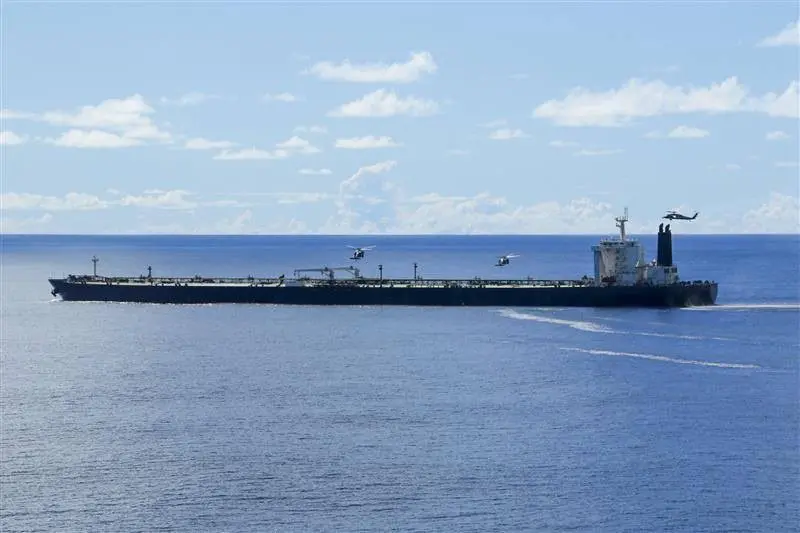
A widening credibility gap has emerged between United States authorities and Guyana’s Maritime Administration Department (MARAD) following the seizure of the oil tanker Majestic X, raising serious questions about transparency, oversight, and the integrity of Guyana’s maritime registry.
US authorities confirmed the seizure on Thursday, April 23, identifying the vessel as “Guyana-flagged” when it was intercepted in the Indian Ocean for allegedly transporting Iranian oil in breach of sanctions. The Pentagon, which released footage of the operation, declared: “We will continue global maritime enforcement to disrupt illicit networks and interdict vessels providing material support to Iran, wherever they operate.”
The vessel—previously known as Phonix—had already been sanctioned by the US Treasury Department in 2024.
MARAD’s response was swift and categorical. “This ship is NOT registered in Guyana; thus, the registration is false and fraudulent… There is no record of this vessel or name in Guyana’s registry. Therefore, the ship is FRAUDULENTLY flying the Guyana flag,” the agency said.
But beyond the emphatic language, the statement offers no supporting evidence—and that absence is now at the center of growing concern.
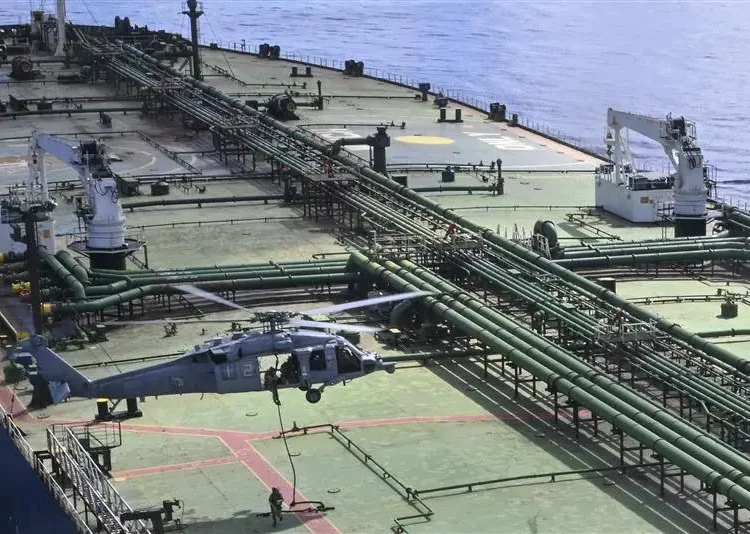
@DeptofWar/X
Assertion Without Evidence
MARAD relies heavily on the claim that the vessel’s IMO number traces back to Phonix and that no such entry exists in Guyana’s registry. Yet it provides no registry extract, no IMO verification record, no correspondence with international bodies, and no documentation to substantiate that conclusion.
In a case with clear international implications, the lack of verifiable proof weakens what would otherwise be a straightforward denial.
Unanswered Operational Questions
The statement also leaves critical operational questions untouched:
- If the vessel was fraudulently flying Guyana’s flag, when was this first detected?
- Did Guyana alert the International Maritime Organisation or partner states before the US seizure?
- What enforcement mechanisms exist to prevent or track such misuse in real time?
- Has any investigation been launched to identify those responsible?
Without these answers, MARAD’s claim rests on assertion rather than verifiable proof.
Contradiction and Deflection
The gap is sharpened by the US position. American authorities did not merely suggest ambiguity—they identified the vessel outright as Guyana-flagged during an active enforcement operation.
MARAD does not explain how a vessel allegedly absent from its registry was able to operate internationally under Guyana’s flag to the extent that it was recognised as such by foreign military authorities.
MARAD acknowledges that false registrations have been targeting Guyana since 2021 and that such schemes have affected multiple jurisdictions. It notes that the IMO tracks vessels falsely flying national flags.
Yet it fails to clarify whether Majestic X had been flagged in any prior alerts, or whether this incident represents a lapse in detection or enforcement.
Rather than closing these gaps, MARAD turns its attention to the media, warning of “unconfirmed and false allegations” about the integrity of Guyana’s registry.
But the central issue is not media interpretation—it is the absence of verifiable evidence to support MARAD’s own claim.
A Test of Registry Integrity
The seizure comes at a time of intensified global scrutiny over sanctions evasion and maritime enforcement. The Pentagon underscored this broader campaign, stating: “International waters cannot be used as a shield by sanctioned actors.”
Guyana faces serious implications. A closed registry is meant to guarantee strict control and accountability; if a vessel can operate globally under its flag without detection—or if authorities cannot convincingly prove after the fact that the registration was fraudulent—then the credibility of that system is fundamentally undermined.
Until MARAD produces verifiable documentation or engages transparently with international partners- and the media- the issue remains unresolved. At stake is not just the status of a single vessel, but the credibility of Guyana’s maritime oversight in an increasingly scrutinised global shipping environment.