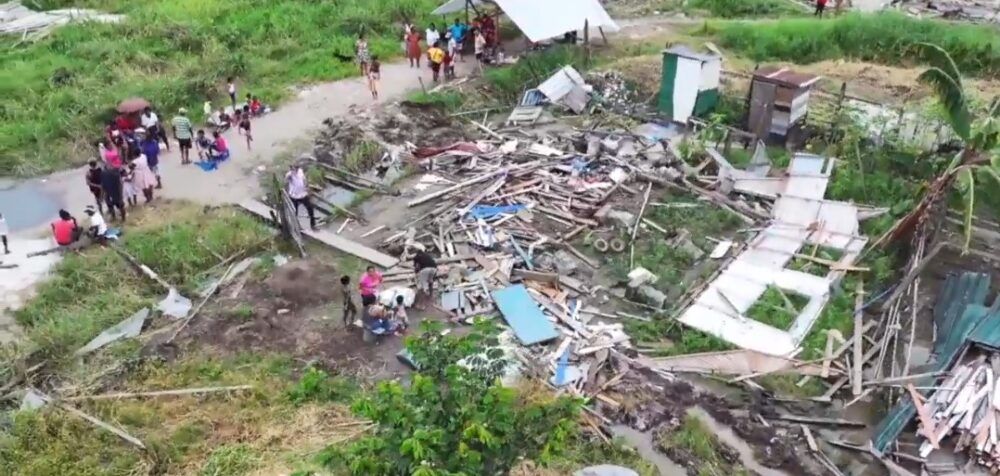
The A Partnership for National Unity (APNU) on Friday delivered a scathing critique of the government’s housing approach, declaring, “Housing in Guyana is displacement not development, hindrance not hope.”
Speaking at a press conference, the coalition pointed to last week’s forced removals at Friendship, East Bank Demerara, where residents—some occupying lands for years—were removed under a court order. APNU argued the incident reflects a troubling pattern seen in Mocha Arcadia, Sarah Johanna and Hill Foot.
Forced removals along the East Bank Demerara have drawn increasing public attention amid ongoing infrastructure expansion and land regularisation efforts. At Friendship, residents were recently removed under a court order, with law enforcement and court marshals carrying out the eviction. Some occupants had reportedly lived on the lands for years and protested the move. The incident reflects similar disputes at Mocha Arcadia, Sarah Johanna and Hill Foot, where residents were displaced to facilitate development projects.
In the case of Mocha Arcadia, demolitions for a major road project sparked national debate over compensation, relocation and the use of force. Opposition parties, including APNU, have pointed to these cases as a pattern of displacement linked to state-led development, while the government maintains the removals are lawful and necessary for national progress.
“People who occupied lands in some cases for many years got an unforgettably horrible experience of displacement with little hope of normalcy or dignity afterward,” the statement said, describing a recurring approach involving court orders, police presence and heavy machinery.
While acknowledging the legal rights of landowners and the state, APNU contended that the current method of enforcement is unnecessarily harsh and lacks humanity. It called for a structured system of consultation and relocation, stressing that long-standing occupants should be provided with alternative housing before removal.
The coalition highlighted a growing housing crisis, noting more than 30,000 pending applications in Region Four and criticising what it described as the allocation of house lots without proper infrastructure. It said many allottees cannot begin construction due to the absence of roads and utilities, calling the process “a paper transaction.”
APNU also raised concerns about administrative bottlenecks at the lands agency and escalating housing costs driven by the country’s oil economy, which it said are pushing citizens into desperate living conditions.
Framing the issue as a policy failure, the coalition argued that Guyana has sufficient land and resources to meet housing demand but lacks effective planning and execution. It urged the government to adopt alternatives such as rent-to-own housing and to develop lands further south of the coast to ease demand.
“As a society we cannot treat our people with disregard,” APNU said, while warning against continued reliance on what it termed “destructive displacement.”
The coalition also expressed concern about what it sees as a disproportionate impact of such removals on African Guyanese communities, citing past experiences including Mocha, and called for a more equitable and humane housing policy.