In a move that signals a transformative shift in planning and foresight in the regional educational landscape, the University of Guyana (UG) has formally entered into strategic partnerships with premier North American institutions during the high-level Work Futures and Capacitation Conclave, which concluded last Friday.
Against the backdrop of Guyana’s unprecedented economic trajectory—projected as the world’s fastest-growing national economy in 2026—the university hosted a select group of global strategic thinkers to map the future of human development in Guyana and the Caribbean. The event culminated in the signing of two significant Memoranda of Understanding (MOU) with Saint Leo University and the New England Institute of Technology, designed to bridge the gap between academic theory and industry demand.
Strategic Alignments for a High-Growth Era
The conclave, held on February 5 and 6 at the University of Guyana’s Turkeyen Campus in Georgetown, served as a crucible for policy insight. It brought together approximately 30 specially selected local and international futurists to deep dive into the critical tensions between skills and knowledge production, technology and humanity, endeavor and work and fixity and hyper disruption.
The primary objectives of the conclave were threefold:
- Shared Global Understanding: Exploring deep perspectives on the issues impacting the work futures as against the future of work on global, regional, and local scales.
- Actionable Workforce Planning: Framing guidelines which might meet and reconcile tensions arising at scale and speed.
- Cross-Sector Partnerships: Building robust networks between government, industry, the community, and academic entities to ensure education remains relevant to the evolving realities of the country and region.
The Saint Leo-UG Partnership: A Global Brand Vision

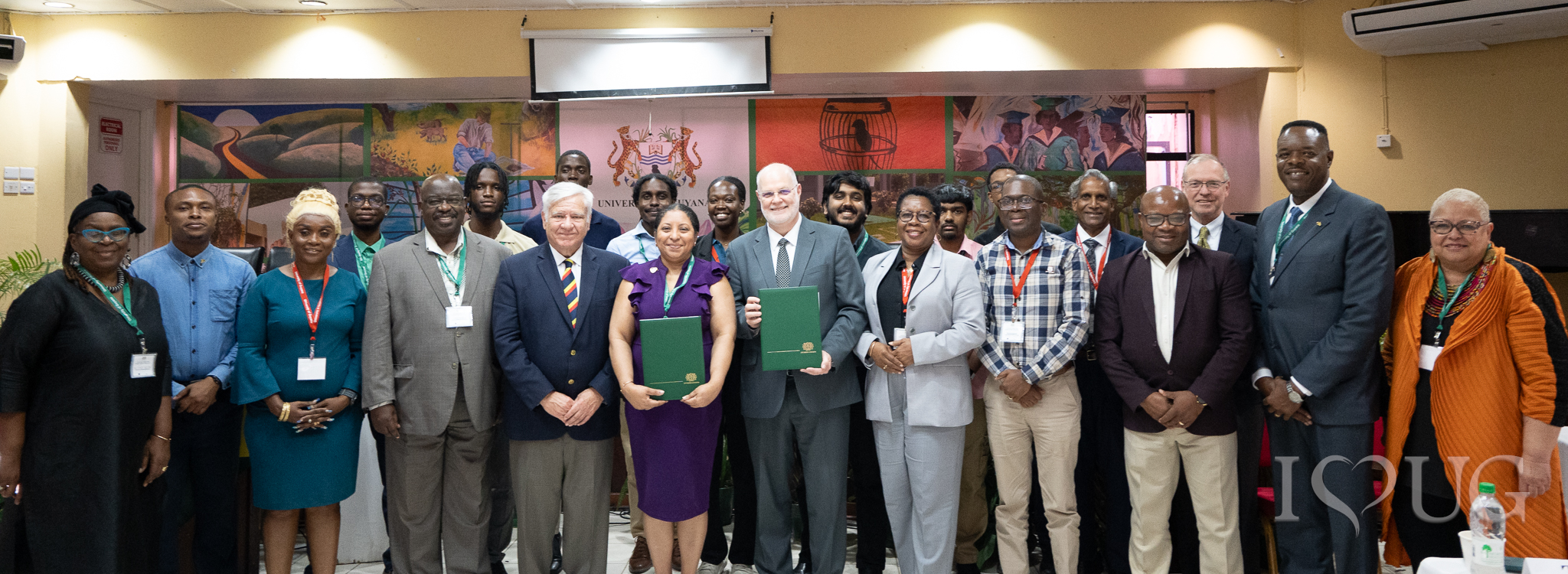
UG’s Vice-Chancellor Professor Paloma Mohamed Martin and Dr. Bryan DePoy, Provost of Saint Leo University who signed the agreement on behalf of President Dr. James Burkee. Also in photo are Dr Robert Robertson, Senior Research Fellow, Commonwealth Institute School of Advanced Studies, University of London [2nd from left]; Prof Leyland Lucas, Dean, School of Entrepreneurship and Business Innovation (SEBI) [extreme left]; and Dr Jacqueline Murray, Director of the Institute for Distance and Continuing Education (IDCE) both of the University of Guyana.
A cornerstone of the event was the formal signing of an MOU between Saint Leo University and the University of Guyana. Dr. Bryan DePoy, Provost of Saint Leo University, signed the agreement on behalf of President Dr. James Burkee.
The St Leo MOU is engineered to facilitate a multifaceted exchange of knowledge. Key initiatives include:
- Academic Exchange: Formalized programs for both student and faculty mobility, allowing for a cross-pollination of teaching methodologies and cultural perspectives.
- Collaborative Research: Joint opportunities for scholars to tackle regional challenges in sustainability, economics, and technology.
- Innovative Credentials: Serious consideration of a Joint Leadership Graduate Certificate, aimed at equipping Guyanese professionals with executive-level management skills.
“Guyana is identified as having the fastest national economic growth in the world in 2026, and the University of Guyana is a regional leader in higher education,” stated Provost DePoy. “We are delighted to complete this MOU as it exemplifies the interest by Saint Leo University President Dr. James Burkee in building a global brand for Saint Leo University.”
Technical Excellence and Engineering

UG’s Vice-Chancellor Professor Paloma Mohamed Martin and Dr. Henry Young, Vice Provost, of the New England Institute of Technology (NEIT) signed another agreement. Also in photo are Dr Robert Robertson, Senior Research Fellow, Commonwealth Institute School of Advanced Studies, University of London [2nd from left]; Prof Leyland Lucas, Dean, School of Entrepreneurship and Business Innovation (SEBI) [extreme left]; and Dr Jacqueline Murray, Director of the Institute for Distance and Continuing Education (IDCE) both of the University of Guyana.
Further strengthening the conclave’s outcomes, Dr. Henry Young, Vice Provost, signed another MOU on behalf of the New England Institute of Technology (NEIT). This partnership underscores the technical and vocational requirements of Guyana’s burgeoning infrastructure and energy sectors.
Vice Chancellor of the University of Guyana, Prof. Paloma Mohamed Martin, a futurist of global repute, whose office curated the conclave, emphasized that these focused conclaves are not merely symbolic but are of deep concern globally. The practical response of St. Leo and NEIT respond to some specific needs of the Guyanese economy which the University is seeking to address. “The University of Guyana appreciates the support from Saint Leo University in our two-day conclave, and we look forward to a productive, sustainable relationship,” Dr. Martin noted. She confirmed a particular interest in fostering linkages in business systems, and complex engineering, sectors that are set to be engines of the nation’s GDP growth. Witnessing the signing were: Dr Robert Robertson, Senior Research Fellow, Commonwealth Institute School of Advanced Studies, University of London, Prof Leyland Lucas, Dean, School of Entrepreneurship and Business Innovation (SEBI) and Dr Jacqueline Murray, Director of the Institute for Distance and Continuing Education ( IDCE) both of the University of Guyana.
Guyana as a Global Laboratory for Human Development
The presence of international futurists at the Turkeyen Campus highlights Guyana’s new position as a global focal point for strategic development. With the economy expanding at a record pace, the challenge has shifted from attracting investment to sustaining prosperity through human capital.
The conclave participants focused on “capacitation” the process of rapidly increasing the country’s ability to perform, manage, and sustain itself. By strengthening its flexible, industry-recognized, and nationally responsive and internationally accepted credentials, UG aims to support the success of resilient graduates with knowledge and skills that match the speed of the private sector and other shifts occurring.