Former Housing Minister and former Member of Parliament Annette Ferguson, who served in the A Partnership for National Unity and Alliance for Change (APNU+AFC) coalition government, has delivered a sharp and comprehensive rebuke of the Central Housing and Planning Authority (CHPA), warning that its growing involvement in the construction of major highways exposes serious policy confusion and deepening transparency and accountability failures in the management of Guyana’s infrastructure sector.
In a letter to the editor, Ferguson stressed that CHPA’s core mandate is to provide affordable housing and related infrastructure for working-class Guyanese, not to function as a de facto highway-construction agency. She expressed concern that CHPA has increasingly been tasked with building major access roads and highways—projects that, she argued, “rightfully fall under the purview of the Ministry of Public Works.” According to Ferguson, the practice of constructing highways through CHPA and later gazetting and transferring them to the Ministry undermines clear lines of responsibility and requires “urgent correction.”
Drawing on her experience in government, Ferguson contrasted the current approach with the infrastructure framework that existed under the APNU+AFC Coalition administration between 2015 and 2020. During that period, she said, all major public roads and highways were designed, supervised, and executed through the Ministry of Public Infrastructure, ensuring “unified technical oversight, consistent standards, and proper accountability.”
Support to CHPA, local authorities, and the Georgetown City Council was limited to works within their defined mandates, such as inner-community roads, drainage, and housing infrastructure. Under the current administration, Ferguson said, there appears to be “no coherent policy direction,” with multiple ministries—including Agriculture and Natural Resources—now constructing roads, resulting in fragmentation and duplication across the sector.
Ferguson also raised concerns about CHPA’s financial governance and oversight. She recalled that prior to May 2015 the agency was widely viewed as a “cash cow,” with funds from housing accounts often diverted to projects that served political or administrative interests rather than the poor and vulnerable. She further noted that CHPA’s audits are conducted by private auditors rather than the Audit Office of Guyana, despite the agency receiving substantial subventions from the Consolidated Fund for infrastructure works such as electricity installation, community roads, and water networks. This arrangement, she argued, should “raise concern” given the scale of public funds involved.
The former housing minister said she had previously raised questions, along with former Minister of Public Infrastructure David Patterson, about CHPA’s technical capacity to build major highways during the construction of the continuation of Mandela Avenue from Aubrey Barker Road to what is now the Heroes Highway. At the time, she recalled, Minister of Housing and Water Colin Croal publicly assured that CHPA possessed the necessary capability.
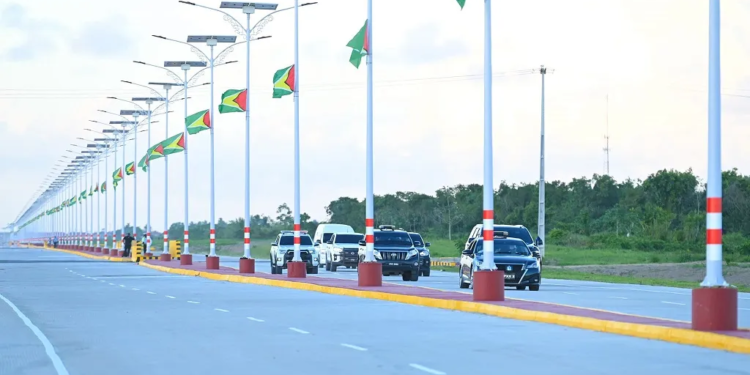
However, Ferguson said recent developments cast doubt on those assurances. As a frequent user of the corridor, she called on Minister Croal and CHPA’s technical team to conduct an “urgent assessment” of the western-bound carriageway, noting that cracks have already appeared. She warned that these early signs of failure pose safety risks and suggest premature wear on a roadway that should still be in sound condition.
Ferguson pointed to the Heroes Highway project itself, noting that the 9.4-kilometre road, constructed at a cost of $13.3 billion, was commissioned just two years ago on December 10, 2025. Yet, she said, widening works are now underway without the public being informed of key technical specifications, including the width and depth of the expansion—details she said were absent from recent public reporting.
She also highlighted persistent congestion at the Jaguar Roundabout following the opening of the Ogle Bypass Road and the Haags Bosch Road connector, where traffic converges from four major directions, including Aubrey Barker Road, Haags Bosch Road, and the alignment of the new Demerara Harbour Bridge. Ferguson said she had previously raised these concerns through written commentary and live video analysis, prompting eventual corrective action.
According to Ferguson, renewed excavation activity along both the western- and eastern-bound sides of the Heroes Highway indicates that widening is imminent. While she welcomed infrastructure improvements in principle, she expressed serious concern about how the works were procured and financed, pointing out that the 2025 National Budget made no provision for this project.
She cited a Kaieteur News report of December 11, 2025, which stated that $4.2 billion in contracts had been awarded for the widening of the highway. This, Ferguson argued, raises major questions about transparency, particularly given that CHPA operates its own tender board. She alleged that contractors deemed favourable are often shortlisted before approvals are sought from the National Procurement and Tender Administration Board, which she described as being dominated by PPP/C-aligned members.
“To spend an additional $4.2 billion on a highway completed just two years ago suggests that the original project lacked a proper feasibility study,” Ferguson said, arguing that increased traffic from the Ogle Bypass should have been anticipated in the initial design.
With Parliament not currently sitting, Ferguson said citizens are left to demand accountability. She publicly called on Minister Croal to explain why the widening was not included in the original design, where the $4.2 billion is being sourced, what data informed the decision, why the project was not deferred to 2026, how long the works will last, and whether the expansion will finally resolve congestion at the Jaguar Roundabout.
Concluding her letter, Ferguson emphasised that she is not opposed to development but to the “persistent absence of transparency and accountability in public spending.” Guyanese citizens, she said, deserve clear information and reassurance that public resources are being managed responsibly.







![[1/7] Emergency workers and police gather at the scene following a deadly shooting in Hamburg, Germany, March 9, 2023 in this still image taken from video. NONSTOP NEWS via Reuters TV/Handout via REUTERS](https://villagevoicenews.com/wp-content/uploads/2023/03/image-2023-03-10T133313.857-120x86.png)