The Alliance For Change (AFC) is demanding answers—full, unambiguous, and immediate—after the Irfaan Ali administration quietly inked yet another bilateral agreement with the United States, this time under circumstances the party describes as suspicious, opaque, and dangerously dismissive of democratic norms.
In a sharply worded statement, issued on Thursday, the AFC questions the timing, intent, and implications of the newly signed accord, noting that Guyana has a six-decade history of agreements with Washington on matters ranging from trade and border security to narcotics and extradition. Yet, the party argues, this agreement stands apart—not for its content, which remains obscured—but for the geopolitical moment in which it has emerged.
“During the last six decades, Guyana would have signed dozens of agreements with the USA… So, it is strange, that on what appears the eve of heighten military pressure against Venezuela that the US has dispatched their Assistant Secretary of War to sign yet another bilateral agreement,” the AFC observed, underscoring what many Guyanese are now openly asking: what is the government hiding?
The press release announcing the accord offered only a vague line that the deal covers the expansion of “military co-operation with full respect for the sovereignty and laws for both countries.” But this phrasing—broad enough to mean everything and nothing—has only intensified public suspicion, prompting the AFC to press further: “What exactly does this ‘military co-operation’ mean for Guyana in general and citizens in particular?”
Transparency is essential in any functioning democracy, especially when national security hangs in the balance. According to the AFC, such an agreement should have immediately triggered consultations with national leaders and parliamentary bodies.
“With what appears to be imminent military action, the Government should have provided the Leader of the Opposition (if he/she was in place) with a full briefing… failing which, the Parliamentary Foreign Affairs Committee should have been convened and provided a full briefing.”
Instead, Guyana remains without an Opposition Leader and without a functioning Foreign Affairs Committee—paralysis created entirely by the administration’s refusal to call a parliamentary sitting. The AFC notes that all branches of democratic accountability are effectively suspended because of a dispute involving “ONE individual.”
Adding to the irony, the party points out that the United States itself—whose agreement we have just signed—has already briefed its own bipartisan Foreign Affairs Committee on its wider strategic posture. “Why should the PPP not do the same?” the AFC asks. It is a question that exposes the deep governance deficit now plaguing Guyana, where critical national decisions are being made behind closed doors while elected representatives and citizens are left in the dark.
The refusal of the People’s Progressive Party (PPP) and elected Speaker Manzoor Nadir to convene a meeting for non-government Members of Parliament to elect a Leader of the Opposition, as mandated under Article 184(1) of the Constitution of Guyana, coupled with the failure to call a sitting of the National Assembly, signals a disturbing disregard for democratic norms.
These actions suggest that the government is not merely undermining democracy but shows little to no respect for it, acting as though the system exists only to serve its convenience rather than the nation. Such conduct erodes public trust and threatens the very foundations of Guyana’s parliamentary democracy.
As the AFC stresses, Guyanese have a right to know what commitments are being made in their name. “The AFC demands that the Government of Guyana provide all relevant stakeholders with a full and complete briefing on the agreements signed with the US. The sovereignty of Guyana is the responsibility of all Guyanese.”
At a time when global tensions are rising and Venezuela’s instability is deepening, secrecy serves only to erode public trust and weaken national unity. Democracy cannot function where information is withheld from those elected to oversee government actions—and certainly not when national sovereignty is at stake.
The Ali administration cannot preach sovereignty abroad while undermining democratic practice at home. Transparency is the backbone of national unity, especially when confronting external threats.
By refusing to brief the opposition, sidelining Parliament, and cloaking national security decisions in secrecy, the government is weakening the very foundations it claims to defend. The country deserves answers, accountability, and full disclosure—not more silence.
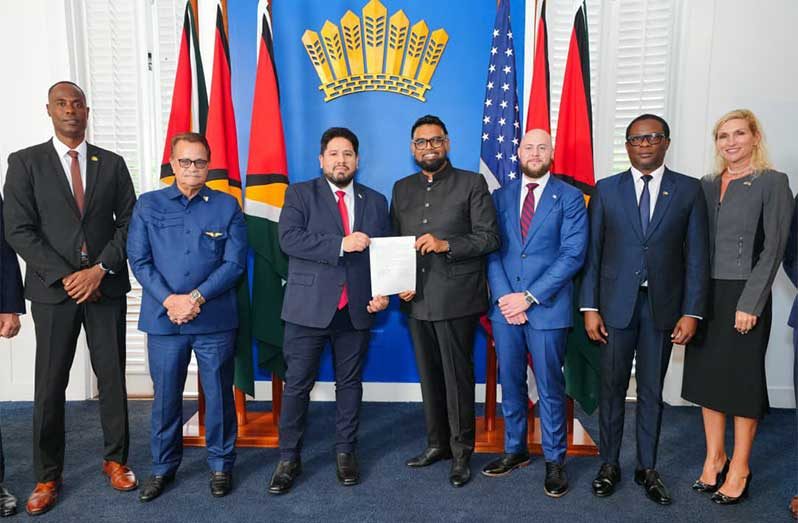
The Government released information stating that President Ali on Tuesday hosted a delegation from the United States at State House, including Patrick Weaver, Senior Advisor to the Secretary of War, and Joseph Humire, Acting Assistant Secretary of War for Western Hemisphere Affairs. The visiting officials were accompanied by US Ambassador to Guyana Nicole Theriot.
According to the release, the discussions underscored the enduring security and military partnership between Guyana and the US, and during the meeting, both nations formalised their intentions to expand military cooperation while affirming full respect for each country’s sovereignty and legal frameworks through a signed Statement of Intent. Beyond this brief disclosure, no further details have been provided, leaving key questions about the scope and implications of the agreement unanswered.