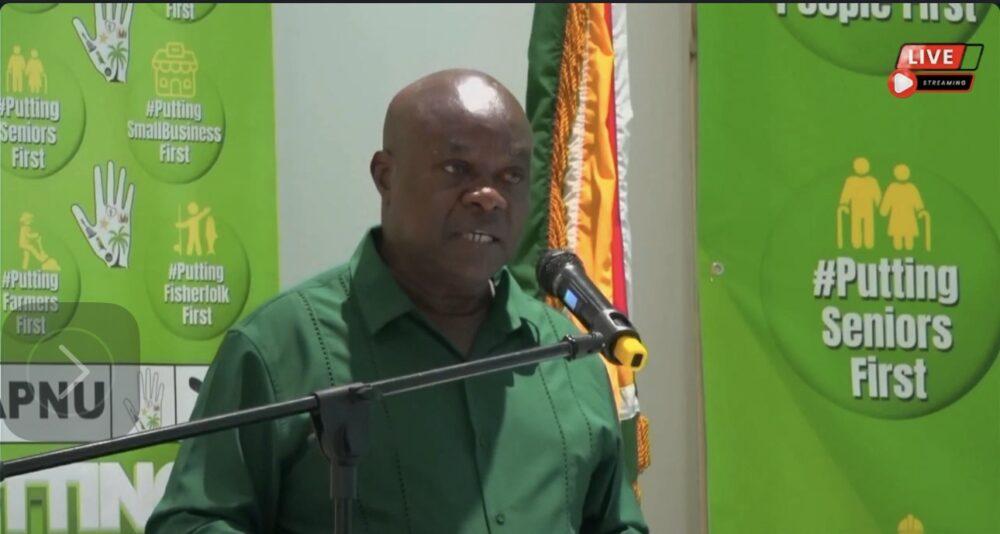
By Mark DaCosta- In the wake of the recent General and Regional Elections held on September 1, presidential candidate, A Partnership for National Unity (APNU) Aubrey Norton, has raised serious allegations concerning the legitimacy of the voting process following the announcement of results by the Guyana Elections Commission (GECOM). Norton’s partnership, which has now been relegated to third place, according to GECOM’s announced count, expressed concerns over irregularities that might have significantly influenced the election outcome.
During a speech broadcast on social media, Norton articulated his party’s dissatisfaction with the reported voter counts that showed a substantial loss for the APNU. He asserted that the electoral process was compromised by what he termed a “padded list,” which, he believes, has fostered an environment riddled with illegalities. His emphasis on the absurdity of decreasing the vote count for the APNU in Region 4 from over 120,000 five years ago to just 40,000 highlighted the concerns about the validity of the election results, noting, “It has never happened in any elections in the world.” Region 4 is the traditional stronghold of the People’s National Congress (PNC) which is the major party in the APNU partnership.
The stark reduction in votes raised alarms about the integrity of the electoral system, particularly in Region 10, where the PNC’s significant foothold appeared to have vanished. Norton noted the peculiar collapse of their support, stating, “We moved from complete domination of the region to having lost the region,” stressing that such drastic changes have never been witnessed in the country’s political history.
Concerns about transparency during the counting process were also voiced. Norton pointed out several discrepancies, including unsigned statements and those lacking any numerical data. These observations have led the APNU to raise calls for recounts in critical regions such as 4, 7, and 10, with the intention of unveiling what they consider to be irregularities that have marred the electoral process. Further complicating matters, Norton remarked, “We also recognised that there are many Commonwealth citizens who voted that didn’t meet the domicile criteria,” insinuating that the voting roster included individuals who were not eligible, thus inflating the numbers against the PNCR.
As Norton and the APNU prepare to navigate the aftermath of the elections, he has expressed a commitment to challenging the results. “We are going to challenge these results until we get to the bottom of how these irregularities and illegalities occur,” he declared, reinforcing the notion that the battle is far from over. The PNC leader’s accusations come amidst a political landscape where the People’s Progressive Party (PPP) seems poised to maintain control under a newly elected government.
Although significant, Norton’s claims come at a time when his party’s position as the voice of the opposition has been fundamentally altered by the election outcome. Following this loss, the PNCR stands on shaky ground as it faces its future in Parliament, with Norton’s leadership now in jeopardy. With alliances among opposition parties being discussed, Norton has called for unity among their ranks, urging supporters to remain focused on the fight against these alleged malpractices.
Norton’s speech encapsulates a profound sense of discontent with the electoral process, which he argues is marred by inconsistencies and potential fraud. The implications of these claims extend beyond mere rhetoric, as they challenge the legitimacy of the PPP’s upcoming governance and seek to galvanise support among disillusioned citizens questioning the integrity of their democratic processes. As the dust settles from the elections, the APNU’s resolve to expose what they deem to be electoral misconduct may shape the political discourse in our nation for the foreseeable future.