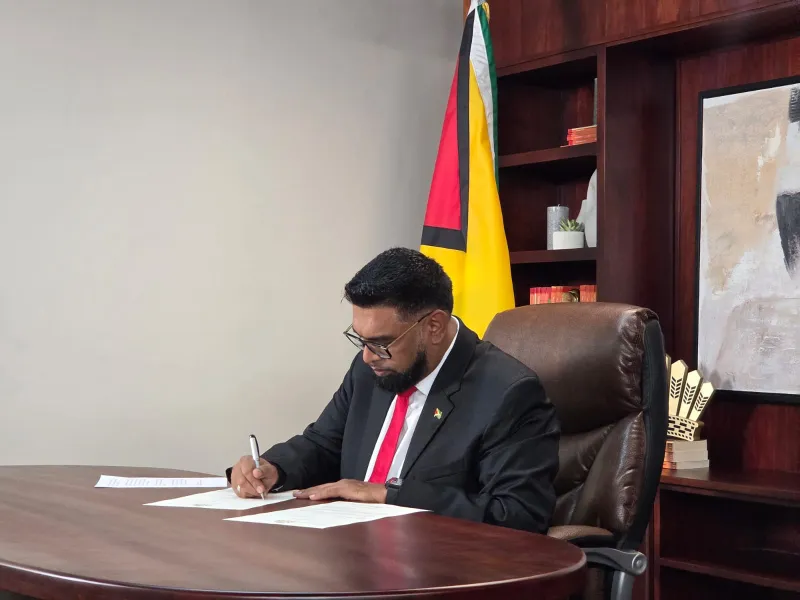
In a move mired in controversy and deepening public mistrust, President Irfaan Ali on Thursday officially dissolved Guyana’s 12th Parliament and all ten Regional Democratic Councils, triggering General and Regional elections now set for September 1, 2025. This decision, made via two presidential proclamations, has sparked serious allegations of collusion, electoral manipulation, and deliberate suppression of democratic safeguards.
While the President touted the dissolution as a routine constitutional act, critics argue it is anything but. The People’s Progressive Party/Civic (PPP/C) regime now stands accused of undermining the very democratic principles it claims to uphold.
Opposition-appointed GECOM Commissioners have sounded the alarm, revealing that the Guyana Elections Commission (GECOM) had internally projected readiness no earlier than September 21. This means the President’s premature announcement overrides expert guidance from the electoral body itself. Worse, the commissioners have accused GECOM Chairperson, retired Justice Claudette Singh, of colluding with President Ali to fast-track elections before the necessary infrastructure is in place—effectively compromising electoral integrity.
This discrepancy raises urgent questions about the integrity of the process and whether key players are acting in bad faith. The commissioners further accused GECOM Chairperson, retired Justice Claudette Singh, of colluding with the President to bypass the commission’s mandate, weaken its independence, and prematurely force an election without the systems needed to ensure transparency. The accusations echo growing sentiment among the public that the electoral process is being hijacked.
“This is not democracy at work—it is manipulation,” said a respected civil society advocate, noting his long record of civic engagement and voter education. “The President and GECOM Chair have abandoned impartiality in favour of political expediency. This is a calculated effort to entrench power, not to empower the people.”
Historical concerns loom large over this move. Of the last six national elections in Guyana, only the 2015 polls have been widely viewed as credible. The others, tainted by systemic irregularities and documented cases of tampering, have left scars on the nation’s democratic fabric. With this latest maneuver, the PPP/C regime appears poised to drag Guyana into yet another discredited electoral process.
Adding to the concerns is Government’s inexplicable failure to allocate US$20 million to GECOM to implement biometric systems—technology that could significantly reduce the risk of voter fraud. This omission is especially alarming considering the current voter list reportedly includes nearly 90% of the national population, a figure many experts deem wildly unrealistic and ripe for abuse.
Despite these glaring issues, President Ali took to the podium at State House, declaring, “Free and fair elections are the lifeblood of a democratic state,” while simultaneously pushing ahead with a timeline and structure that undermine both freedom and fairness.
The President’s call for “every eligible voter to participate” rings hollow to many who now question whether the election machinery is being rigged against them from the outset. As the country enters official campaign season, the core question is no longer which party will win, but whether the system will allow the people’s will to be truly heard.