Every year, without exception, a major flood occurs somewhere. Residents of the heavily-populated coastal regions are trapped between the receding coastline and depleted mangrove forest to the north and the menacing conservancy with its fragile earthen embankments encasing hectares of flood plains to the south. Floods incur incalculable costs − in terms of damage to homes, destruction of farms and death of livestock.
The annual cycle of floods still threatens two decades after the catastrophic 2005 ‘Great Flood’. Major floods were also recorded in 2006 and 2011. The 2006 floods impacted about 3,000 families and destroyed thousands of hectares of farmland. Over 1,000 families were affected in Mahaica and Mahaicony after floods destroyed their farms, livestock and homes in 2011.
Floods, from 1988 to 2006, affected 965,000 persons and resulted in more than US$663M in economic damage. The aging East Demerara Water Conservancy for example, constructed in 1880, suffered an ominous breach at La Bonne Mère in 2002 – only three years before the 2005 ‘Great flood’ but the government-of-the-day ignored the imminent catastrophe.
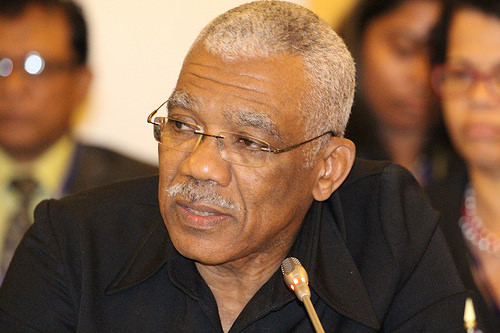
Former President David Granger, speaking on the programme – The Public Interest – reminded that the People’s Progressive Party Civic (PPP/C) administrations, in office for 28 of the last 33 years, are answerable for the worst floods in recent history − in 2005, 2006, 2011 and 2021 – which exposed the population to unsafe water supply and insanitary solid waste and sewage disposal.
Previous PPPC administration acknowledged that over 290,000 persons were adversely affected in the 2005 ‘Great flood’. The current administration acknowledged that “the worst flooding ever seen” in every region in the 2021 ‘Great flood’ affected 150,000 persons.
Mr. Granger pointed out that PPPC administrations never conduct inquiries into environmental disasters and, as a result, never learn lessons from them. Soon after the 2005 ‘Great Flood,’ the administration went on a carefree spending spree, squandering billions on World Cup Cricket, the Caribbean Festival of the Arts and the construction of a five-star hotel and other prestige projects while neglecting the infrastructure needed to protect the population from floods.
The PPPC administration’s closure of the well-drained East Demerara Sugar Estates − compounded by mismanaged maintenance of drainage infrastructure measurably contributed to flooding. It is a well-known fact that the sea level along the coastland is rising faster than the average global warming trend and that the coastal plain is sinking owing to groundwater extraction, soil erosion and drainage of the wetlands.
Land use change – by the reckless removal of trees, construction of housing and roadways causing increased runoff and widespread flooding – reduced the soil’s ability to absorb excessive rainwater. The interplay of high sea levels, high rainfall levels and low levels of maintenance of drainage infrastructure increased the risk of flooding.
The PPPC administration’s failure to construct an efficient network of canals, reservoirs or artificial lakes to store water during persistent rainfall aggravated the situation. Investment in canals, kokers and sea defence infrastructure is insufficient although the inadequacies of the drainage systems are blatant. Further, the National Drainage and Irrigation Authority has been notoriously languorous in responding expeditiously to floods away from the nearby paddy and sugarcane cultivation on the coastland.
Guyana needs a National Flood Control Master Plan and National Climate Change Policy and Action Plan that could alert residents to the onset of extreme weather, augment capabilities of disaster risk management agencies and advance sea-defence and flood protection infrastructure. National planning should aim at protecting lives and property from the floods of the sort that have affected our country over past decades.󠄀