Monday, November 16, 2026
Village Voice News
ADVERTISEMENT
  • Home
  • News
  • Sports
  • Editorial
  • Letters
  • Global
  • Columns
    • Eye On Guyana
    • Hindsight
    • Lincoln Lewis Speaks
    • Future Notes
    • Blackout
    • From The Desk of Roysdale Forde SC
    • Diplomatic Speak
    • Mark’s Take
    • In the village
    • Mind Your Business
    • Bad & Bold
    • The Voice of Labour
    • The Herbal Section
    • Politics 101 with Dr. David Hinds
    • Talking Dollars & Making Sense
    • Book Review 
  • Education & Technology
  • E-Paper
  • Contact Us
No Result
View All Result
Village Voice News
No Result
View All Result
Home News

Scientists say 1 billion people on track to die from climate change

Admin by Admin
August 31, 2023
in News
(Stockbyte/Getty Images)

(Stockbyte/Getty Images)

0
SHARES
0
VIEWS
Share on FacebookShare on Twitter

By CARLY CASSELLA

The fossil fuels that humanity burns today will be a death sentence for many lives tomorrow.

READ ALSO

Unstoppable: UG Graduands Achieve Academic Excellence in spite of Severe Health Challenges, Loss of Loved Ones

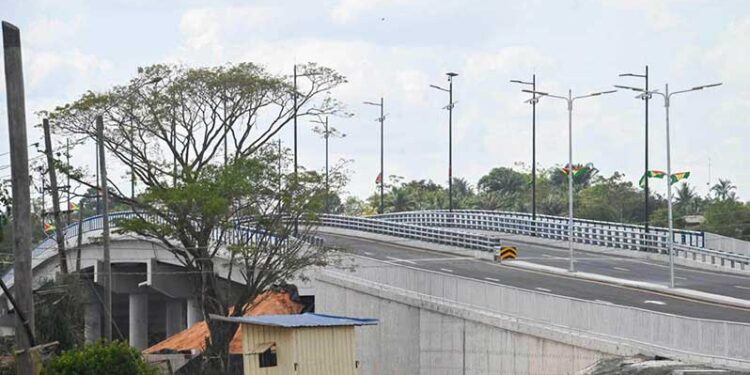
New Mackenzie–Wismar Bridge: From Granger/Nagamootoo Initiative to US$35M Four-Lane Crossing

A recent review of 180 articles on the human death rate of climate change has settled on a deeply distressing number. Over the next century or so, conservative estimates suggest a billion people could die from climate catastrophes, possibly more.

As with most predictions for the future, this one is based on several assumptions.

One is a rough rule of thumb called the ‘1000-ton rule’. Under this framework, every thousand tons of carbon that humanity burns is said to indirectly condemn a future person to death.

If the world reaches temperatures 2°C above the average global preindustrial temperature, which is what we are on track for in the coming decades, then that’s a lot of lives lost. For every 0.1 °C degree of warming from now on, the world could suffer roughly 100 million deaths.

“If you take the scientific consensus of the 1,000-ton rule seriously, and run the numbers, anthropogenic global warming equates to a billion premature dead bodies over the next century,” explains energy specialist Joshua Pierce from the University of Western Ontario in Canada.

“Obviously, we have to act. And we have to act fast.”

The human death rate from climate change is extremely tricky to calculate, even in the present day.

The United Nations reports that every year, environmental factors take the lives of about 13 million people, and yet it’s not clear how many of these deaths are directly or indirectly due to climate change.

Some experts argue abnormal temperatures on their own may already claim as many as five million lives a year. Other estimates are much lower.

Part of the problem is that the global effects of climate change are manifold. Crop failures, droughts, flooding, extreme weather, wildfires, and rising seas can all impact human lives in subtle and complex ways.

Predicting the future death toll of these climate catastrophes is inherently imperfect work, but Pierce and his coauthor, Richard Parncutt from the University of Graz in Austria, think it’s worth pursuing.

They argue measuring emissions in terms of human lives makes the numbers easier for the public to digest, while also underlining how unacceptable our current inaction is.

“Global warming is a matter of life or death for a billion people,” says Pierce.

“As predictions of climate models become clearer, the harm we are doing to children and future generations can increasingly be attributed to our actions.”

To stress that point, Pierce and Parncutt have applied the 1000-ton rule to the Adani Carmichael coalmine in Australia – set to become the largest coalmine ever.

If the entirety of this coalmine’s reserves are burned, the authors say it could cause the premature deaths of about 3 million people in the future.

“Many of those who will die are already living as children in the Global South,” write Pierce and Parncutt, “burning Carmichael coal will cause their future deaths with a high probability.”

Technically, the 1000-ton rule does not take into account possible climate feedback loops, which could make future environmental fallout from carbon emissions even worse, even faster.

This rule is actually “an order of magnitude best estimate“, which means it’s more of a range, somewhere between 0.1 to 10 deaths per 1000 tons of carbon burned.

That leaves a lot of room for scenarios even more dire than the one outlined here.

“When climate scientists run their models and then report on them, everybody leans toward being conservative, because no one wants to sound like Doctor Doom,” explains Pierce.

“We’ve done that here too and it still doesn’t look good.”

It’s a hard reality, but it’s one that the public and policymakers need to face head on.

The review was published in Energies.

(Source: Science Alret)

ShareTweetSendShareSend

Related Posts

Candisa Caesar – Bachelor’s Degree in Nursing (Distinction)
Feature

Unstoppable: UG Graduands Achieve Academic Excellence in spite of Severe Health Challenges, Loss of Loved Ones

by Admin
November 15, 2026

As graduands of the University of Guyana (UG) prepare to walk across the graduation stage, each carries a unique story...

Read moreDetails
The new Mackenzie-Wismar Bridge ( Guyana Chronicle Delano Williams photo)
Feature

New Mackenzie–Wismar Bridge: From Granger/Nagamootoo Initiative to US$35M Four-Lane Crossing

by Admin
November 15, 2026

The new Mackenzie–Wismar Bridge, scheduled to be commissioned on Sunday, November 15, 2026, represents the culmination of nearly a decade...

Read moreDetails
News

Mohamed’s Detention, Workers’ Rights And MV Barima Cases Fuel GTUC Concerns

by Admin
November 15, 2026

By Mark DaCosta- Guyana's constitutional order rests on a simple idea: those who govern, and those who hold them to...

Read moreDetails
Next Post

Bursary awarded to Fourteen (14) Students from the Peter D’Aguiar’s Scholarship Fund


EDITOR'S PICK

Minister of Labour Joseph Hamilton provides details of the project

Thousands of citizens to work in one of Guyana’s largest gold mines

January 10, 2025

WORD OF THE DAY: VERBOSE

July 1, 2025
Capt Ibrahim Traoré

Why Burkina Faso’s leader, Capt Ibrahim Traoré, captured hearts and minds around the world

May 16, 2025

Police Conduct Community Outreach in Beterverwagting

May 30, 2024

© 2024 Village Voice

No Result
View All Result
  • Home
  • News
  • Sports
  • Editorial
  • Letters
  • Global
  • Columns
    • Eye On Guyana
    • Hindsight
    • Lincoln Lewis Speaks
    • Future Notes
    • Blackout
    • From The Desk of Roysdale Forde SC
    • Diplomatic Speak
    • Mark’s Take
    • In the village
    • Mind Your Business
    • Bad & Bold
    • The Voice of Labour
    • The Herbal Section
    • Politics 101 with Dr. David Hinds
    • Talking Dollars & Making Sense
    • Book Review 
  • Education & Technology
  • E-Paper
  • Contact Us

© 2024 Village Voice