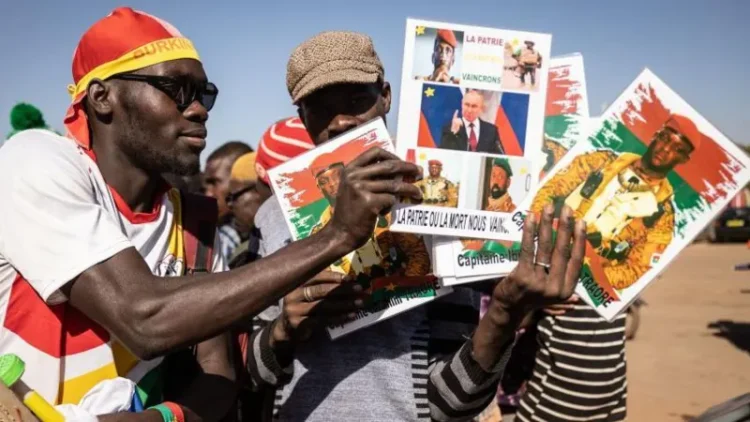
By Farouk Chothia (BBC) A charismatic 37-year-old, Burkina Faso’s military ruler Capt Ibrahim Traoré has skilfully built the persona of a pan-Africanist leader determined to free his nation from what he regards as the clutches of Western imperialism and neo-colonialism.
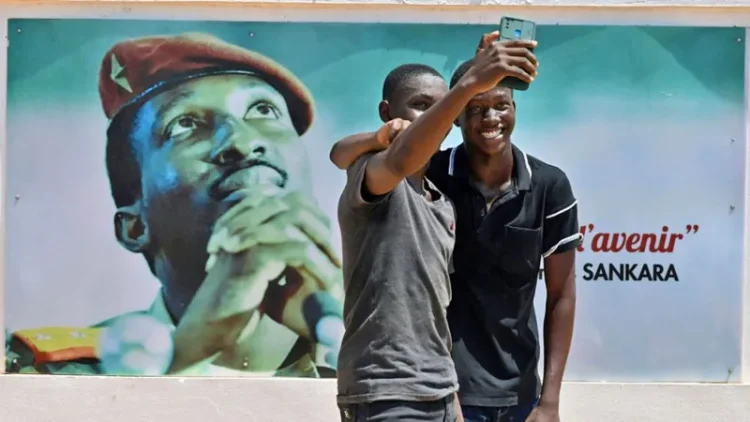
His message has resonated across Africa and beyond, with his admirers seeing him as following in the footsteps of African heroes like Burkina Faso’s very own Thomas Sankara – a Marxist revolutionary who is sometimes referred to as “Africa’s Che Guevara”.
“Traoré’s impact is huge. I have even heard politicians and authors in countries like Kenya [in East Africa] say: ‘This is it. He is the man’,” Beverly Ochieng, a senior researcher at global consultancy firm Control Risks, told the BBC.
“His messages reflect the age we are living in, when many Africans are questioning the relationship with the West, and why there is still so much poverty in such a resource-rich continent,” she said.
After seizing power in a coup in 2022, Traoré’s regime ditched former colonial power France in favour of a strong alliance with Russia, that has included the deployment of a Russian paramilitary brigade, and adopted left-wing economic policies.
This included setting up a state-owned mining company, requiring foreign firms to give it a 15% stake in their local operations and to transfer skills to Burkinabé people.
As part of what Traoré calls a “revolution” to ensure Burkina Faso benefits from its mineral wealth, the junta is also building a gold refinery and establishing national gold reserves for the first time in the nation’s history.
However, Western-owned firms appear to be facing a tough time, with Australia-headquartered Sarama Resources launching arbitration proceedings against Burkina Faso in late 2024 following the withdrawal of an exploration licence.
The junta has also nationalised two gold mines previously owned by a London-listed firm, and said last month that it planned to take control of more foreign-owned mines.
Enoch Randy Aikins, a researcher at South Africa’s Institute for Security Studies, told the BBC that Traoré’s radical reforms had increased his popularity in Africa.
“He is now arguably Africa’s most popular, if not favourite, president,” Mr Aikins said.
Support for Western-style democracy has fallen in many African states, research shows
His popularity has been fuelled through social media, including many misleading posts intended to bolster his revolutionary image.
Ms Ochieng said that Traoré first caught the attention of Africans when he spoke at the Russia-Africa summit in 2023, telling African leaders to “stop behaving like puppets who dance every time the imperialists pull the strings”.
This speech was heavily publicised by Russian media, which has become a major player in promoting Traoré’s pan-Africanist image.
Traoré attended commemorations in Russia last week to mark the 80th anniversary of the Soviet victory over Nazi Germany in World War Two. He posted on X that he, along with military leaders from neighbouring Mali and Niger, were inspired by it “to winning the war against terrorism and imperialism at all costs”.
Thanks to his rhetoric and pushed by a slick social media campaign, his appeal has spread around the world, including among African-Americans and Black Britons, Ms Ochieng noted.
“Everyone who has experienced racism, colonialism and slavery can relate to his messages,” Ms Ochieng said, pointing out that African-American rapper Meek Mill had posted about him on X late last year, saying how much he liked his “energy and heart” – though he was ridiculed for mixing up names by referring to Traoré as Burkina Faso and later deleted the post.
But France’s president is not a fan, describing Traoré as part of a “baroque alliance between self-proclaimed pan-Africans and neo-imperialists”.
Emmanuel Macron was also referring to Russia and China whom he accused, in a 2023 speech, of provoking coups in Africa’s former French colonies, and hypocritically stirring up old arguments over sovereignty and colonial exploitation.
Traoré’s popularity comes despite the fact that he has failed to fulfil his pledge to quell a 10-year Islamist insurgency that has fuelled ethnic divisions and has now spread to once-peaceful neighbours like Benin.
His junta has also cracked down on dissent, including the opposition, media and civil society groups and punished critics, among them medics and magistrates, by sending them to the front-lines of the war against the jihadists.
Thomas Sankara, who was killed in 1987, was praised by supporters for his integrity and selflessness – and remains an icon for many in Africa
For Rinaldo Depagne, the Africa deputy director of the International Crisis Group think-tank, Traoré commands such support because “he is young in a country with a young population” – the median age is 17.7 years.
“He is media-savvy, and uses the past to build his popularity as a reincarnation of Sankara,” he told the BBC.
“And he knows the art of politics – how to make a nation completely traumatised by war feel there is a better future. He is really good at that game.”
Sankara rose to power in a coup in 1983 at the age of 33, rallied the nation under the motto “Fatherland or death, we will win!”, and was killed four years later in another coup that put Burkina Faso back in France’s political orbit until Traoré’s seizure of power.
Ghanaian security analyst Prof Kwesi Aning, who previously worked at the Kofi Annan International Peacekeeping Training Centre, said the popularity of the military leader reflected a political shift taking place on the continent, especially in West Africa.
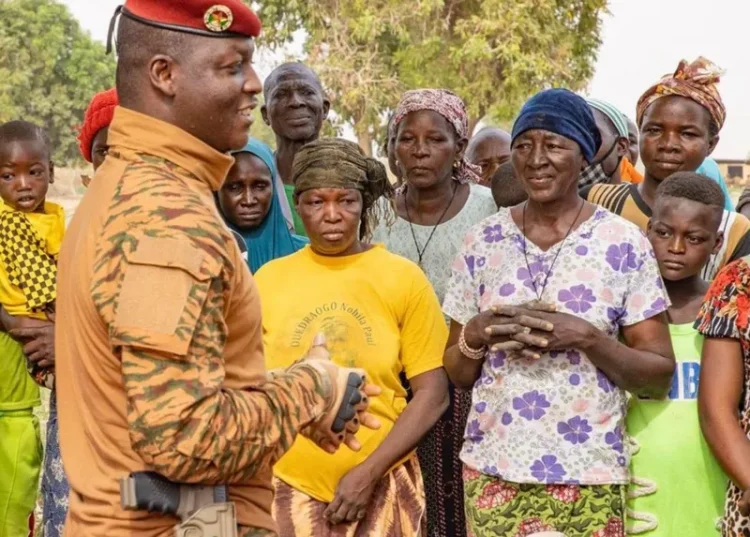
Capt Traoré is at ease chatting to people – here with agricultural workers in March
It was Traoré who stole the show at the inauguration of Ghana’s President John Mahama in January, when he arrived wearing battle fatigues with a pistol in his holster.
“There were already 21 heads of state there, but when Traoré walked in, the place lit up. Even my president’s bodyguards were running after him,” Prof Aning said.
Traoré offered a sharply contrasting image to some of the continent’s other leaders, who struggled to walk but clung to power by rigging elections, he said.
“Traoré is stylish and confident, with a very open face and a small smile. He is also a powerful orator, and presents himself as a man of the people.”
In a sign that his Russian-allied junta has made some progress on the economic front, the International Monetary Fund (IMF) and World Bank have given a generally upbeat assessment.
In a statement in early April, the IMF said that despite a “challenging humanitarian and security” environment, the economy was expected to remain “robust” in 2025, and the regime had made “commendable progress” in raising domestic revenue, containing the public wage bill, and increasing spending on education, health and social protection.
As for the World Bank, it said that inflation had surged from 0.7% in 2023 to 4.2% in 2024, but the extreme poverty rate, which refers to people living on less than $2.15 [£1.61] a day, had fallen by almost two percentage points to 24.9% because of “robust growth” in the agriculture and services sectors.
Despite these reports from US-based financial institutions, relations with both France and America have been frosty.
This appeared to be a reference to the long-standing view of the US, and some of its African allies, that Russian forces were propping up Traoré in exchange for a stake in Burkina Faso’s gold industry – undermining the military ruler’s image as a leader who expelled French troops in 2023 to reclaim the country’s sovereignty.
Gen Langley’s comments, made in early April during a US Senate committee hearing, triggered an uproar among the captain’s supporters, who felt their hero was being smeared.
This was further inflamed when shortly afterwards, the Burkinabé junta said it had foiled a coup plot, alleging the plotters were based in neighbouring Ivory Coast – where Gen Langley then made a visit.
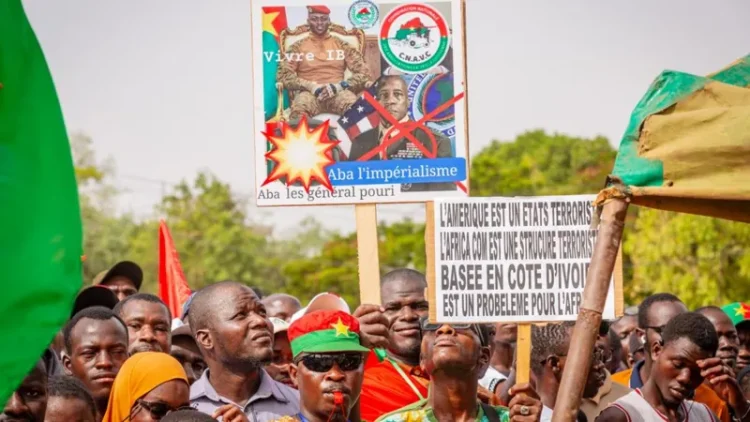
A huge rally in support of Capt Traoré was held in Ouagadougou on 30 April – along with others in cities around the world, including London
But the junta took the opportunity to organise one of its biggest rallies in Burkina Faso’s capital over fears that “imperialists” and their “lackeys” were trying to depose the captain.
“Because Colin Powell lied, Iraq was destroyed. Barack Obama lied, Gaddafi was killed. But this time, their lies won’t affect us,” one protester, musician Ocibi Johann, told the Associated Press news agency.
Rallies in solidarity with Traoré were also held abroad, including in London, on the same day.
He took to social media afterwards, posting in French and English, to express his gratitude to them for sharing his vision “for a new Burkina Faso and a new Africa”, adding: “Together, in solidarity, we will defeat imperialism and neo-colonialism for a free, dignified and sovereign Africa.”
It is impossible to say how things will end for the young captain, but he – along with military leaders in Mali and Niger – have certainly shaken up West Africa, and other states have followed their example by ordering French forces to leave.
The three military-ruled neighbours have also pulled out of the regional trade and security grouping Ecowas, formed their own alliance, and have ended free trade in the region by announcing the imposition of a 0.5% tariff on goods coming into their countries.
Mr Aikins said Traoré could learn from others, pointing out that when Rawlings took power in Ghana at the age of 32, he was known as “Junior Jesus” but after 19 years he left a mixed legacy – he had been unable to stem corruption despite helping to create an “enduring” democracy.
For a “lasting legacy”, Mr Aikins said, Traoré should focus on achieving peace and building strong state institutions to bring about good governance rather than “personalising” power and cracking down on dissent.