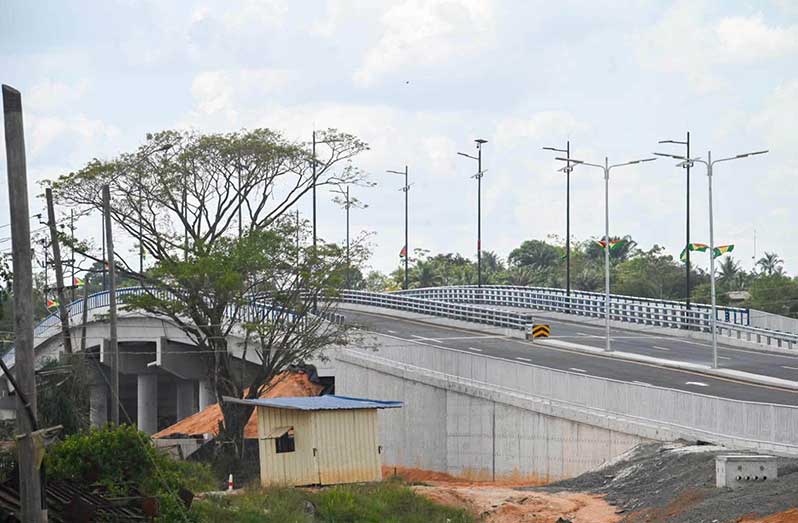
The new Mackenzie–Wismar Bridge, scheduled to be commissioned on Sunday, November 15, 2026, represents the culmination of nearly a decade of planning, feasibility studies, engineering and construction. While the four-lane structure is being delivered under President Irfaan Ali’s administration, the project itself was initiated and advanced during the APNU+AFC coalition government of President David Granger and Prime Minister Moses Nagamootoo.
The historical record shows that the replacement project was already moving through the formal planning and procurement process several years before the PPP/C returned to office in August 2020.
The original bridge: A crossing built for the bauxite industry
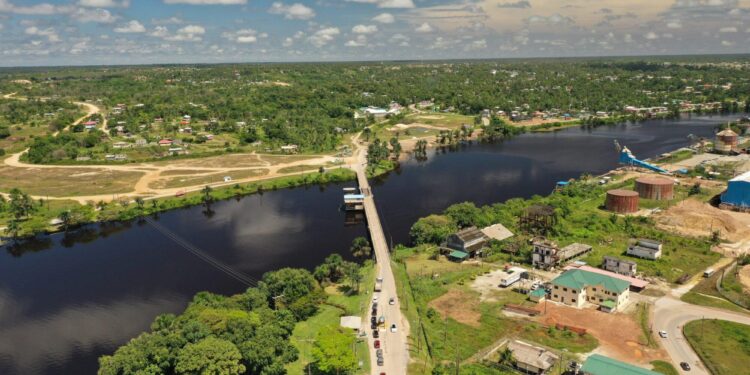
The existing Mackenzie–Wismar Bridge was constructed by the Demerara Bauxite Company (DEMBA). Work began in 1965, and the bridge was completed in 1967.
According to the Guyana National Trust, the 213-metre structure was originally designed to transport bauxite from the Wismar and Christianburg side of the Demerara River to the processing facilities at Mackenzie.
Built with steel and timber, it accommodated railway cars and vehicular traffic. Railway operations ended in 2006, leaving the bridge to serve road users.
Its single-lane configuration required traffic to move in alternating directions, increasingly creating congestion as Linden expanded and vehicle numbers grew.
2016–2020: Project initiated under Granger–Nagamootoo
The formal process to replace the ageing bridge began under the a Partnership for National Unity + Alliance for Change (APNU+AFC) President David Granger/Prime Minister Moses Nagamootoo administration.
On November 30, 2016, Stabroek News reported that tenders had been opened at the National Procurement and Tender Administration Board for a feasibility study and design for a new bridge across the Demerara River at Wismar.
This was an important early step in moving the proposal from discussion towards technical planning.
In August 2018, the Caribbean Development Bank approved approximately US$4.4 million to support Guyana’s Transport Sector Enhancement Project. Part of the financing was allocated to feasibility studies and detailed designs for a new Wismar bridge, alongside improvements to the Lethem Aerodrome and construction of a new riverine terminal at Parika.
In March 2019, tenders were again opened for the feasibility study and preparation of detailed designs. Italian engineering firm Politecnica Ingegneria ed Architettura Società Cooperativa subsequently undertook the technical work.
Public consultations were held in October 2019 and July 2020, allowing Linden residents and other stakeholders to examine proposed designs and raise concerns. The initial preferred proposal featured an elevated concrete bridge with two traffic lanes and pedestrian facilities.
Politecnica completed the feasibility study and detailed designs in June 2021, after the change of government.

2020–2023: The project advances under the Ali administration
Following the change of administration in August 2020, the PPP/C government inherited the project, including the feasibility and design work undertaken by the previous administration.
In June 2023, Stabroek News reported that negotiations for construction were expected to begin. The proposed design had been expanded from two lanes to four, reflecting the government’s decision to pursue a wider crossing.
The project’s financing arrangements also advanced. The Ministry of Finance’s 2023 Mid-Year Report recorded a US$50 million loan agreement with the Saudi Fund for Development, signed on June 5, 2023, for construction of a four-lane bridge connecting Mackenzie and Wismar.
This financing agreement formed part of the subsequent construction phase.
2024: US$35 million construction contract signed
On January 5, 2024, a US$35 million construction contract was signed for the new four-lane bridge. President Ali witnessed the signing.
The agreement was executed by Permanent Secretary of the Ministry of Public Works, Vladim Persaud, and Dong Sheng Li, Managing Director of China Railway Construction (Caribbean) Co. Ltd.
The President said the project was expected to be completed within two years. Construction officially commenced on April 8, 2024.
The government presented the bridge as a major investment intended to reduce congestion and strengthen transportation links between the coast and the hinterland.
2025–2026: Construction and commissioning
The project involved more than the bridge structure itself. Approach roads, drainage systems, temporary construction facilities and connecting roadways were also required.
In January 2025, the government reported that construction was approximately 31 per cent complete.By December 2025, the Department of Public Information reported progress of 92.3 per cent.
In March 2026, the Ministry of Public Works reported that the main bridge works were 97 per cent complete, although supporting infrastructure remained under construction.
After further work, asphalt paving and load testing, the government announced November 15, 2026, as the commissioning date.
What the new bridge delivers
The new structure is approximately 224 metres long and features four traffic lanes, two pedestrian walkways separated from vehicular traffic, modern lighting and navigational clearance for river vessels.
The project also includes improved approaches and connecting road infrastructure. Its toll-free access is particularly significant for commuters, households and businesses that previously incurred recurring crossing costs.
The four-lane configuration will allow traffic to move in both directions simultaneously, replacing the alternating single-lane arrangement that has long frustrated motorists.
A project spanning two administrations
The history of the Mackenzie–Wismar Bridge demonstrates the importance of recognising the different stages of major national infrastructure projects.
The Granger–Nagamootoo administration initiated the formal replacement process, advanced procurement and feasibility planning, and secured CDB support for the technical studies. The Ali administration subsequently inherited the project, advanced the design to four lanes, secured the construction arrangements and oversaw the building phase.
As Linden prepares to welcome its new crossing, the bridge stands as a project whose development spans two administrations and nearly a decade of public planning and investment. Its lasting value will ultimately be measured not only by the structure itself, but by the opportunities, economic activity and improved connectivity it delivers to Region Ten and the wider country.