—says pressures on land and water resources increase to critical point
The Food and Agriculture Organization of the United Nations (FAO) last week launched a landmark report highlighting the worsening state of the earth’s soil, land and water resources and the challenges it poses for feeding a global population expected to near ten billion by 2050.
“The pressures on soil, land and water ecosystems are now intense, and many are stressed to a critical point,” FAO Director-General QU Dongyu wrote in the foreword to the synthesis report, entitled the State of the World’s Land and Water Resources for Food and Agriculture – Systems at breaking point (SOLAW 2021). “Against this background, it is clear our future food security will depend on safeguarding our land, soil and water resources.”
“Current patterns of agrifood production are not proving sustainable,“ the Director-General said in remarks at the launch. “Yet, agrifood systems can play a major role in alleviating these pressures and contributing positively to climate and development goals,” he added.
The report says if we keep to the current trajectory, producing the additional 50 percent more food needed could mean water withdrawals for agriculture increasing by up to 35 percent. That could create environmental disasters, increase competition for resources, and fuel new social challenges and conflicts.
Among the key challenges:
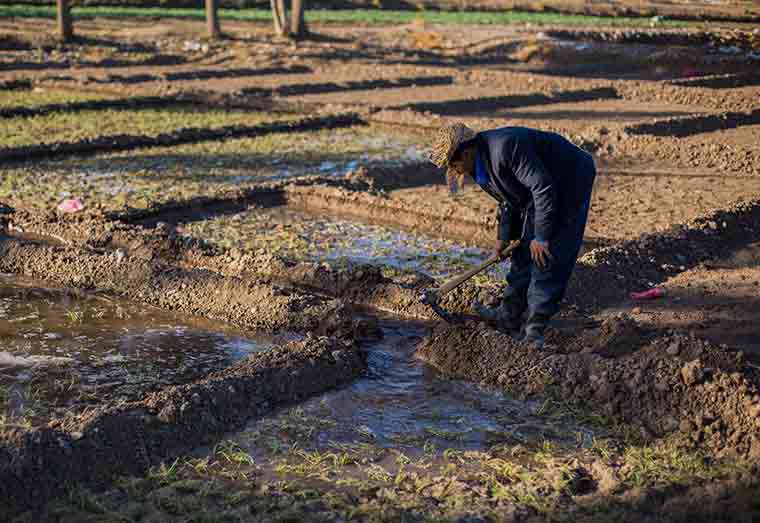
Human-induced soil degradation affects 34 percent – 1 660 million hectares – of agricultural land.
More than 95 percent of our food is produced on land, but there is little room for expanding the area of productive land.
Urban areas occupy less than 0.5 percent of the Earth’s land surface, but the rapid growth of cities has significantly impacted land and water resources, polluting and encroaching on prime agricultural land that’s crucial for productivity and food security.
Land use per capita declined by 20 percent between 2000 and 2017.
Water scarcity jeopardizes global food security and sustainable development, threatening 3.2 billion people living in agricultural areas.
Solutions on hand
With limited arable land and freshwater resources, a rapid scaling-up of technology and innovation is vital. We must strengthen the digital architecture needed to provide basic data, information and science-based solutions for agriculture that make full use of digital technologies and are climate-proofing.
Land and water governance must be more inclusive and adaptive, to benefit millions of smallholder farmers, women, youth and indigenous peoples. They are the most vulnerable to climatic and other socio-economic risks and face the greatest food insecurity. There needs to be more integrated planning at all levels. And investments in agriculture must be redirected towards social and environmental gains.
Sustainable soils, land and water are the foundations for resilient agrifood systems. So the sustainable use of these resources is key to achieving climate mitigation and adaptation targets. For example, wise use of soils alone can potentially sequester one-third of greenhouse gas emissions from agricultural land.
FAO’s work on land and water
FAO works to promote coherent approaches to sustainable soil, land and water management to feed the growing population. These include food security; human health and nutrition; water quality and governance and management of food production systems; the provision of essential agricultural ecosystem services and biodiversity conservation; and climate change mitigation and adaptation.
Through partnerships, projects, studies and information-sharing, FAO helps to increase the understanding of the biophysical and socioeconomic relationships between land and water resources. These are vital to better production, better nutrition, better environment for better lives. FAO’s approach helps raise awareness of the degradation of resources caused by inappropriate agricultural practices, such as land-clearing. It also promotes wise water use, innovation and technologies with particular attention to water-scarce areas.
FAO is helping to bring greater coherence to policies and research to combat climate change and protect the primary production system supporting the bulk of our food. Its toolkits, digital and real time informatics support governments, farmers, and users in developing legal and financial policies and in providing technical resources for improving land, soil, and water management.