Philip Moore, the sculptor of the 1763 Monument, was born on October 12, 1921. He hailed from Manchester Village on the Corentyne, Berbice. Moore was a teacher, an elder, a parent, an artist. Moore believed he was an ancient spirit reincarnated in a modern body.
As an African in especially rural Guyana (British Guiana) the young Philip was exposed to a number of religious traditions, but especially shades of West African spiritual traditions, diluted by Judeo-Christian: Anglo Catholic, Roman Catholic, up and coming Protestant religions.
Like most working class of post-independence Guyana experienced more ancestral spiritual connections by joining the spiritual traditions of the Jordanites. Moore converted to Jordanite Christianity, around 1940, a religion which focused on self-help, personal pride, communal life, hard work, and study of the Bible.
In spite of all the Christian prejudices, Jordanite Spirituality gave meaning to the lives of those “Wretched of the Earth,” whose lives and practices for personal and community development, were expected to have meaning only within the narrow context of European religious traditions, fractured by the struggle for hegemony among the various Catholics, Jews and Protestant religious sects.
Moore was an international person. He was a professor with international responsibilities. He was a sculptor, and taught his art to students in Guyana and in the United States of America. His students could be seen exhibiting for sale their sculptures of Art in the Avenues, especially Main Street, with a noticeable “Mooresan” style.
Philip Moore was a professor at the prestigious Princeton University, United States. His skills as a teacher were so highly appreciated that throughout the illness of his latter days, his place as a professor at Princeton University was kept open, hoping that he would return to his anxious students.
So appreciated he was by Princeton that the authorities were prepared to come to Guyana to take him to the University where his teaching styles were most appreciated. So appreciated Princeton University was for his services he received a pension throughout his illness, to the time of his death.
Moore was the most appreciated professor at the Burrowes School of Art in Guyana. His association at that College was more of a community rather than the formal education institution that it was. That was the atmosphere of peace that was generated with his presence.
Moore had a unique style. His productions were not just physical objects known as sculptures. They were spiritual messages, capturing the Ancestral essences.
Was it by chance or by Ancestral design that:
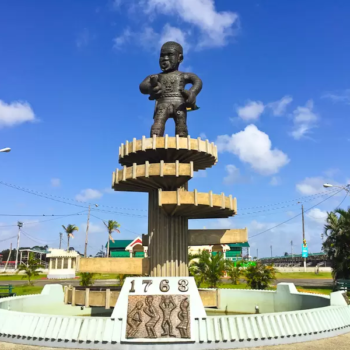
Motivated by love for his native Guyana and assisted by the government, he got the chance to create what would be the largest bronze sculpture in the region. Moore’s 1763 Monument, nearly 25 feet tall, dominates the Plaza of the Revolution in Georgetown, Guyana. A defiant African warrior, with pre-Columbian-like helmet and African breastplate, stands at the ready to march against any enemy who dares to desecrate his homeland. It reminds one of the pervasive African belief that the spirits of one’s ancestors continue to exercise influence upon the living. (Source Folk Art of America from: https://folkart.org/mag/philip-moore)
Even in an exhibition on Slavery at the Bath Museum of Slavery, at the top floor of the Museum stood the Replica of “Cuffy” (Kofi ) very proudly with the explanations of the Splints for all to see.
Moore had little formal education. In 1938 he received a school-leaving certificate.
He considered himself “spirit taught” artist following a dream he had in 1955, in which a large hand reached down to him from the heavens, and a voice commanded him to begin his career as an artist.The Cacique’s
Moore was the recipient of the Cacique’s Crown of Honour (C.C.H.), the second highest award in the Order of Service of Guyana.
In 2012 Moore received the Lifetime Achievement Award (Posthumous). He was the first ever in Guyanese art to be so awarded.The citation was received by his daughter Corine Munroe at the award ceremony of the Guyana Visual Arts Competition on December 14 at the National Cultural Centre (NCC)
In 2013 Moore was given an award from the Ministry of Culture Youth and Sport for his contributions to the field. His son Philip Moore Jr. affected the award.
Moore died at his home in Lancaster Village, Corentyne, Berbice on May 13, 2012.
Dr. Rudi R. Guyan contributed to this article.