By Mark DaCosta- Sometimes life leaves little room for certainty. You step away from what is familiar, knowing only that you cannot remain where you are. That is the choice Ricardo now faces as he walks into an uncertain new chapter — leaving behind a Georgetown apartment he shared for three years with a close Guyanese friend, not because the friendship has ended, but because his mother’s failing health demands a sacrifice.
He does not know exactly what the move will bring. He knows only what he is trying to save — a little more money, a little more hope, and perhaps a little more time for his mother.
A Venezuelan migrant named Ricardo, who became a friend of this writer, came to our country to escape hardship in his own country. He has now left the Georgetown apartment he shared for three years with his Guyanese friend. He is moving into free accommodation provided by his employer so that he can send more money to his seriously ill mother. The story shows how economic necessity shapes the private lives of migrants, and how it can strain even close friendships.
For three years, the two men shared an apartment in Georgetown. One was a Guyanese, Anthony, and the other a Venezuelan, Ricardo, who arrived in our nation after conditions at home became untenable. This week, that arrangement ended.
Ricardo’s journey mirrors that of thousands of Venezuelans who have crossed into Guyana in recent years. He described shortages of food, water and electricity in his homeland. Economists generally attribute Venezuela’s crisis to several causes, including the collapse of its oil industry, economic mismanagement and international sanctions, though they debate how much weight each deserves.
In Guyana, Ricardo found work operating a cement machine at a large construction site in Mahaica. His days were long. He left Queenstown around six each morning and returned near seven in the evening. His wages exceeded those of his flatmate, and Anthony, in turn, took charge of the household, keeping the apartment clean and preparing meals. It was a quiet division of labour that sustained both men.
Anthony says much of what furnished the home came from Ricardo’s pocket, including the stove, washing machine, fans, beds and music equipment. Neighbours were curious about the pair, but their private lives are not a matter for public comment.
Ricardo’s departure was driven by arithmetic. His employer offered him lodging at the worksite free of charge, and the rent he would no longer pay could be redirected to Venezuela, where his mother suffers from a grave heart condition. She has endured two heart attacks, the latest reportedly following the recent earthquake in her country. Though physically unhurt by the tremor, she was left deeply shaken. For Ricardo, every saved dollar carries weight.
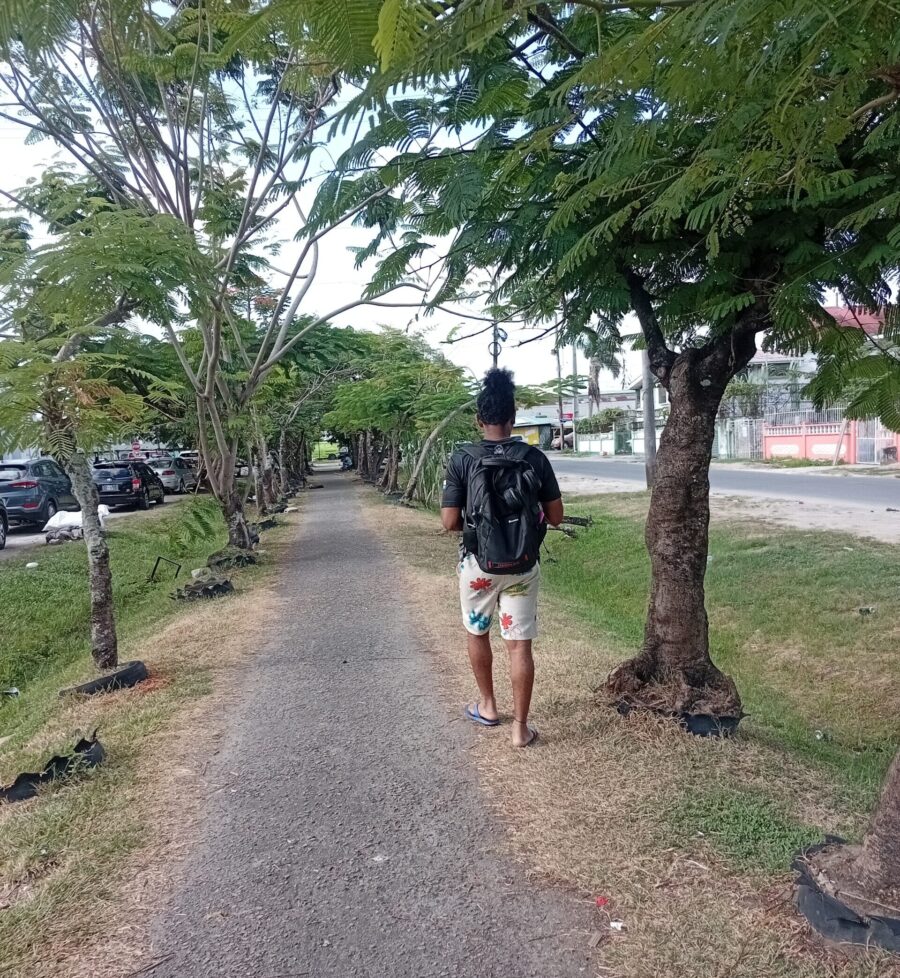
On the morning of 25th September, this reporter accompanied Ricardo to Bourda Market as he bought provisions for his new quarters. Later that day, his employer sent a vehicle to collect his belongings from the apartment. Ricardo admitted the decision had been painful and spoke openly of his distress at leaving. Yet he remained resolute that the move was a step toward a better life.
His story raises questions that reach beyond one household. Guyana’s construction boom has drawn a growing migrant workforce, and employer-provided housing is becoming an attractive, and sometimes unavoidable, arrangement. For workers supporting relatives abroad, such offers are difficult to refuse. Yet they can leave behind local friends and flatmates who have built their routines around shared lives.
Anthony now remains in an apartment that is quieter and emptier, and likely costlier to maintain on his own. But behind the empty space is a story about choices made when there are no easy choices.
Ricardo did not leave because he had stopped valuing the friendship or because the life they built together no longer mattered. He left because circumstances placed a greater responsibility on his shoulders — the need to help a mother whose health is failing and whose son is thousands of miles away.
His departure is a reminder that migration is not only about crossing borders in search of work. It is also about the difficult decisions that follow — what must be left behind, what can be sacrificed and what must be carried forward.
The room may now be empty, but the reason Ricardo left is not. He stepped into the unknown because, to him, saving his mother was worth the uncertainty.